
Midnight on the Red Planet
The year is 2054. Out across the boundless red deserts of Mars, you look through the windows of Erebus Station, the first domed city humankind has ever built. In the sky, two tiny moons, Phobos and Deimos, race across the rust-coloured horizon.
You glance at the titanium-cased watch on your wrist. Its dial holds two different life zones. The indication on the left whispers that your loved ones back on Earth have long since fallen into deep sleep. Yet the orange luminous hand on the right tells you that you are only in the middle of Mars's own long Sol day. While a day on Earth lasts 24 hours, here, on this foreign soil beneath your feet, time flows more slowly; a Martian day runs to exactly 24 hours, 39 minutes and 35 seconds.
And it is precisely here that a question begins to test the limits of the human mind: how can wheels and springs built for Earth's 24-hour rhythm measure, at the very same time and without ever faltering, that extra 39 minutes of Mars's cosmic rhythm?
The answer lies not in the cockpits of spacecraft or in computer software, but in a small watchmaking workshop in Moscow, in the purely mechanical wheels of the genius watchmaker Konstantin Chaykin. By entrusting humanity's conquest of space not to digital screens but to pure mechanical engineering, Chaykin has rewritten the history of watchmaking.

How the Genius Turned the Wheels
To synchronise both Earth time and Mars time inside a single watch, at the same instant, is a little like asking a car to travel at both 100 km/h and 103 km/h at once, on the same engine. In a mechanical watch everything is fed from a single mainspring, the power source, and a single balance wheel, the heart of the watch.
To achieve the impossible, Chaykin developed differential gear modules and bespoke tooth-count ratios. He took the 24-hour main rotation from the base movement and, through a mathematical formula, converted it into the 24.65979-hour Martian day by means of an additional patented astronomical module with extremely precise micro-gear ratios. The tooth counts of the wheels are calculated so finely that when the Earth wheel has turned for 365 days, the Mars wheel positions itself flawlessly against a full Martian year of 687 days.
The secret lies in a proportional translation. The motion leaving a single power source is slowed, stage by stage, along the gear train of the added module; each wheel's tooth count is chosen so that the output shaft completes a turn exactly 39 minutes and 35 seconds longer than an Earth day. Two times are thus born from a single pulse of the same balance, yet never blur into one another. What Chaykin has done, in essence, is to engrave the mathematics of the heavens into wheels of brass and steel.

The Space Program Collection: Five Cosmic Masterpieces
Let us now examine, under a single roof, the five cosmic masterpieces born from this mechanical genius, together with all their complications, materials and construction secrets.
Stargazer
The model at the very highest level of complexity, a Grand Complication. With its case that rotates on both sides it pushes the boundaries of watchmaking, and inside it houses a tourbillon that cancels the negative effect of gravity on precision. The case is specially aged in a brutal, industrial manner, its textured stainless steel echoing the outer hull of a spacecraft. The movement is an ultra-complex hand-wound calibre developed by Chaykin entirely from scratch and assembled by hand.
Here are the seventeen complications a single watch can carry:
Astronomically Precise Moon Phase: it tracks the phases of the Moon so finely that only one day of deviation accumulates over 122 years.
Moon Age Indicator: shows numerically how many days have passed since the start of the new-moon cycle.
Four-Phase Jumping Moon Display: a system realised for the first time in the world by Chaykin, showing the Moon's four main phases, the new moon, first quarter, full moon and last quarter, with instantaneous jumps.
Solar Activity Cycle: the world's first watch complication to mechanically follow the Sun's 11-year magnetic sunspot and activity cycle.
Sunrise Azimuth Indicator: hold the watch level and point it north, and a yellow arrow marks the exact angle at which the Sun will rise on the horizon that day.
Sunset Azimuth Indicator: by the same logic, a blue arrow shows the angle at which the Sun will set.
Tourbillon Cage: by constantly rotating the heart of the watch about its own axis, it distributes the errors caused by gravity and preserves accuracy.
Regulator Hour Indication: the mean solar hour shown on a separate sub-dial, independent of the main dial.
Regulator Minute Indication: the minute hand turning independently on the central main dial.
Length of Day: calculates how many hours of daylight the day will hold at your latitude.
Length of Night: a mechanical ruler showing how many hours the night will last.
Equation of Time: shows the plus or minus 15-minute difference between true solar time and the artificial 24-hour time on our wrist, arising from Earth's elliptical orbit.
Retrograde Day of the Week: a day indicator advancing across a dial reminiscent of the Joker's mouth, jumping back to the start on Sunday night.
Zodiac Calendar: a rotating ring showing which zodiac band the Sun occupies through the year.
Northern Hemisphere Star Chart: a rotating sapphire disc showing the instantaneous position of the constellations.
Mean Solar Time: the 24-hour main time dial.
Sidereal Time: an astronomical indication based on Earth's rotation about its axis relative not to the Sun but to the distant stars, namely 23 hours 56 minutes and 4 seconds.

Mars Conqueror MKI
The first prototype designed for the Mars explorers of the future. Its design draws on the sharp, functional panels of the Soviet space programmes. At the lower part of the sharply faceted, ultra-light and durable titanium case, the crown is shaped like the exhaust nozzle of a space rocket, while the strap is covered in the white technical fabric used in real spacesuits. At its heart, Chaykin's own 175-part patented astronomical module sits atop a Swiss-made ETA 2836-2 movement.
Although the watch is fed from a single heart, the dial is divided into three independent zones. The central dial shows Earth local time and a second time zone (UTC). The left dial reads Mars's 24-hour-39-minute local Sol time in a 24-hour format. The right dial is a miniature orrery, a model of the solar system: it shows the instantaneous positions of the Sun, Earth and Mars in space, and mechanically calculates the periods of Mars Opposition, when the two planets come closest, occurring once every two years.

Mars Conqueror MK3 Fighter
An instrument built to military and tactical standards for the pilots who will one day fly in the Martian atmosphere. On the aggressive, geometrically angled titanium case, the 24 special screws around the bezel symbolise the locking mechanisms on the docking hatches of space stations. The calibre K.15-0 automatic movement is built from a 125-part Chaykin synchronisation module integrated onto a base ETA 2893-2; its twin-crown system is governed by a mechanical mode indicator that switches between winding, setting and time zone.
Two technical details set this model apart. The hour and minute hands, shaped like launch rockets, are named the Starship Hands. Cleverer still is the dual-colour lume synchronisation: the hands and indexes showing Earth time glow in blue-green super-luminova, while the indications belonging to Mars time shine in a Martian orange. So when you glance at the watch in the dark, you can tell at once which planet's time you are living in.

Lunokhod
Taking its name from the legendary Soviet Moon rover, the Lunokhod overturns the very idea of traditional hands; it is, in effect, a miniature Moon simulator worn on the wrist. Its case is made entirely by hand from genuine Wootz, or Bulat, steel. The wavy, watered texture born from acid-etching this steel of ancient Indian origin mirrors perfectly the craters and rugged terrain of the lunar surface. The geometric recesses on the sides of the case represent the toothed wheel tracks of the Moon rover. The movement is the hand-wound calibre K.05-0.
This watch has no conventional hands; time is read from special discs rotating on the dial. The real spectacle unfolds at the centre: a vast 12 mm Moon sphere, carved from Wootz steel and held still. Around this fixed sphere moves a half-cylinder of blackened silver, a shadow, driven by the movement. In this way the Moon's play of light and shade, from crescent to full, comes to life on the dial in fully physical, three-dimensional form. The watch also carries a mechanical day-and-night indicator.


Lunokhod Prime
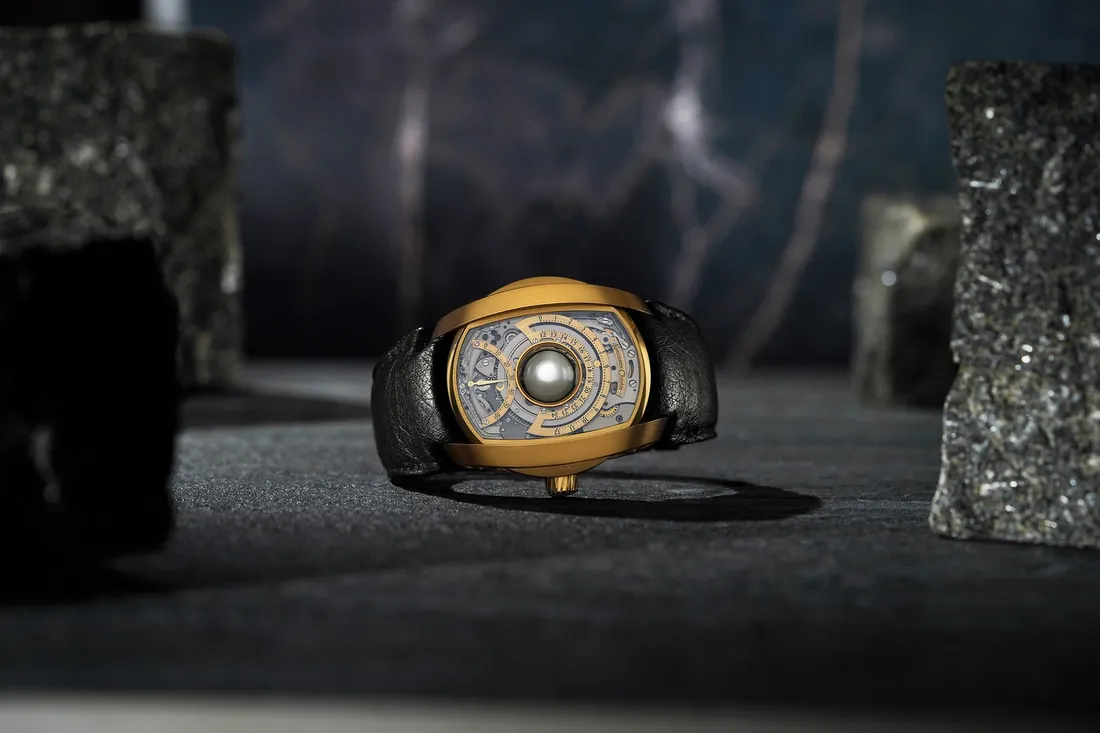
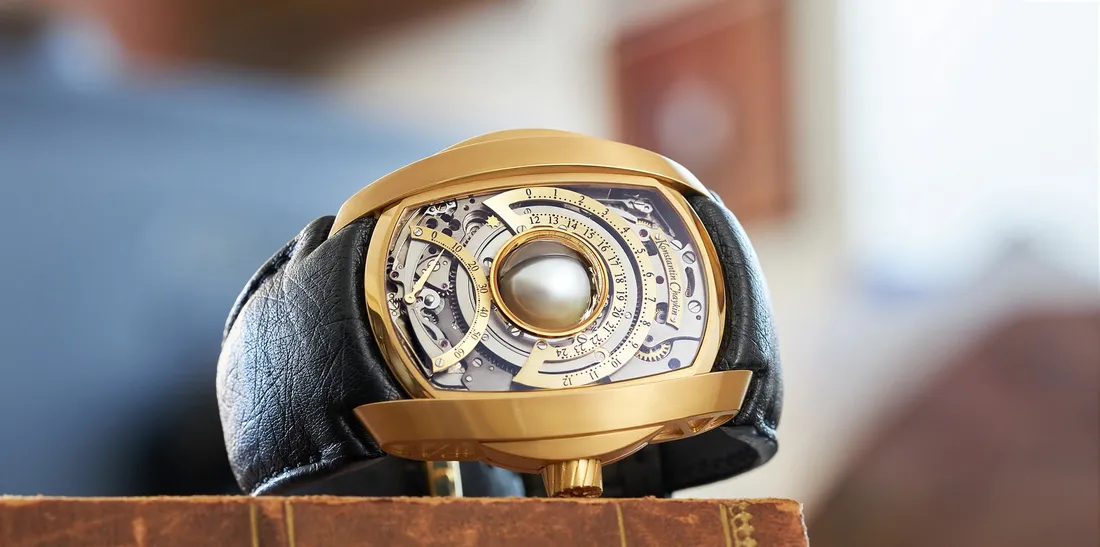
The aristocratic version that unites the brutal, industrial stance of the Lunokhod with the elegance of traditional haute horlogerie. In place of the base model's raw steel lines, it offers a polished case worked in noble metals, recalling the smooth alloys of space rockets; the dial details use pure gold and rhodium-plated silver elements. The calibre K.05-0 architecture is preserved, but all the movement bridges, wheels and the dial plate are adorned with hand engraving, raised to an artistic dimension.
That mesmerising three-dimensional Moon sphere and its silver shadow mechanism remain here too. Time is read with analogue grace on the noble, rhodium-plated circular indicators turning around the sphere, while the transitions between night and day are woven into the dial with engravings worthy of a work of art.
A Watchmaker's Letter to the Universe
With this collection of five watches, Konstantin Chaykin does not merely measure time; he immortalises humanity's place in the universe in the noble texture of micro-mechanical wheels and legendary Wootz steel. In a digital age, to entrust the most complex rhythms of the heavens once again to wheels of brass is perhaps the boldest poem of engineering.