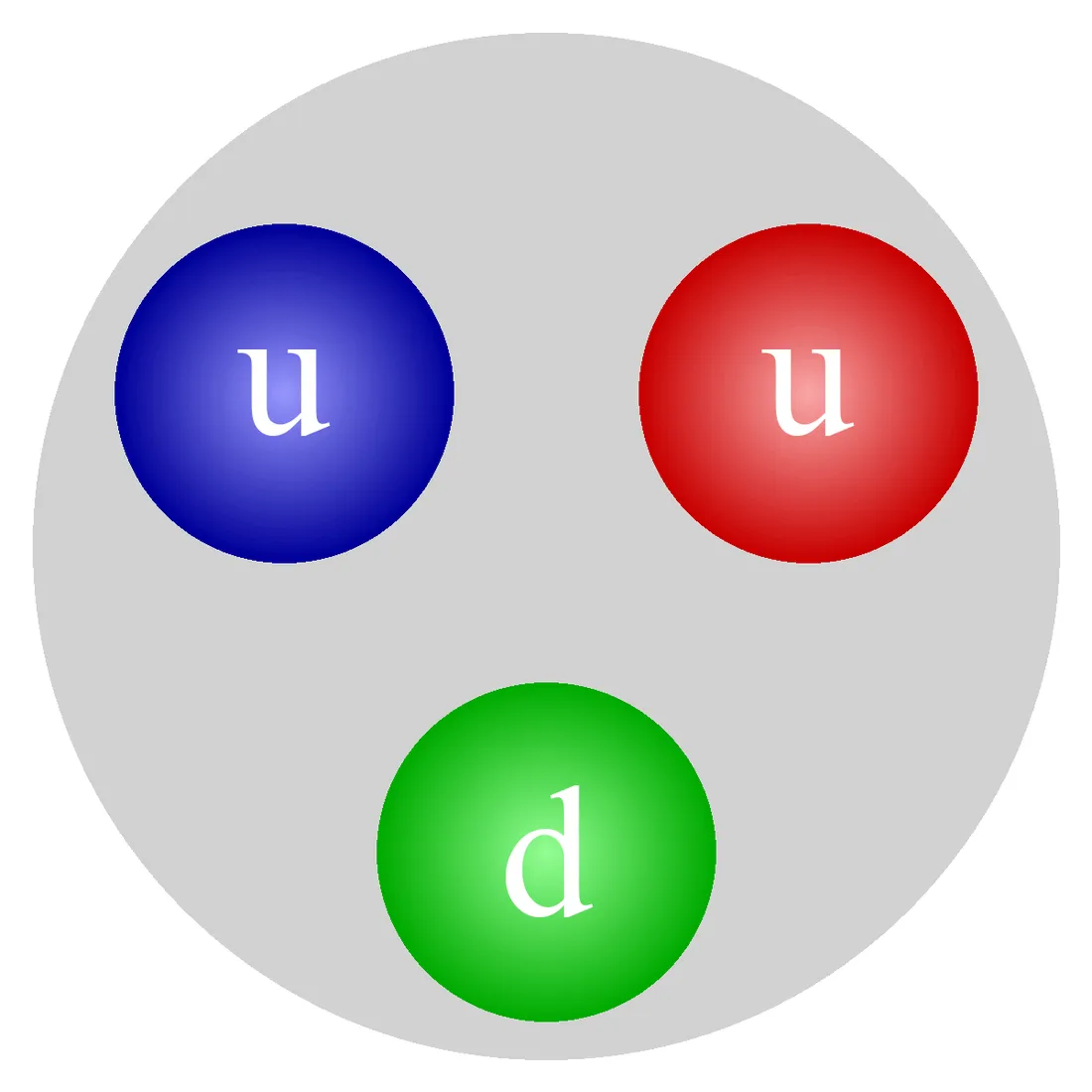
Modern physics has fundamentally shaken the classical view that held the universe, for centuries, to be made of static matter with fixed, solid boundaries. Nowhere has that shaking been more violent than inside the proton, the very heart of matter. In 2008, a paper published in Science, one of the world’s most prestigious scientific journals, and regarded as a turning point in particle physics, titled “Ab Initio Determination of Light Hadron Masses” (Science, Vol. 322, No. 5905), used extraordinarily precise Lattice QCD (Lattice Quantum Chromodynamics) calculations to confirm a fascinating fact known in popular science as the “proton mass crisis”: only about one percent of a proton’s mass comes from the intrinsic mass of its fundamental building blocks, the quarks. The remaining ninety-nine percent, the vast bulk of its mass, consists of quantum foam and trapped pure energy inside what looks like empty space.
Werner Heisenberg and the Uncertainty Principle: Nature Cannot Stay Empty
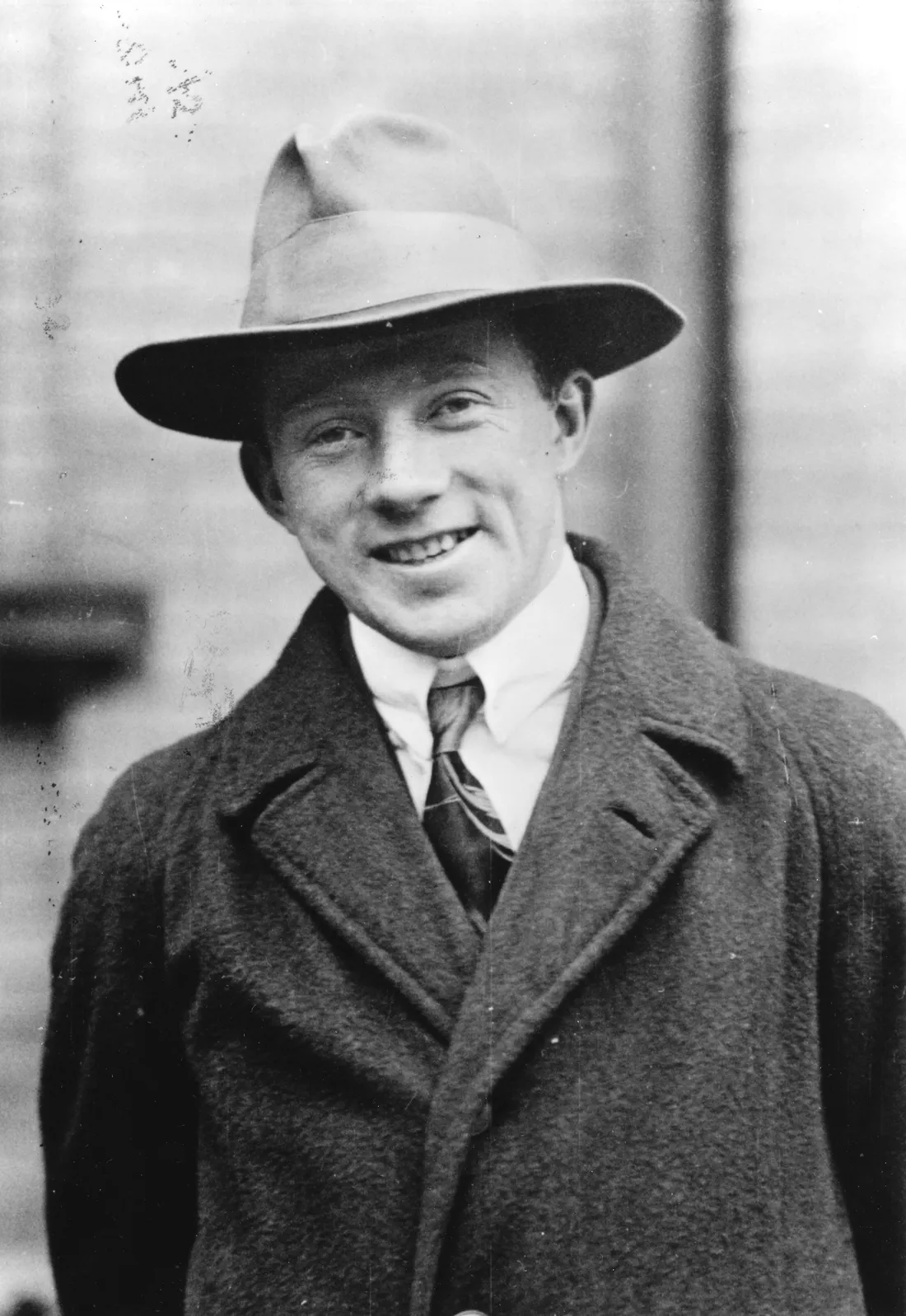
To understand this ocean of energy making up the other ninety-nine percent, we have to look at one of the founding fathers of quantum mechanics, the German physicist Werner Heisenberg, and his famous Uncertainty Principle. So how did Heisenberg, still a young genius in the 1920s, arrive at this mind-bending conclusion, and what did he actually see in the laboratory?
Heisenberg wanted to measure the position and speed of electrons in the subatomic world at the same time. But there was a huge problem: to see something, you have to shine light on it, meaning you have to send it a photon. In everyday life, when you shine light on a car, the car does not budge. But an electron is so tiny that even the smallest particle of light you send to see it delivers it a massive kick the instant it strikes. The moment we see the electron, the very light that let us see it sends it flying off wildly.
In other words, the instant you measure the electron’s position precisely, its speed becomes completely uncertain; and the moment you try to measure its speed, its position slips away.
With these famous thought experiments, Heisenberg discovered the most radical rule of the universe: in the microscopic realm there is no certainty, only probabilities and uncertainty. And this same uncertainty applies, in exactly the same way, between time and energy.
According to Heisenberg’s formulas, the more you shrink a slice of time, that is, the more precisely you try to measure time, the greater the uncertainty in the amount of energy within that slice of time, and the more wildly it fluctuates.
So what does this actually mean? Let us explain it with a very simple example: an absolute “zero energy” or “absolute emptiness” is impossible in the universe. Because if the energy in a room were completely zero and fixed, we would know that room’s energy with one hundred percent certainty. But quantum rules do not allow that; in nature, nothing’s value can ever be pinned down to exactly zero.
To get around this ban on certainty, nature performs an ingenious trick: in what looks like an empty vacuum, once every quadrillionth of a second, it suddenly makes energy spike. Out of that enormous burst of energy, virtual particles and antiparticles, for instance a quark and an antiquark, suddenly appear out of nothing. These particles come into existence as if borrowing energy from the universe itself. But before the quantum police notice, within a split second they touch each other, annihilate one another, and return the borrowed energy back to the vacuum. This is what is called “quantum foam”: nature endlessly boiling and fluctuating, billions of times a second, as if saying, “you can never pin me down to exactly zero.”
Colour Confinement and the Square of the Speed of Light (c²)
How does this terrifying foam and chaos inside the proton hold itself together, without flying apart, in such an extraordinary mathematical order? This is where the strongest force in nature steps in: Colour Confinement.
Quarks are bound to one another by glue-like particles called gluons. Like electric charge, these particles also carry a “colour charge” (red, green, blue). Every other force in the universe, two magnets or two planets, for instance, weakens as the objects move apart. But the strong nuclear force and colour confinement work in exactly the opposite way. Inside the proton, quarks move at nearly the speed of light and constantly try to escape. As they move apart, the gluon bond between them stretches like a rubber band, and the pulling force grows exponentially. The enormous energy you would need to snap that rubber band instead tears open the quantum vacuum and creates brand new virtual quark pairs out of nothing. Quarks can never break free; they are trapped forever inside this cosmic order.
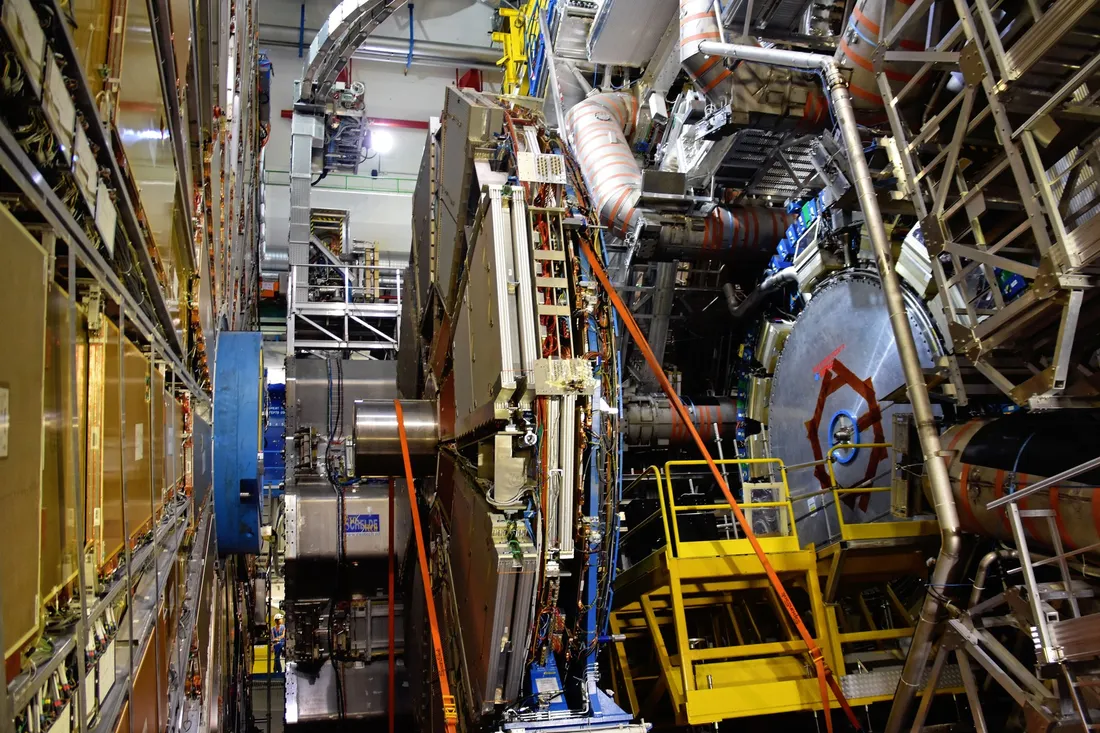
This extraordinary state of affairs, confirmed by direct physical measurement, is the most concrete proof in nature of Albert Einstein’s famous E=mc² (mass-energy equivalence) equation, formulated in 1905. In the equation, E stands for energy, m for mass, and c for the speed of light (300,000 km/s).
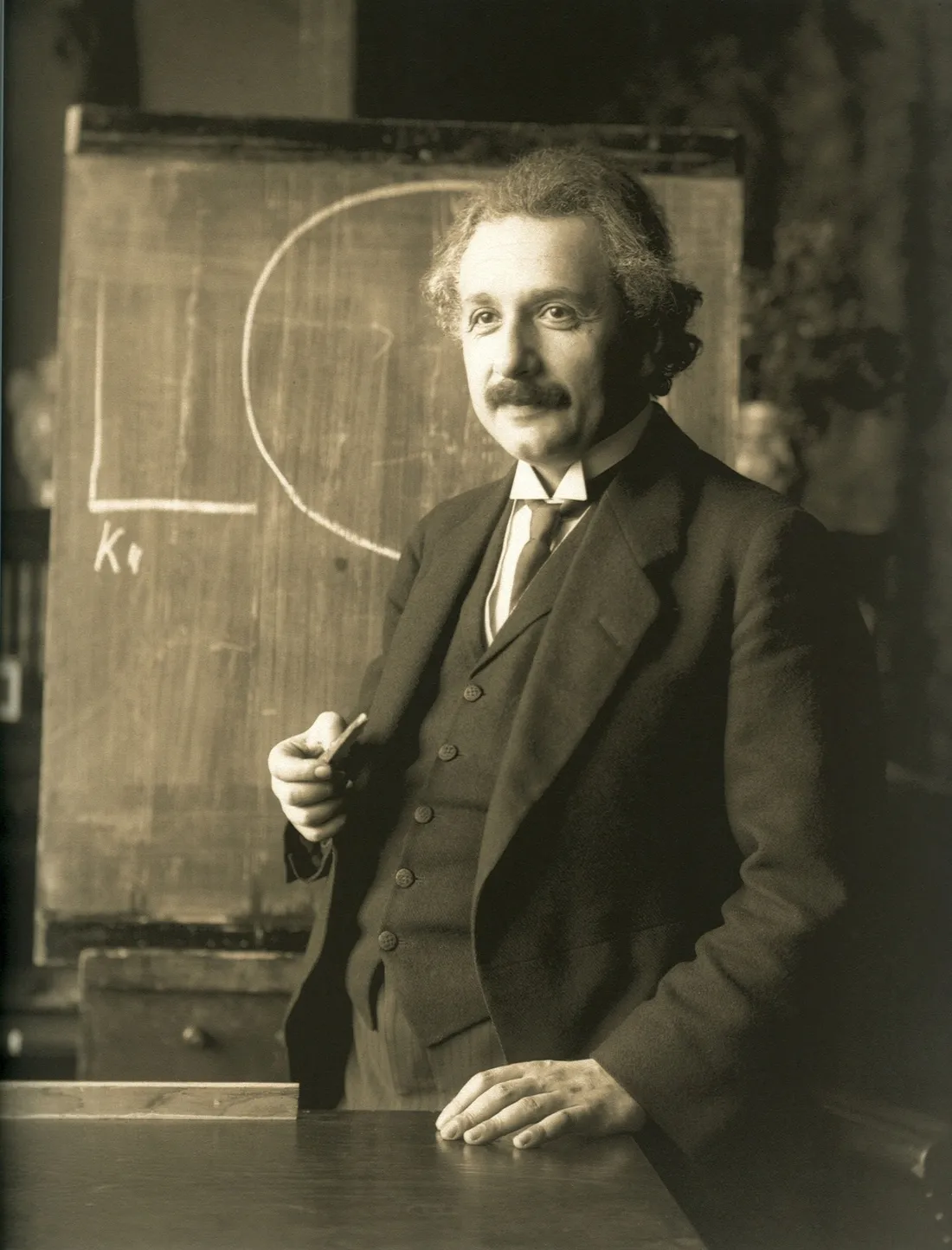
A natural question arises here: what does the square of the speed of light (c²) have to do with converting mass into energy? When Einstein merged three-dimensional space with one-dimensional time and discovered the fabric of spacetime, he had to mathematically equate two utterly different concepts, metres and seconds. The c² in the equation is not a speed of motion at all, but a universal conversion constant. Just as we multiply by 100 to convert centimetres into metres, nature multiplies a tiny amount of matter (m) by a factor as staggeringly large as c² (90,000,000,000 km²/s²) to convert it into pure energy (E). This is why mass is really energy that has become extraordinarily concentrated in a very small space, “freezing” into something that only imitates solid matter.
The Final Destination: The Secret of Existence Renewed Every Instant
So where does all of this finally lead us: the terrifying quantum foam inside the proton, the vacuum fluctuating under Heisenberg’s law of uncertainty, and Einstein’s equation that equates mass with pure motion?
This picture, which appears at the frontiers of both microscopic particle physics and universal cosmology, proclaims a single truth: nothing in the universe is static, self-sufficient or solid; existence is being ceaselessly re-created, every single instant, every single second.
When we look around us, we assume that stones, metals and mountains are fixed and unchanging. Yet that solidity is only an illusion of perception. As that groundbreaking paper in Science proved, the quantum foam that makes up ninety-nine percent of the mass at the heart of a proton stays standing only because particles are annihilated and recreated billions of times a second, because the universe is ceaselessly borrowing and repaying energy at every instant. The universe is not a mechanical structure created once and then left to run on its own. Divine Power rewrites the book of the universe every instant, endlessly, from the smallest subatomic particle to the most colossal galaxy. Every particle that exists falls into nonexistence every millisecond, and is clothed again in being, that same instant, by the command “Be.”
format_quote"Matter is frozen motion; time is the sound of that motion."
Matter Made Manifest in Haute Horlogerie: Jaeger-LeCoultre Calibre 184
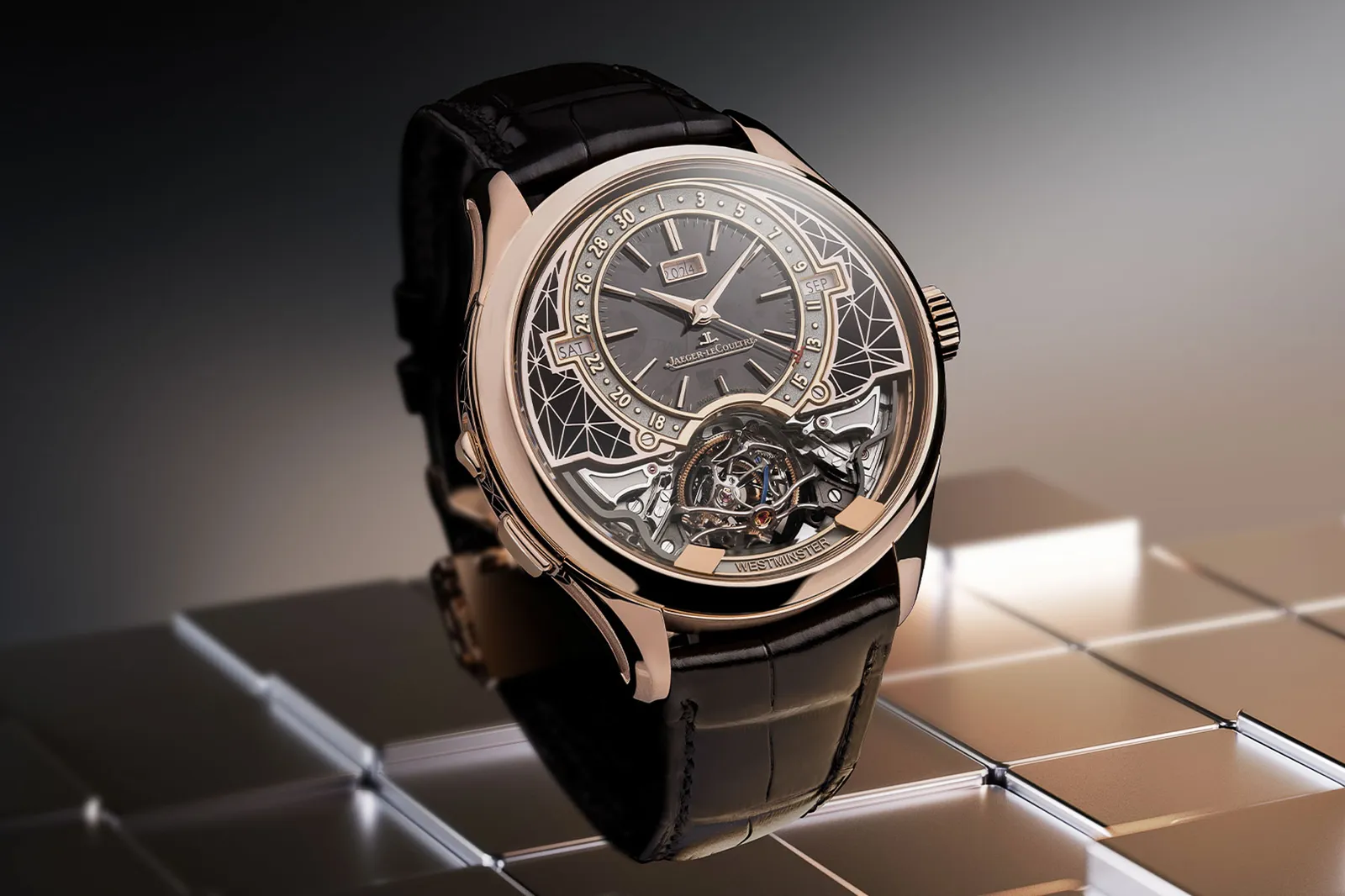
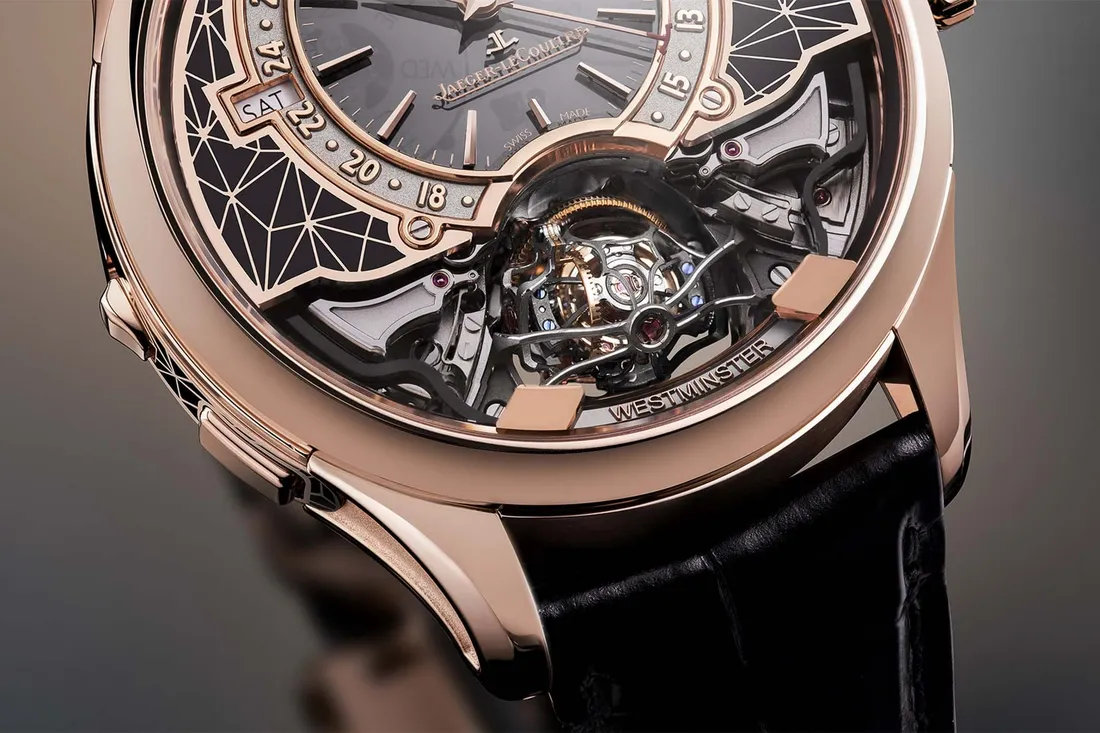
The most refined point that human hands have ever reached in bending time and matter, in imitating that cosmic dance renewed every instant, is without question the Jaeger-LeCoultre Master Hybris Artistica Calibre 184, a peak of Haute Horlogerie. Calibre 184 first appeared in 2019 inside the Master Grande Tradition Gyrotourbillon Westminster Perpétuel case, and was most recently reinterpreted in 2024 in a pink gold case as part of the Hybris Artistica family. This watch is a flawless reflection, in the world of micro-mechanics, of that immense symphony of creation and motion described above.
A Three-Dimensional Quantum Foam: The Multi-Axis Gyrotourbillon
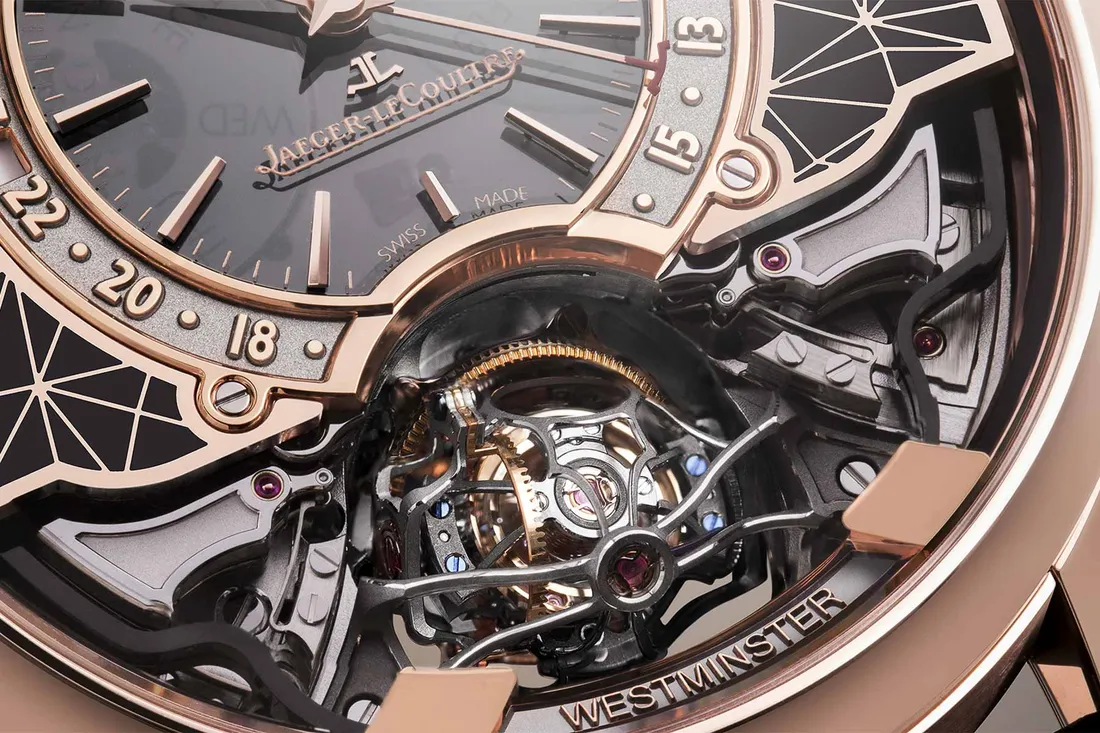
The inside of a proton is a field of quantum foam whose direction can never be predicted. The spherical Gyrotourbillon at the heart of Calibre 184 is the mechanical twin of that multi-dimensional quantum dance. Now in its fifth generation since Jaeger-LeCoultre invented the multi-axis tourbillon concept in 2004, it is the smallest Gyrotourbillon the house has ever produced. Rotating on two separate axes, it compensates for the effect of gravity in almost every position, and it also carries a constant-force mechanism that ensures a steady flow of energy to the regulating organ.
This extraordinary Gyrotourbillon assembly is itself made of 94 individual micro-components. The master watchmakers built these 94 parts from materials so light that the total weight of the cages comes to under 0.4 grams. Tumbling through the air, its outer cage completing a full rotation every 60 seconds and its inner cage spinning at an astonishing 12.6 seconds per turn, this spherical mechanism is the unpredictable, wild kinetic energy inside a proton, translated into a watch.
Horological Colour Confinement: The Order of 1,052 Particles
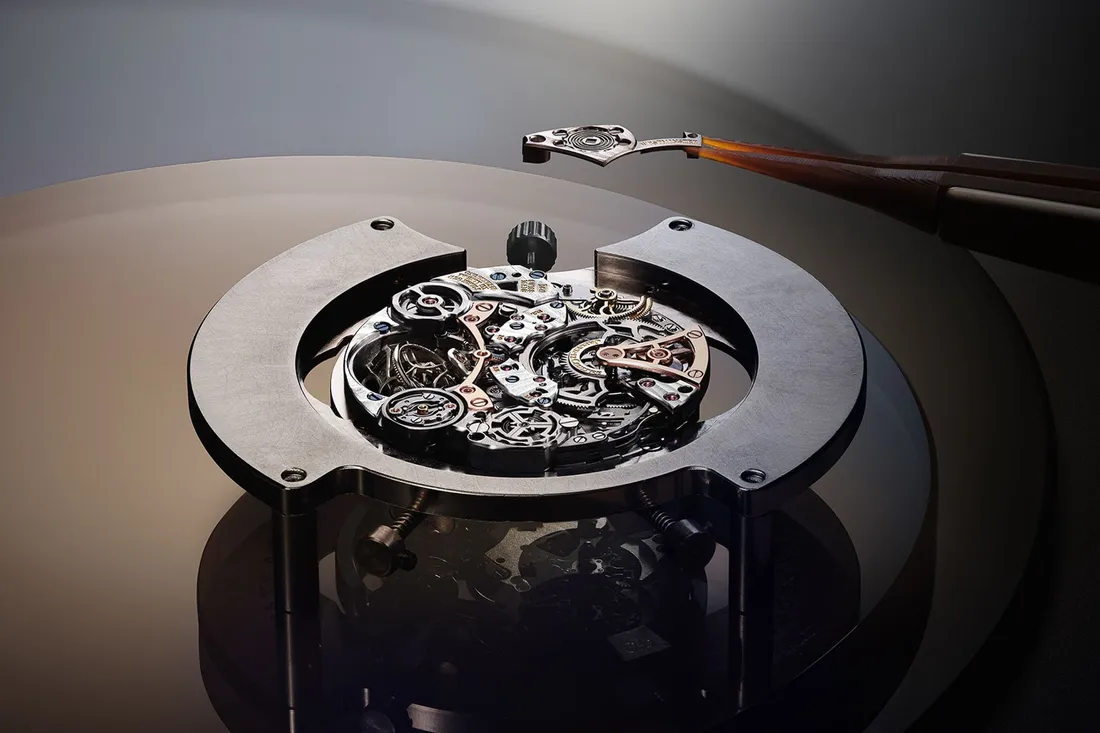
Although the trillions of virtual particles inside a proton look like pure chaos, they form one of the most stable structures in the universe thanks to the mathematical order of colour confinement. Jaeger-LeCoultre’s engineers achieved something similar: they managed to pack exactly 1,052 micro-components into Calibre 184’s narrow case, just 43mm across and 14.1mm thick. Among those components sit 137 jewels, the movement is entirely hand-wound, and it holds a 52-hour power reserve.
These 1,052 components are chained to one another by invisible mechanical bonds, much like the quarks and gluons inside a proton. The parts are so small, so tightly packed and so kinetically interdependent that the enormous potential energy released by the mainspring flows between these 1,052 components exactly the way energy flows via gluons. Further proof of that density: the watch is finished entirely by a single watchmaker, working alone from start to finish over five months, with no stage ever handed off to another pair of hands. The dead-beat minute hand, driven directly by the Gyrotourbillon, jumps forward in one precise, discrete step every sixty seconds; on the large date display, the gap between the 16th and the 17th day of the month is deliberately left wider than the rest to make room for the Gyrotourbillon, yet the engineers still designed the mechanism to leap across that gap perfectly. The perpetual calendar needs no manual correction until the year 2100, and, unusually even among perpetual calendars, it can be set both forward and backward without damaging the mechanism. The watch’s noble weight and worth on the wrist come less from the mass of its metal than from this micro-mechanical density, so reminiscent of colour confinement. Chaos, held together by a colossal mathematical order built by human genius, is put entirely in service of a flawless harmony.
format_quote"Chaos, held together by a colossal mathematical order built by human genius, is put entirely in service of a flawless harmony."
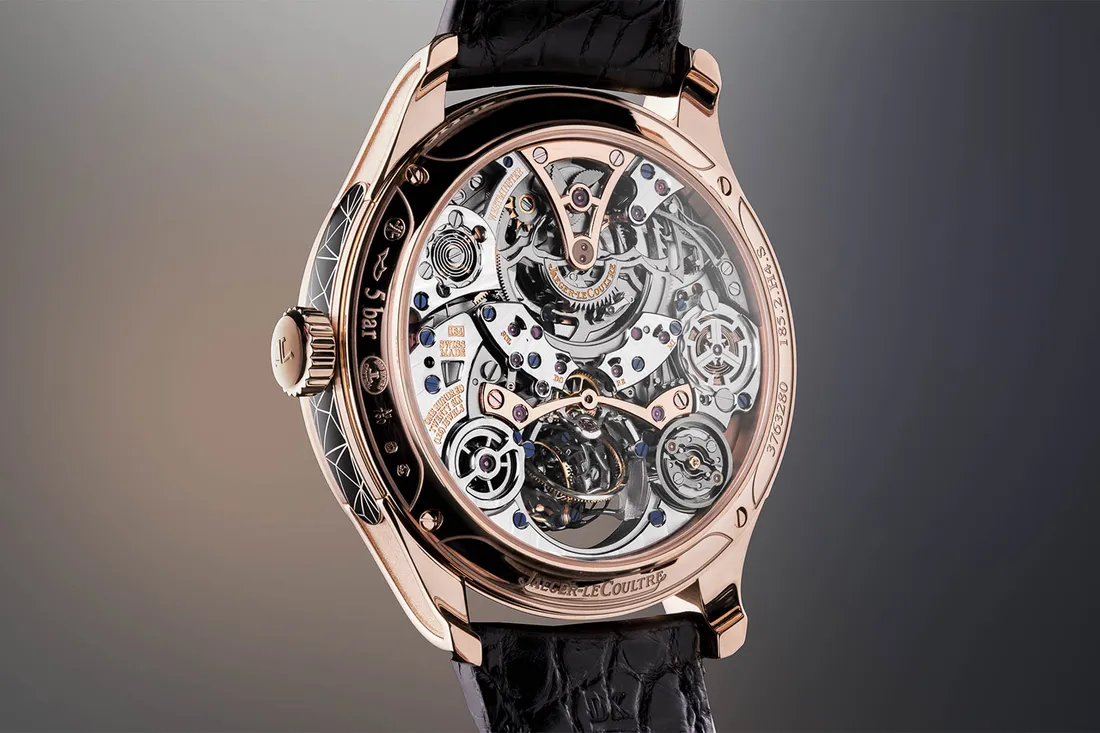
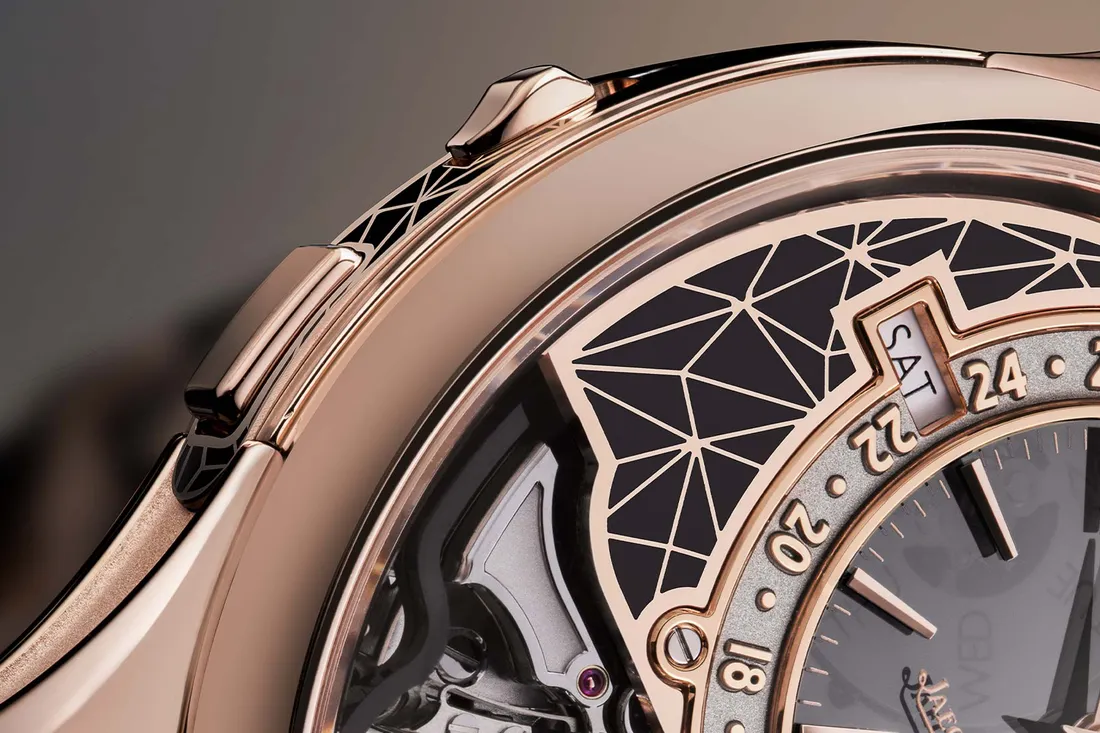
This mechanical density also shows up in the artistry of the dial. Along the dial’s edges and on the case flanks sit plates of black Grand Feu enamel worked with a fine-lined geometric pattern; at the centre, a smoky, semi-transparent sapphire crystal offers a glimpse of the calendar discs turning underneath. For the sake of harmony, even the gongs are finished in the same black tone as the dial.
Energy Turned to Music: Patented Crystal Gongs, Square-Section Design and Acoustic Genius
Calibre 184 turns its 1,052-part mechanical density and the wild spin of the Gyrotourbillon into a cosmic music that stirs the soul. But this sound is no ordinary chime; it draws on the most advanced acoustic engineering and patented inventions in the history of watchmaking. This minute repeater alone is protected by 7 separate patents.
To perfect the pitch of the chime, Jaeger-LeCoultre’s masters invented square-section gongs in place of the traditional round wire. This design maximises the surface area the hammers strike. When a hammer meets the gong, the energy spreads across a far greater mass, and the resulting sound is not the thin, shrill, metallic tone of an ordinary watch, but astonishingly rich, deep and full.
In conventional minute repeaters, the hammers strike metal rings fixed inside the case, and the sound is muffled as it tries to escape through the air trapped within the case. Jaeger-LeCoultre’s masters solved this problem by patenting “Crystal Gong” technology. In this ingenious system, the front sapphire crystal is mechanically welded to the watch’s square-section gongs. The hammers strike not the metal inside the case, but these crystal extensions attached directly to the watch’s front glass. The crystal then behaves like a giant loudspeaker diaphragm, carrying the sound straight out into the air with essentially no loss.
What is more, even the hammers themselves are far from ordinary. The house’s patented “Trébuchet” hammers work on a mechanical hinge, just like a medieval trebuchet catapult. An instant before a hammer strikes the gong, the mechanism releases it, so the hammer strikes not under the tension of its own spring but with pure kinetic acceleration, and immediately springs back without lingering against the gong. This keeps the sound from ever being muted, so it stays clean and clear. One of the seven patents also covers a time-lapse reduction mechanism that keeps the striking tempo equally smooth no matter which hour is being chimed, so the same calm rhythm is preserved whether the watch strikes one o’clock or twelve.
This patented hammer-and-crystal-gong system gives voice to time by playing the Westminster Melody. This iconic tune, made famous worldwide by London’s Big Ben clock tower, is in fact an intricate four-note composition (E, C, D, G). Firing its four dedicated hammers and crystal gongs in sequence with millisecond precision, Calibre 184 breathes Big Ben’s noble, full, rhythmic melody onto the passage of time, note for note, with flawless acoustics, at every hour and quarter. Just as the vibrations of particles in the quantum world bring matter into being, inside Calibre 184 the mechanical energy compressed within the movement is transformed, through this patented genius, into a perfect sound: the melody of time itself.
Conclusion
Anyone who wants to understand how Einstein’s E=mc² brings matter into being in the microscopic world, and how the universe’s cosmic order renews itself at every instant, need not look at laboratory graphs. They can instead look at the magnificent 94-part Gyrotourbillon of Calibre 184, at the silent dance of the 1,052 parts packed into its narrow case, and at the Westminster symphony pouring out of its patented crystal gongs. Because this watch is the most extraordinary horological universe ever built in imitation of human genius: one in which energy becomes mass, chaos becomes harmony, and quantum foam becomes the symphony of time.