Chapter I: A Misty Ascent and the Legacy of the Automaton
The cable car left the pine forests of the Vallée de Joux behind and climbed slowly into sheer rock walls and dense fog. Outside there was no sound but the drone of the wind. The two watchmakers sitting opposite one another on the wooden bench broke the silence with that faint, crystalline tick coming from inside a case.
Marc, the younger of the two, was a questioning watchmaker who specialises in micro mechanical analysis. Henri, sitting across from him, was a senior master who had given forty years of his life to grand complications and was in love with the history of automata.
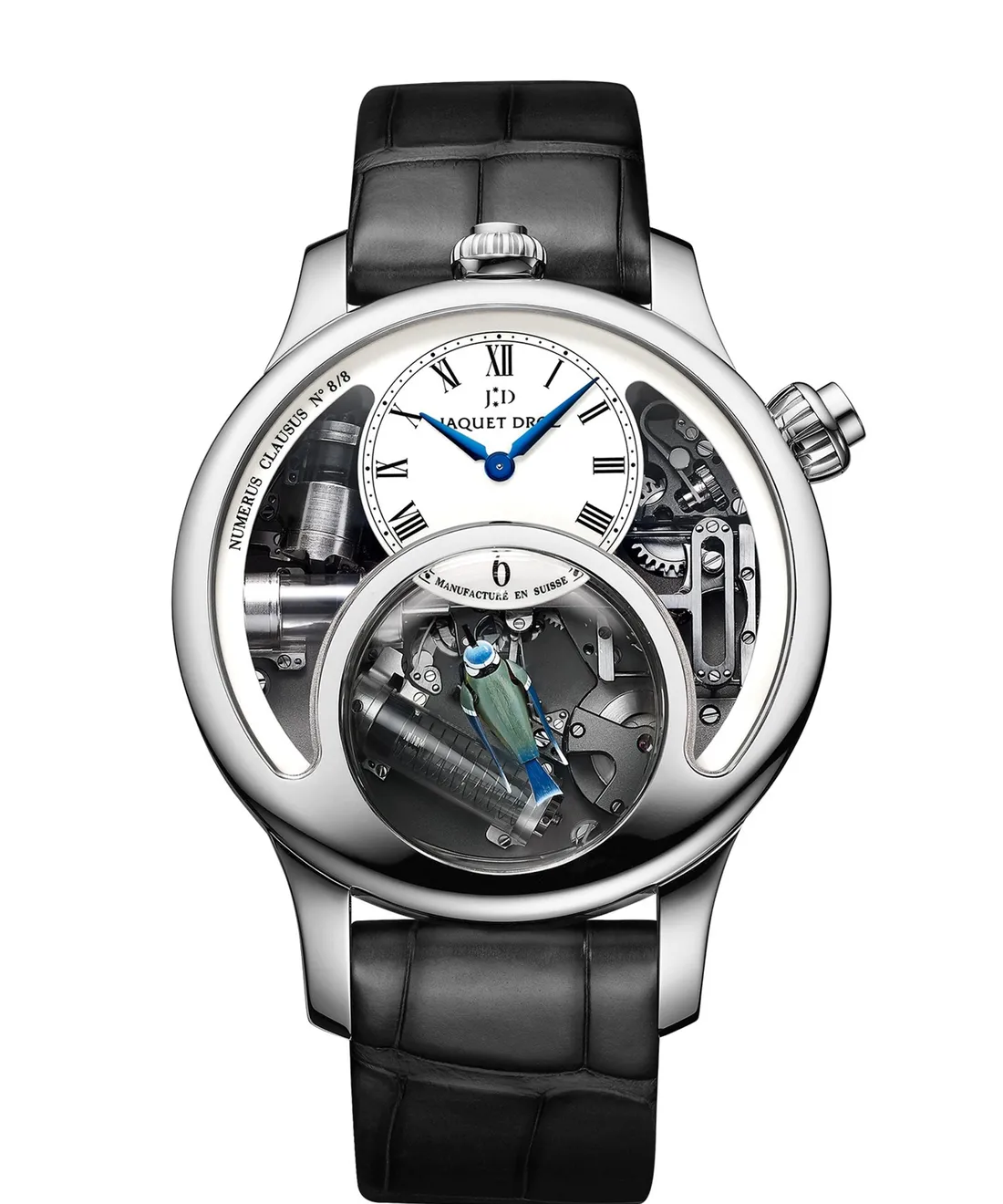
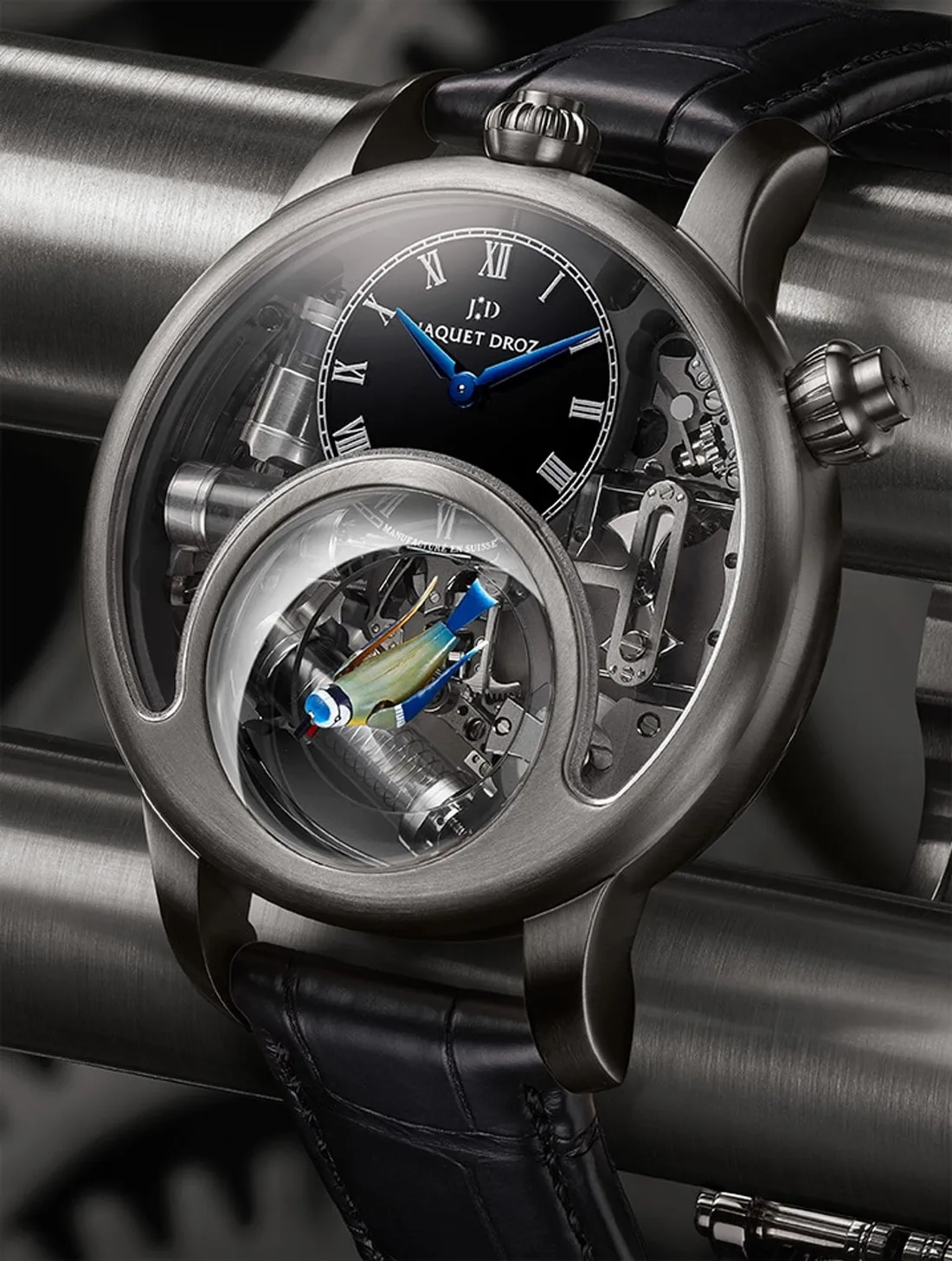
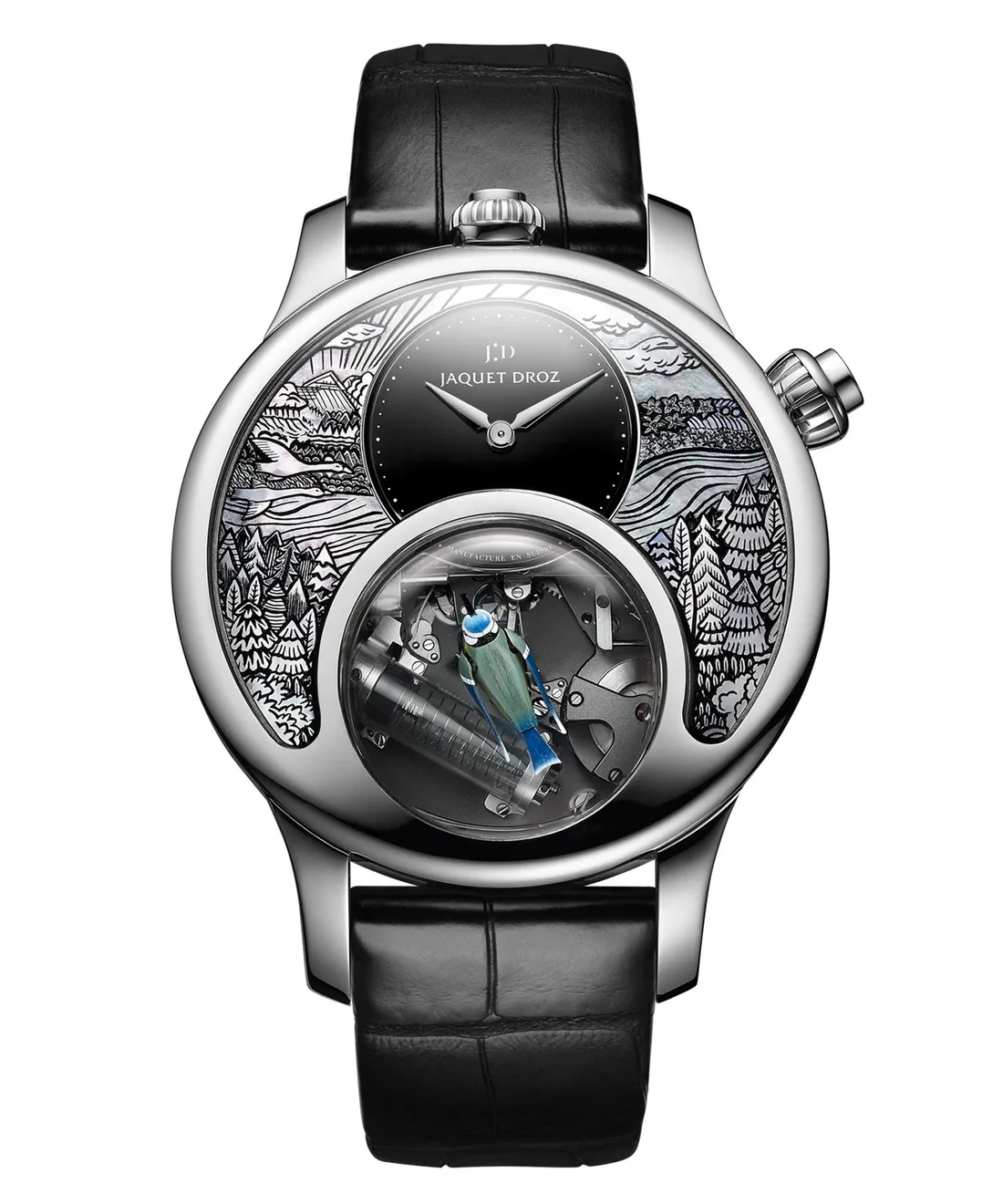
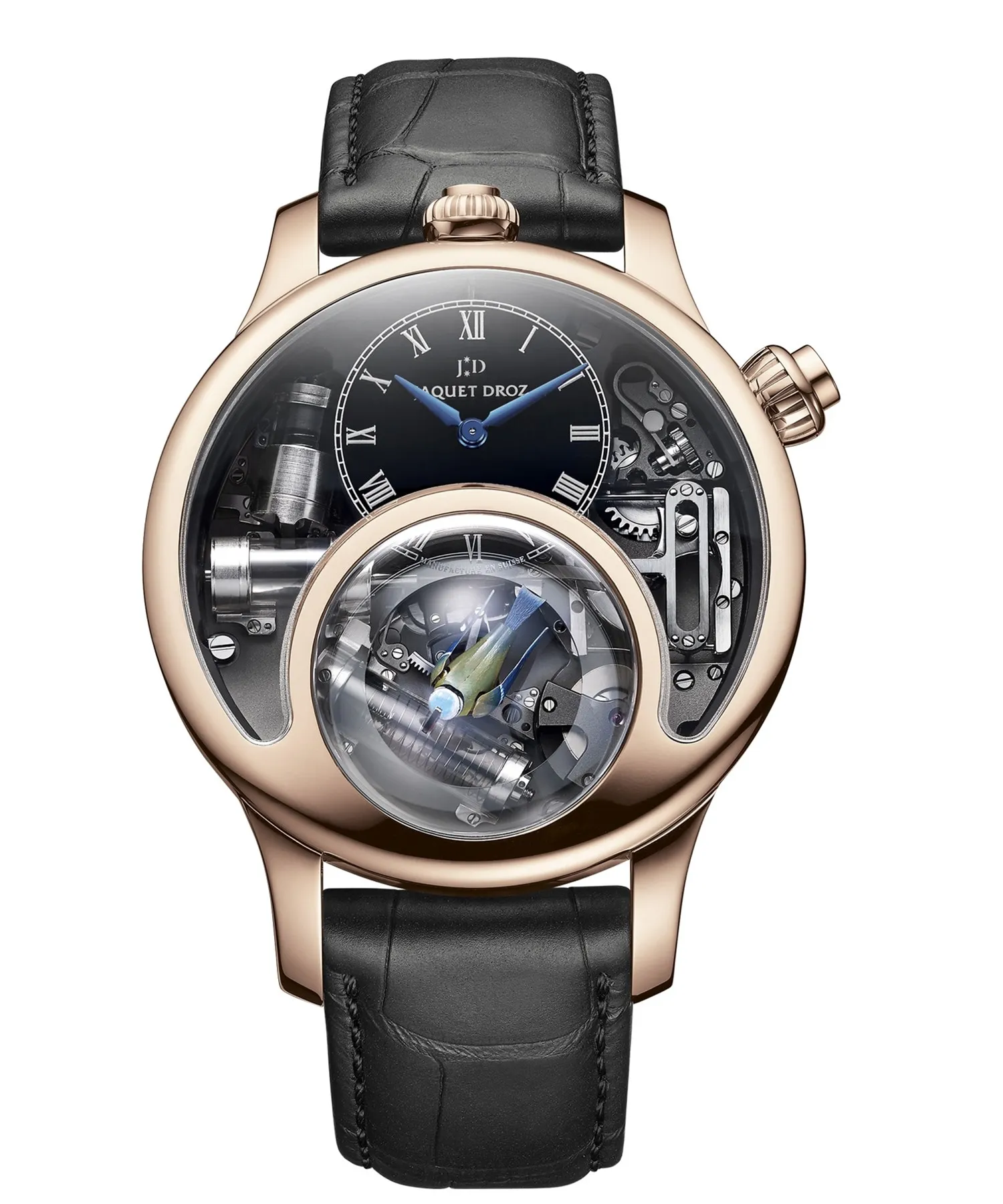
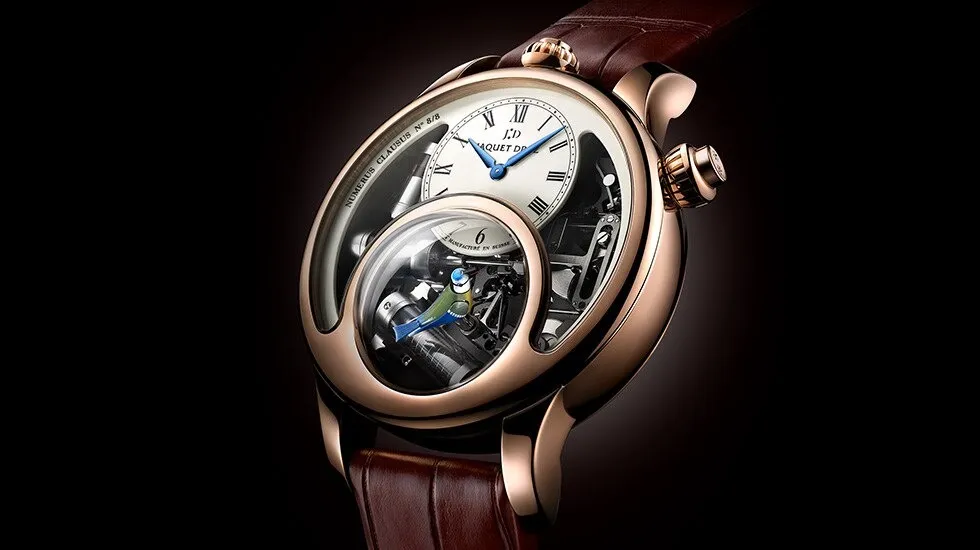
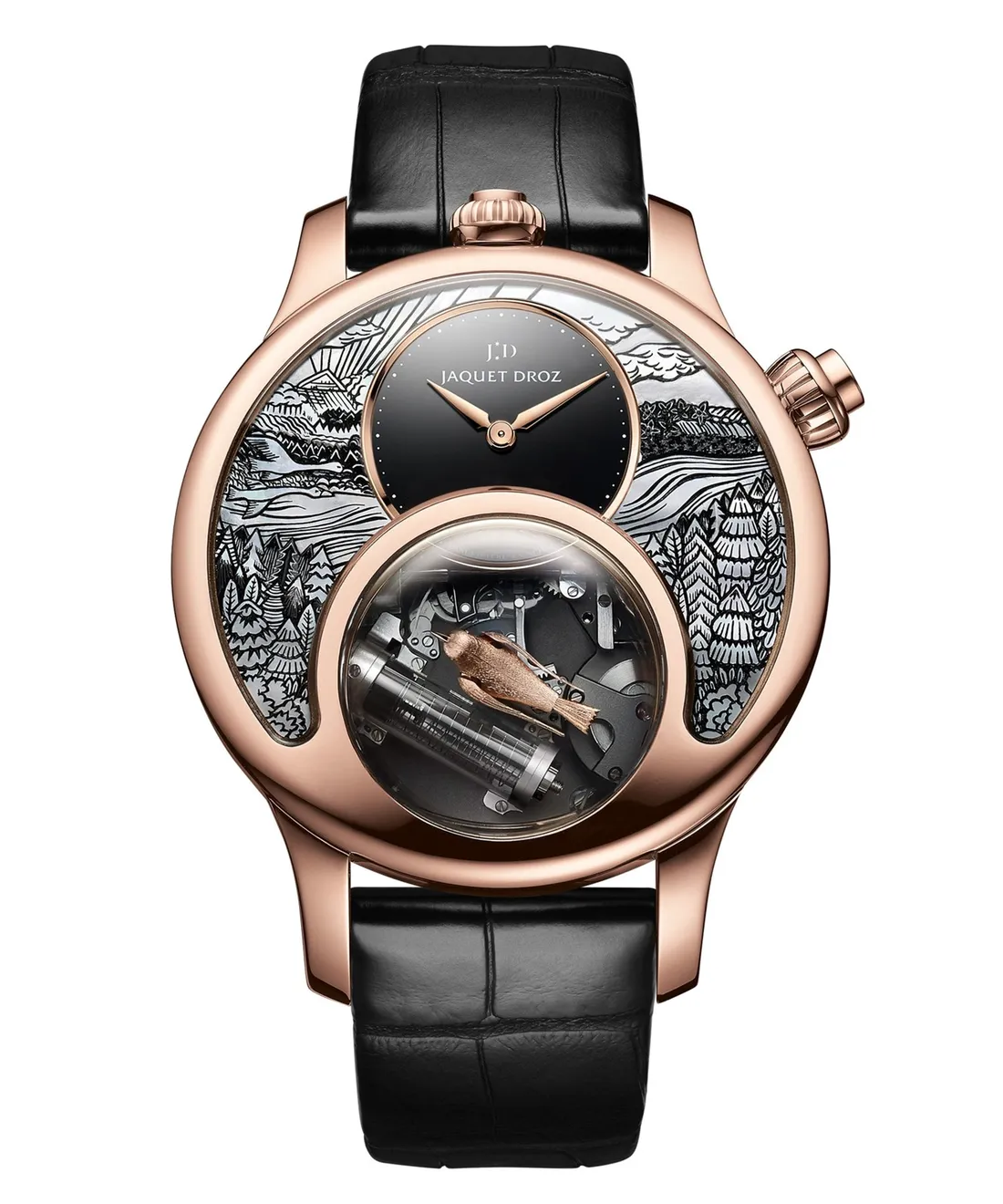
Marc's eyes were locked on the red gold case on Henri's wrist and on the transparent dome above it: "Henri, the thing on your wrist looks less like a watch than a small theatre stage. A tiny dial at the top, and below it a blue bird held inside a sapphire bell jar. I can see the Jaquet Droz logo. Who is the historical genius behind this house?"
Henri smiled and pulled his sleeve back a little further: "We have to go to the eighteenth century, to the mountains of Neuchâtel, Marc. Pierre Jaquet-Droz lived between 1721 and 1790; he was not a programmer or an electrical engineer. He was a genius of automata, burning with the desire to create mechanical life."
"There was no electricity then, no battery. Pierre Jaquet-Droz built human sized automata he called the Writer, the Draughtsman and the Musician. Thanks to the thousands of wheels and cams inside them, these mechanical children dipped a quill in ink and wrote real letters, and drew portraits. All three stand in the museum in Neuchâtel today, and they still work."
"And this watch," said Henri, "is that enormous legacy of automata transposed, in the twenty first century, into the micro world of a forty seven millimetre wristwatch."
Chapter II: The Secret of the Singing Bird, a Pneumatic Breath
Marc leaned forward: "So does the bird just sit there, or does it sing? But what I really want to know is technical: traditional singing bird watches use pinned cylinders or metal combs. How did a music box fit into that restricted space? Or is there a digital chip?"
Henri laughed: "If there were a single digital chip or a loudspeaker I would throw this watch into the fire. There is not one electronic component in it."
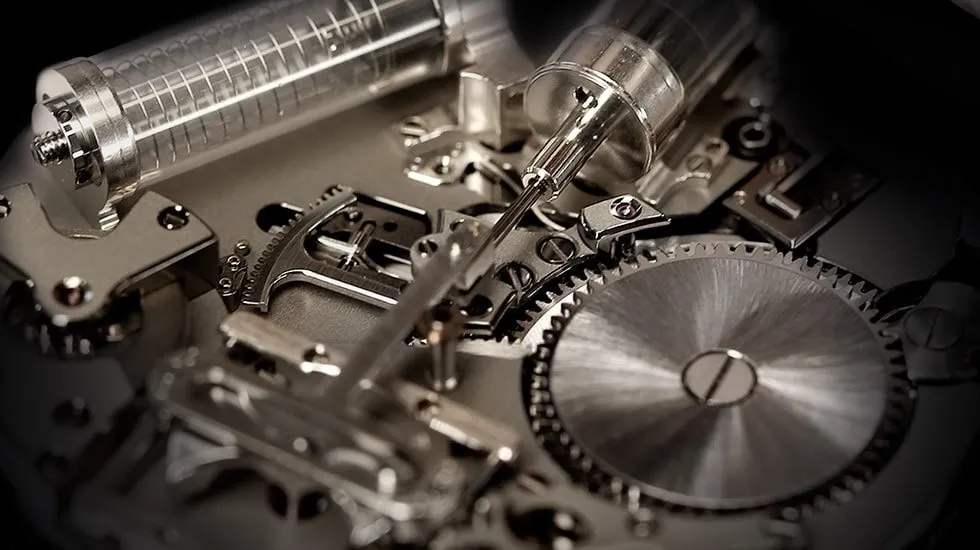
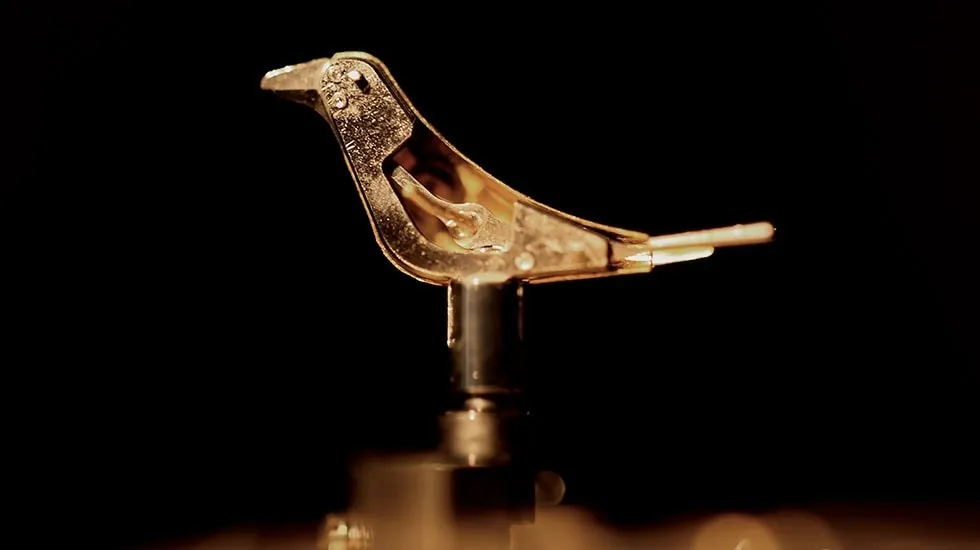
"Traditional music boxes make a metallic sound by striking metal against metal. But a bird in nature does not make a metallic sound; it sings by blowing air. The engineers at Jaquet Droz threw the music box logic away in this watch. In its place they built a miniature pneumatic piston and whistle mechanism."
"A pneumatic piston?" said Marc. "How do you produce an acoustic melody with air pressure in the restricted volume of a wristwatch?"
"Think of a very simple instrument: the slide whistle. It works in three steps."
1. The breath: those transparent cylinders under the dial are micro pistons made of sapphire and carbon. When the button is pressed, the pistons draw in the air inside the case and push it out through a fine channel. What really matters here is that the pressure stays constant; in singing bird mechanisms this is provided by an air brake, a governor vane that turns and works against the air. If the pressure fluctuates, the sound loses both its pitch and its strength.
2. Making the sound: the compressed air strikes a sharp lip at the end of the tube. What happens there is not the vibration of a metal reed; the thin air jet passes alternately above and below the sharp edge, shedding vortices in turn. In acoustics this is called the edge tone, or the air reed. The voice of the flute, the organ and the whistle is born of this principle.
3. Bending the melody: inside the tube there is a second micro piston that slides back and forth and changes the effective length of the tube. The fundamental frequency of a tube closed at one end is the speed of sound divided by four times its length. At twenty degrees the speed of sound is three hundred and forty three metres a second, so a high whistle of three kilohertz calls for an effective length of about three centimetres. Clearly such a tube cannot lie straight in a forty seven millimetre case; the resonator is therefore folded, and by using the ratio of a volume to its neck, that is a Helmholtz type cavity, the same pitch is obtained from a far smaller space.
Marc looked up: "And as the piston slides, the frequency changes continuously."
"That is the secret of birdsong," said Henri. "A bird does not sing separate notes; it sings by sliding its frequency. A comb music box can only produce discrete notes. A sliding piston bends the sound, which is to say it draws the gliding line of a real trill. The way to imitate nature was not more notes, but the transitions between them."
format_quote"A bird in nature does not make a metallic sound; it sings by blowing air."
Henri, senior watchmaker
Chapter III: The Acoustic Barrier and the Idea of Resonance
Marc frowned: "The mechanism is wonderful, but does that sound not drown inside a closed case? How does it reach the outside so clearly?"
"This is where acoustic resonance comes in," said Henri. "To understand resonance, think of the classic wine glass. When the frequency of a sound coincides with the natural frequency of the glass, the glass absorbs the energy, vibrates violently and may break. The coincidence of a body's natural frequency with the wave arriving at it is what we call resonance."
"But two things have to be separated here, Marc, because most accounts stop short at this point. The first is the matching of frequency, the second is the transfer of energy to the outside. Between the tiny air cavity inside and the great mass of air outside there is a large acoustic mismatch. The sound of a small, stiff source transfers very badly straight into air. A membrane or a dome is a transformer that mediates between those two media."
"And I would like to correct a misunderstanding," he added. "People say sapphire swallows sound; that is not true. Sapphire has very low internal damping, which means that when struck it rings on and on. It is a resonator of high quality. The problem is not that it absorbs the sound, but whether its own natural frequencies fall in the band of the whistle, and how much of its vibration it can hand over to the air."
"So there are two dangers," said Marc.
"Yes. The first is a mismatch: if the modes of the dome lie far from the band of the whistle, the sound stays inside, the bird flaps its wings and almost nothing is heard outside. The second is a match that is too sharp: if the dome rings at a single frequency with a very high quality factor, that one note comes out exaggerated and the rest of the song is lost; the sound turns into a piercing ring. What is wanted is the measured middle way between those two extremes."
"Jaquet Droz stopped the sapphire dome being a barrier to sound," said Henri. "They turned it into a transparent loudspeaker membrane that vibrates gently along with the sound."
format_quote"People say sapphire swallows sound; that is not true. Sapphire has very low internal damping, which means that when struck it rings on and on."
Henri, senior watchmaker
Chapter IV: The F.P. Journe Comparison, Mechanical Against Acoustic Resonance
Marc suddenly straightened up: "Wait a moment, Henri. You said resonance. But in high watchmaking the first legend that comes to mind at the word resonance is François-Paul Journe and his famous Chronomètre à Résonance. Journe used resonance in his watch too. Are the two the same thing? Did he also run a sound mechanism in his watch?"
Henri smiled with pleasure and wrote two headings with his finger on the misted window of the cable car: "A wonderful question. Both makers rest on the same basic principle of physics, the tuning of frequencies; but their aims are as different as night and day."
"In F.P. Journe's watch there is no singing bird and no sound mechanism. He was pursuing a watch that does not drift. He made two independent balance wheels standing side by side tune one another through their common baseplate. The history of that phenomenon goes back to 1665: Christiaan Huygens noticed that two pendulum clocks hanging from the same beam locked onto each other after a while. Today we call it entrainment, or locking."
"Locking has a condition," Henri added. "The rates of the two oscillators have to be close enough to each other; otherwise they cannot capture one another. When they do, a shock that speeds one of them slows the other, and the average rate stays steady. So Journe's resonance is mechanical, and its aim is to make time more precise."
"At Jaquet Droz, on the other hand, the aim is not to correct the drift of the watch but to create an acoustic loudspeaker. The sound of the whistle inside is tuned to the sapphire dome outside. Where Journe tuned wheels to one another, Jaquet Droz tuned the sound to the glass itself."
format_quote"Where Journe tuned wheels to one another, Jaquet Droz tuned the sound to the glass itself."
Henri, senior watchmaker
Chapter V: The Acoustic Tuning of the Sapphire Dome
Marc asked: "But how do you tune a glass? Sapphire is one of the hardest materials after diamond. How could the people in that workshop tune this hard crystal like an instrument?"
"Remember the logic of the glass harp," said Henri. "Run your finger around the rim of a glass and it rings. Add water, that is add mass, and the pitch falls. Thin its wall and its bending stiffness falls, so the pitch falls again. The natural frequency of a plate or a dome is proportional to its thickness, inversely proportional to the square of its span, and proportional to the square root of the ratio of the material's stiffness to its density. In sapphire that ratio is very high, so the modes of the dome start out very high indeed; the work of tuning is to bring those modes down towards the band of the whistle."
"The process has four steps," he continued.
A block of synthetic sapphire: crystal of pure aluminium oxide, melted above two thousand degrees, is cut.
2. Five axis machining: the block is hollowed into a dome with diamond tools. The curve is not there only for beauty; this geometry decides in which modes the sound waves will gather on the surface of the dome.
3. Laser interferometry: the dome is taken into an acoustic chamber, the whistle band between two thousand and four thousand hertz is played from beneath it, and a laser maps the sub micron oscillations of the crystal. In this way it becomes visible how the dome vibrates at which frequency.
4. Polishing to microns with diamond powder: the inner walls are thinned with felts charged with diamond powder. As the thickness falls, the modes of the dome come down and approach the band of the whistle.
"And here lies the most delicate part of the work," said Henri. "The aim is not to lock exactly onto a single frequency. Had that been the aim, the dome would shout one note and swallow the rest of the song. What is wanted is an agreement broad enough to pass the whole band between two thousand and four thousand hertz. When that range is held, the work is stopped. The sapphire no longer imprisons the sound; it vibrates gracefully along with it and becomes a transparent membrane."
Chapter VI: The Architecture of the Dial and the Summit of Detail
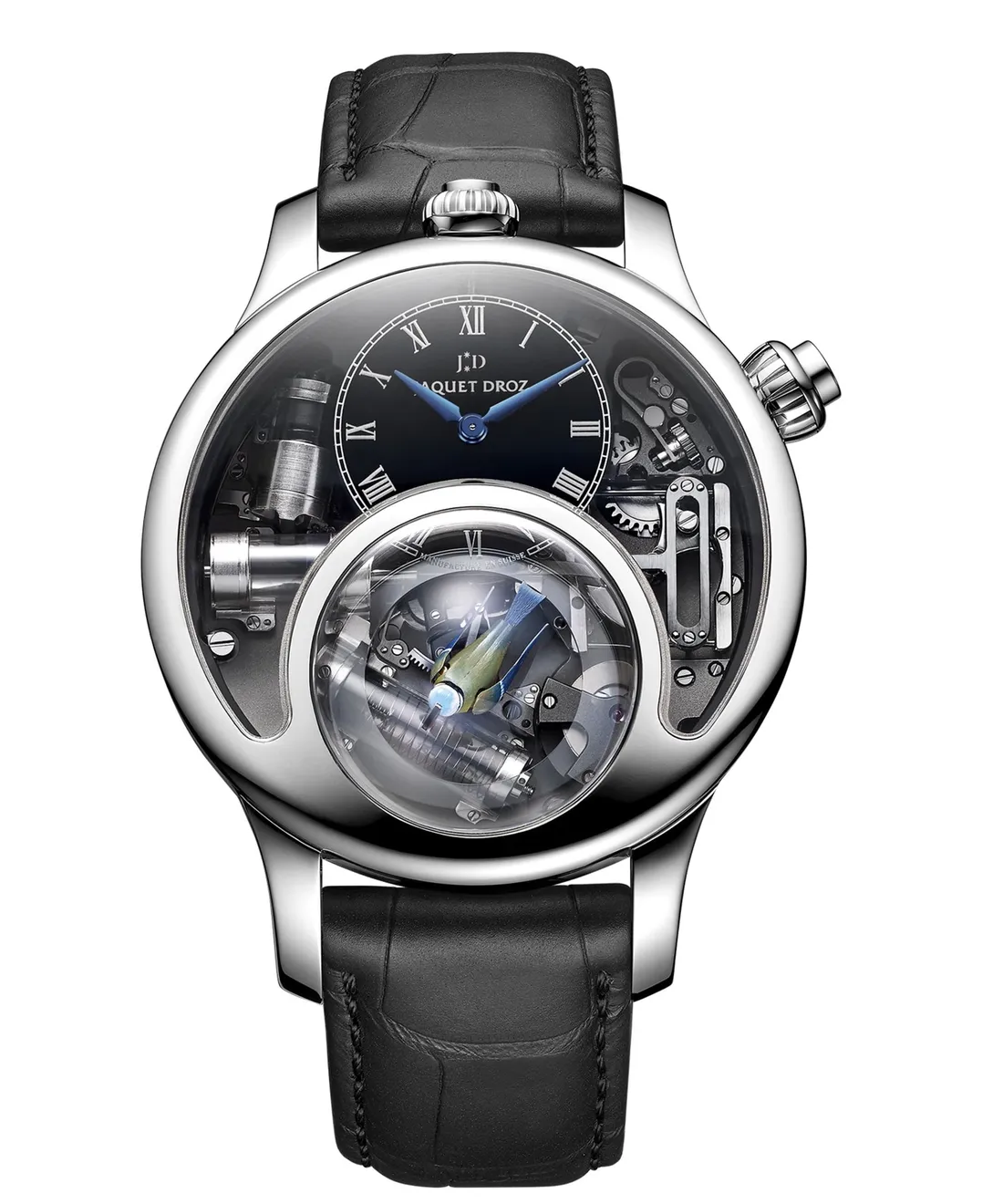
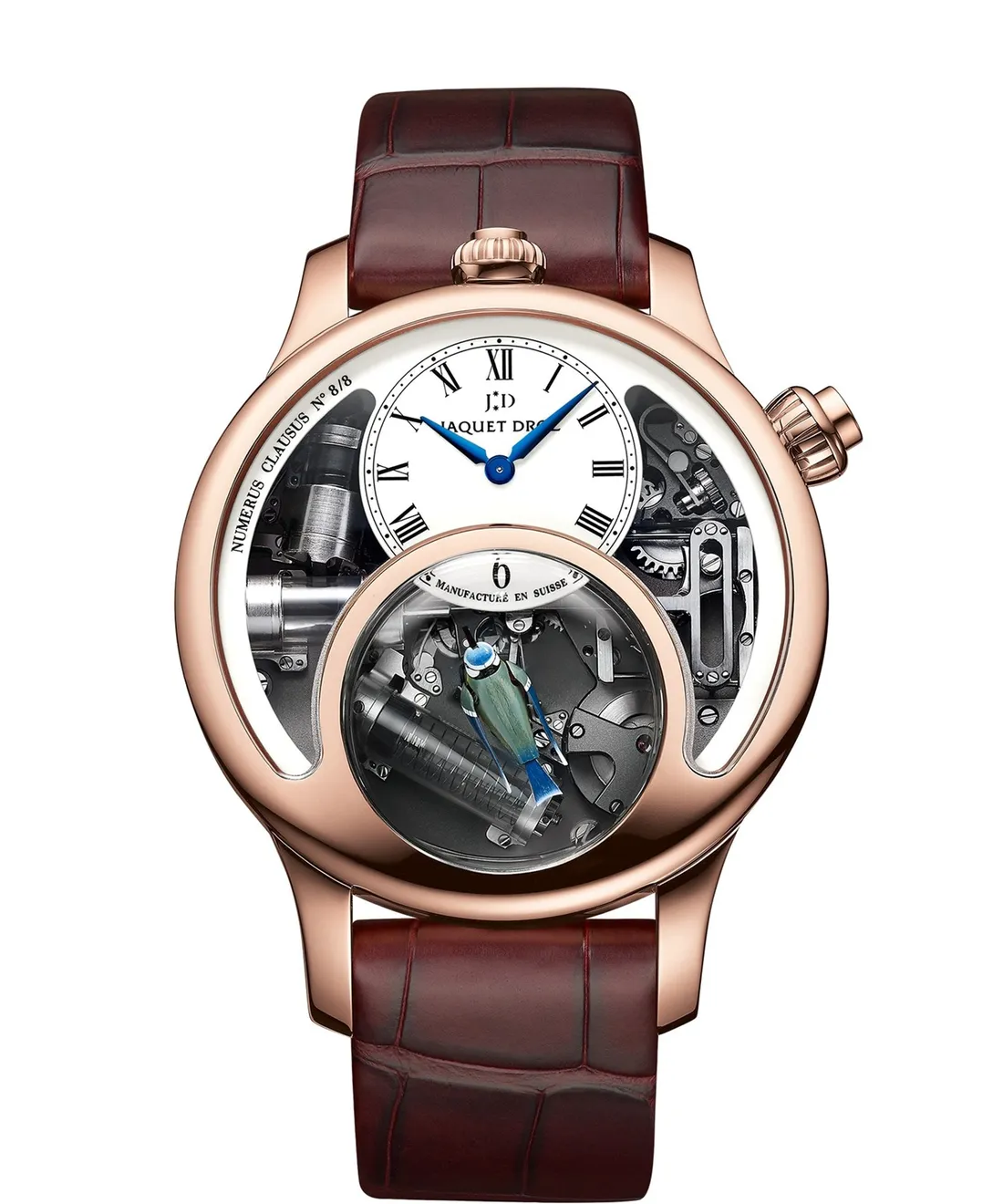
Marc studied the dial: "The hours and minutes are shown in the small circle above, and below is the dome of the bird. When the two circles meet they form a perfect figure of eight. And there is an inscription on the rim."
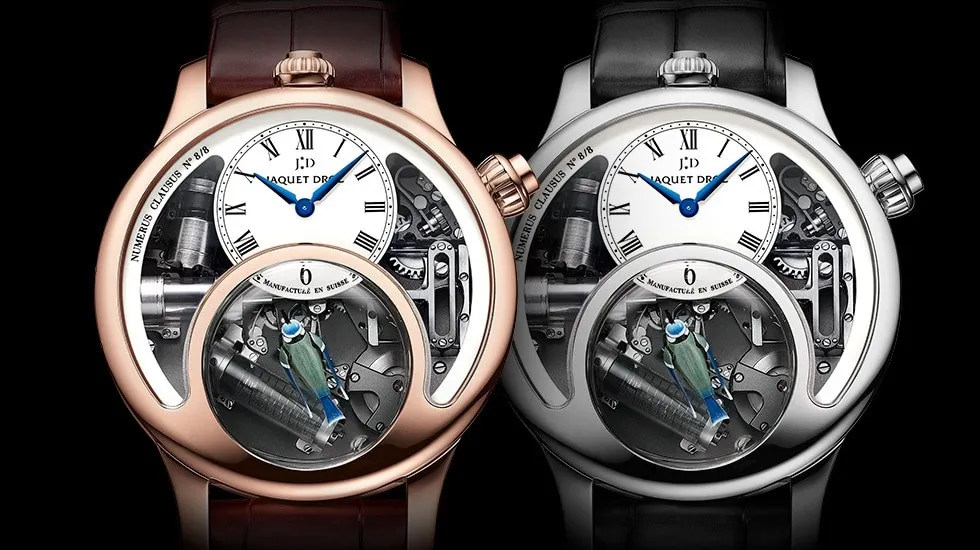
"The figure eight is the aesthetic signature of Jaquet Droz and stands for infinity," said Henri. "On this reference the upper dial is made of sapphire crystal with platinum Roman numerals applied to it; on other versions of the same automaton the house uses ivory coloured Grand Feu enamel. Enamel is fired at around eight hundred degrees and its colour does not fade over centuries. The hands are blued steel."
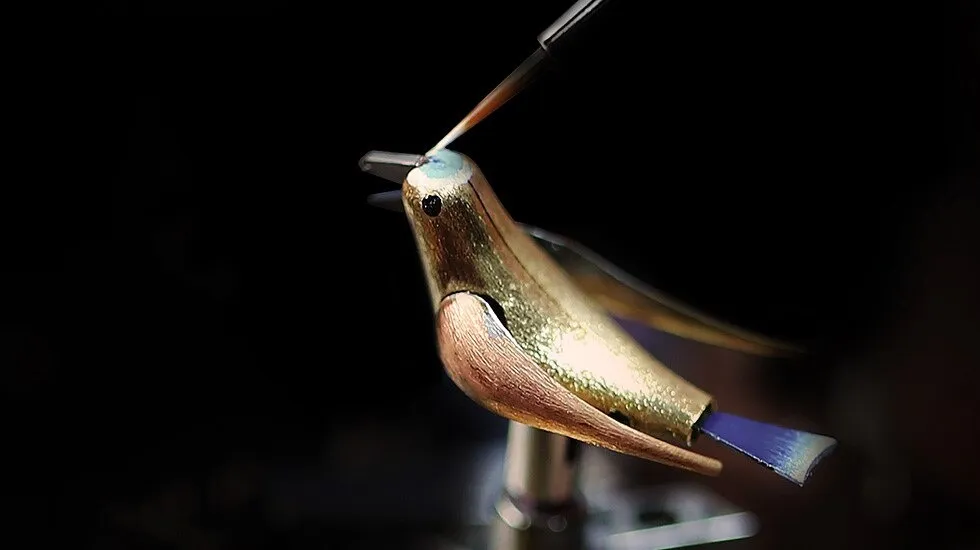
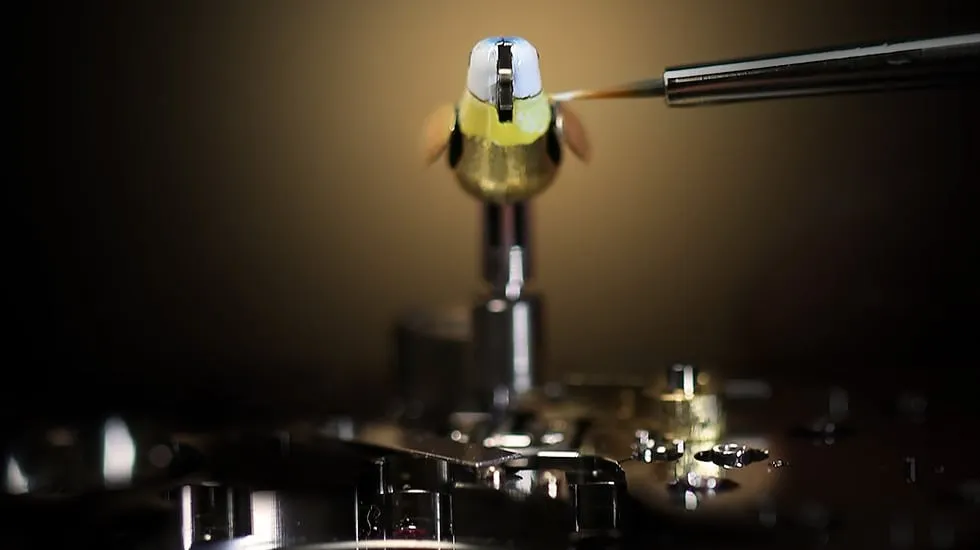
"The transparent area below is the pure spectacle of mechanics. The bird does not only sing; it beats its wings, opens its beak, moves its tail and turns about itself. All of that happens in sequence at the press of a single button, because all of it hangs on the same series of cams."
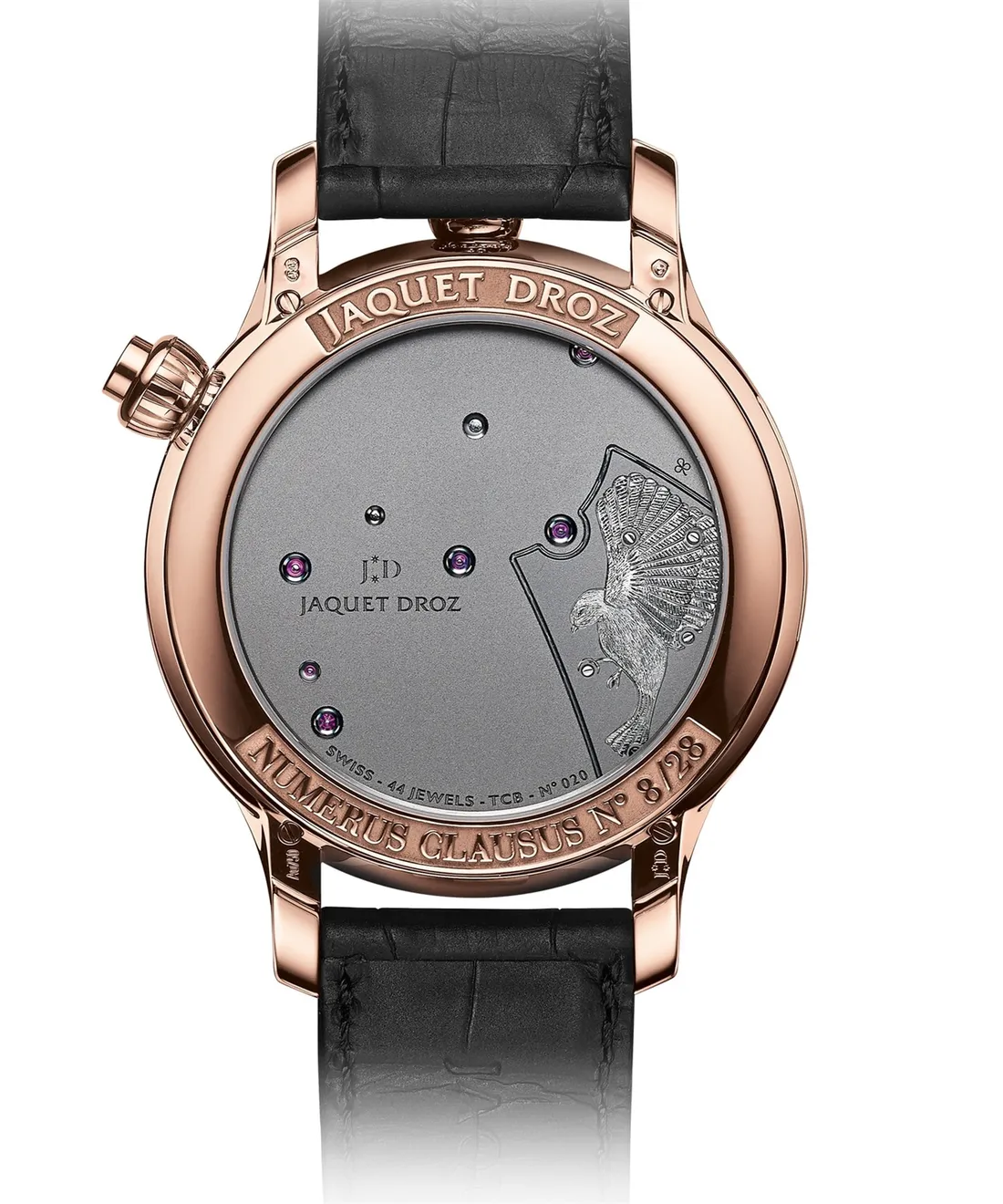
"Look carefully at the writing on the rim," he added. "Numerus Clausus N° 8/28. Which is to say that this piece is the eighth of a closed series of twenty eight. On the bridge it says Swiss, forty four jewels and the movement's own number: twenty nine jewels belong to the watch itself and fifteen to the singing mechanism, which makes forty four."
"The calibre is called the Jaquet Droz 615," said Henri. "Self winding, with a single barrel, a balance wheel with a regulating screw and a silicon balance spring, and a platinum oscillating weight. Twenty one thousand six hundred vibrations an hour, thirty eight hours of power reserve. The case is forty seven millimetres, and with the dome its height rises to twenty three millimetres. And let me say this too: this watch is not water resistant. One does not expect water resistance from a body built to let sound through."
Reaching the Summit: The Song of Time
The cable car came into the summit station with a great jolt. Outside, snowflakes were drifting down. When the doors hissed open the mountain air struck their faces.
Marc looked one last time at the blue bird under the sapphire dome of the Jaquet Droz The Charming Bird: "You know, Henri, François-Paul Journe tuned wheels to one another in order to remove the friction inside mechanics and make time perfect. Jaquet Droz took the whistle of an air driven pipe and, by thinning a sapphire crystal as hard as diamond micron by micron, turned it into a transparent instrument. One is the physics of time, the other the music of time."
Henri pressed lightly on the button attached to the crown. The miniature blue bird beneath the sapphire dome came suddenly to life; it beat its wings, turned about itself, opened its beak, and in the silence of the snowy mountains a trill of crystalline clarity rose up.
Turning up the collar of his coat and taking his first step out into the snow, Henri turned back: "That is why high watchmaking is a branch of art, Marc. This watch does not show us the time; it reminds us that time has a soul, that it can beat its wings and that it can sing the most beautiful song in nature."
format_quote"This watch does not show us the time; it reminds us that time has a soul, that it can beat its wings and that it can sing the most beautiful song in nature."
Henri, senior watchmaker