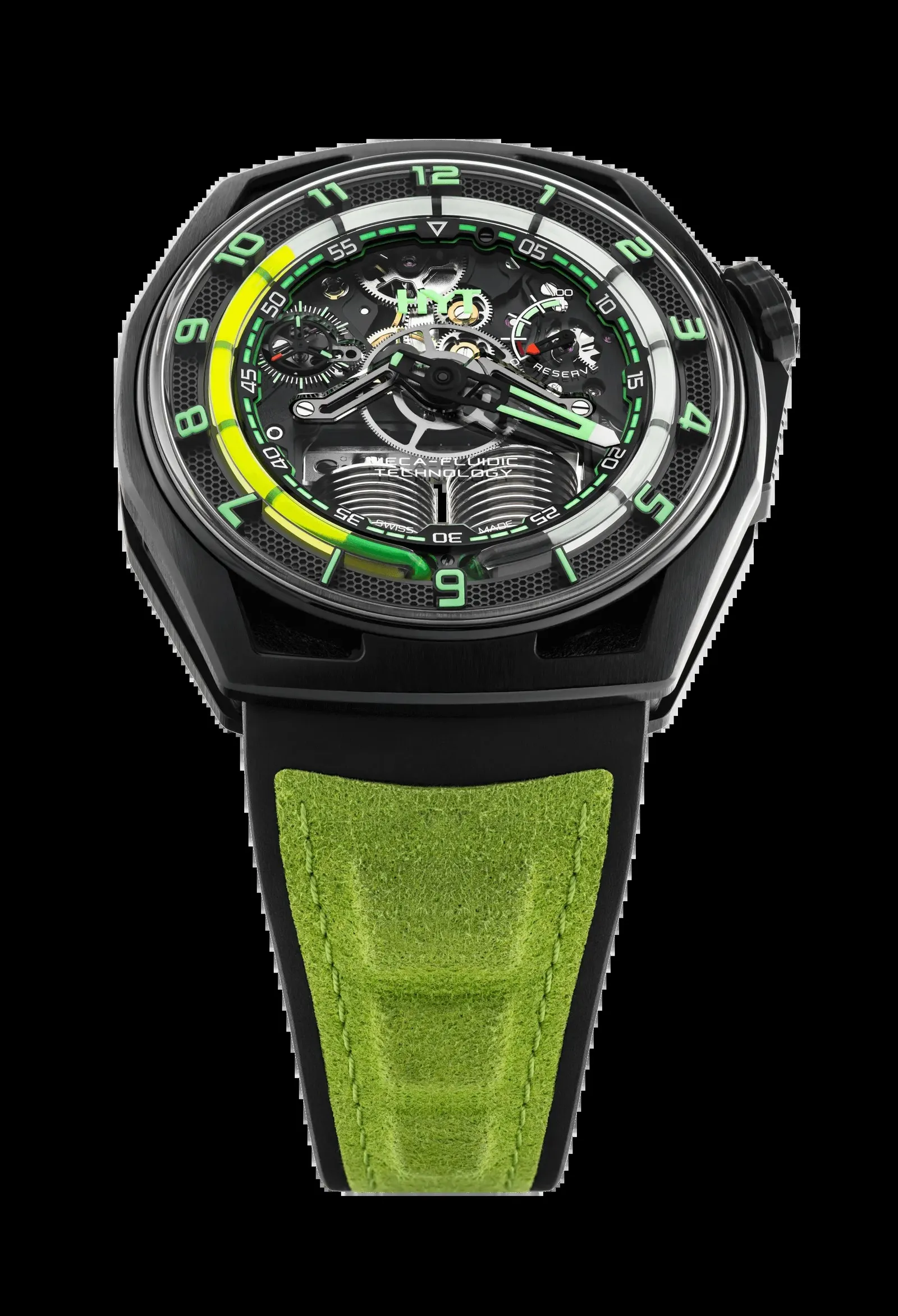
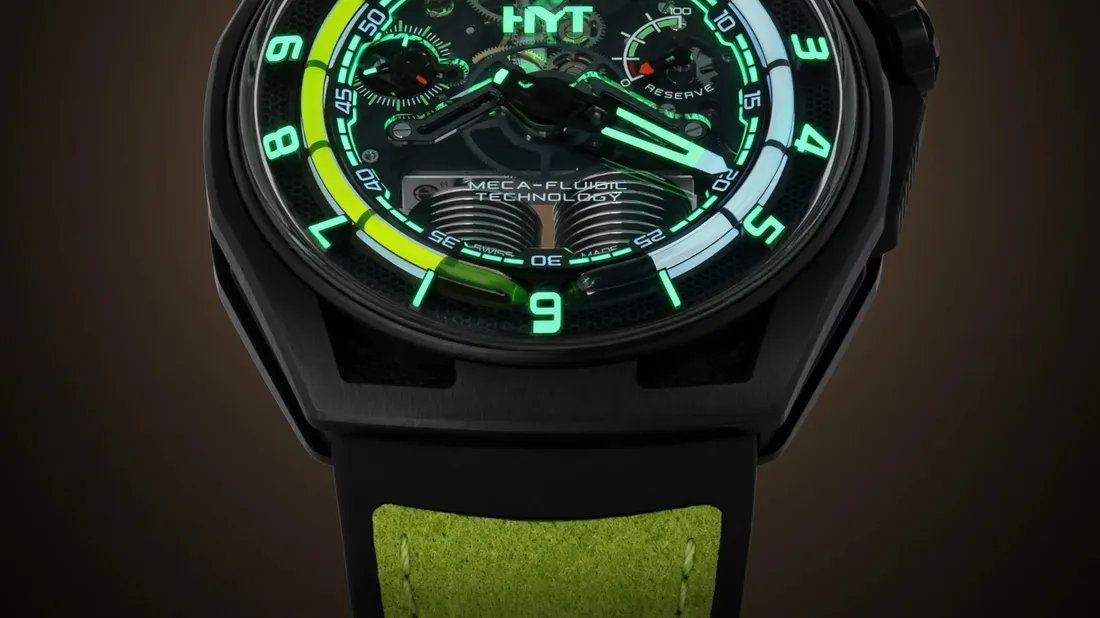
Look up at the night sky. Somewhere out in that pitch black emptiness, a phosphorescent green cloud is drifting: a nebula. Now lower your eyes to your wrist. Inside a black carbon case, flowing along a thin glass tube, the very same phosphorescent green. The HYT Hastroid Green Nebula is as if someone took that celestial object and strapped it to your wrist. Because this watch tells time with neither hands nor digits; it tells time with a flowing, living liquid.
In this single object, three universes meet: astronomy, fluid mechanics, and watchmaking. So it is not only collectors who get excited in front of this watch, but physicists and astronomers too. Let us dive together into the science behind this green liquid, beginning with its very name.
Hastroid: A Celestial Stone That Carries Liquid
Even the watch’s name comes from space. Hastroid is a name HYT coined for this series, drawn straight from astronomy and futurism; a fusion of two ideas.
The first is asteroid: the great masses of rock and metal that tumble in orbit through space. The watch’s multi layered, futuristic carbon case and its angular, aggressive lines evoke exactly a meteorite, a stone hurled through the cosmos. The second is hydro: a nod to the liquid mechanics that are the brand’s signature. HYT fused the two into Hastroid. So the spirit of the word is this: a futuristic celestial body that carries liquid within itself. In short, a little space rock, fastened to your wrist.
What Is a Nebula? The Cradle and the Grave of Stars
And where does the second name, Nebula, come from? A nebula is a vast cloud of gas and dust stretching across light years in the depths of space. But what exactly is a cloud of gas and dust? The gas is almost entirely hydrogen, the simplest and most abundant matter in the universe, with a little helium beside it. The dust is microscopic grains of carbon and silicates, a kind of cosmic soot and sand. These clouds are so vast that light takes years to cross from one edge to the other, yet so thin that the emptiness within them is emptier than the finest vacuum we can build in a laboratory.
The most poetic part is this: a nebula is both a cradle and a grave. Stars are born inside nebulae, as gravity squeezes a cloud of gas over millions of years until a sun ignites at its heart. The famous Orion Nebula is one such stellar nursery, visible even to the naked eye. The celebrated Pillars of Creation, in the Eagle Nebula, are towers of gas light years tall, with new stars being born inside them.
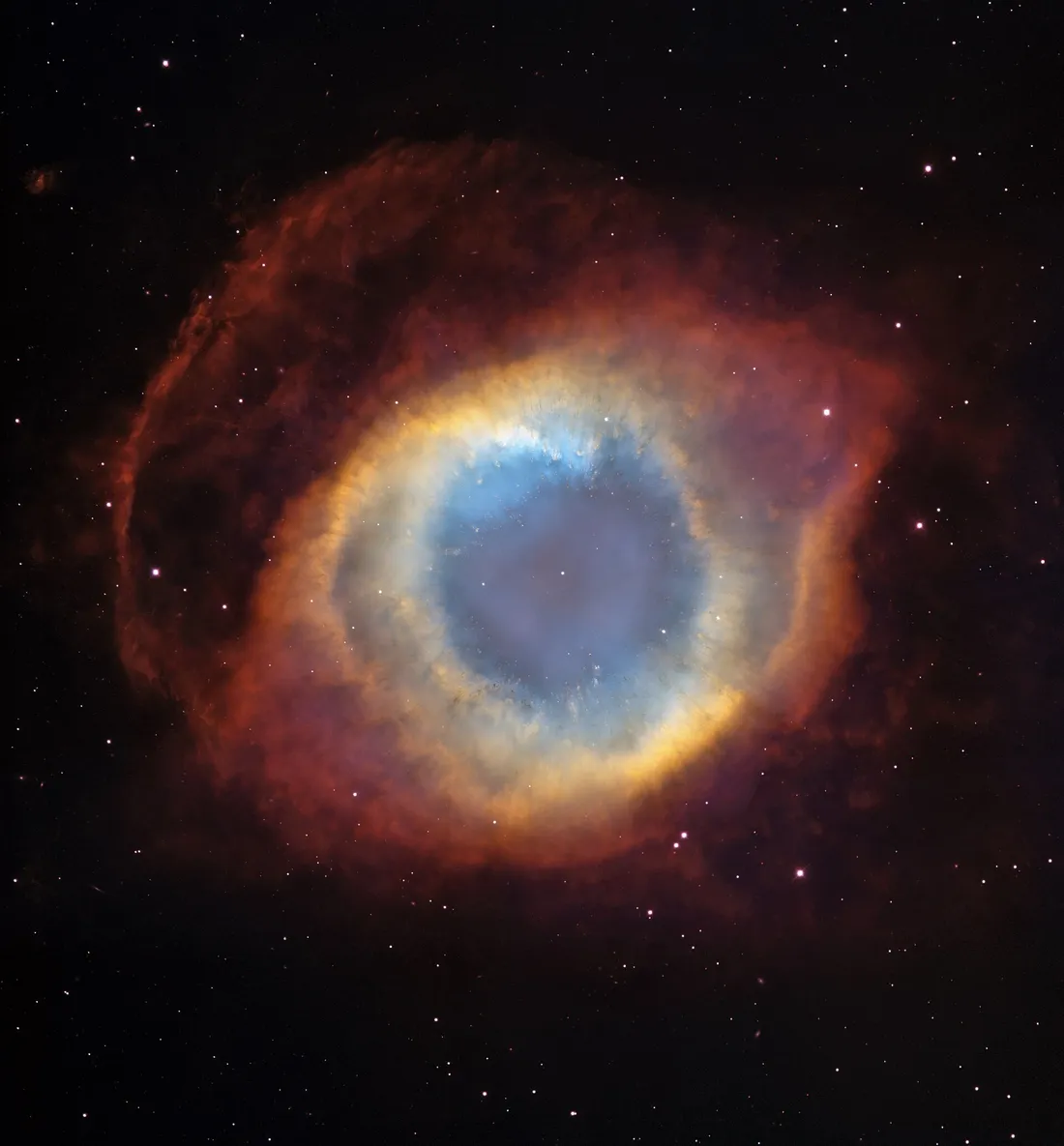
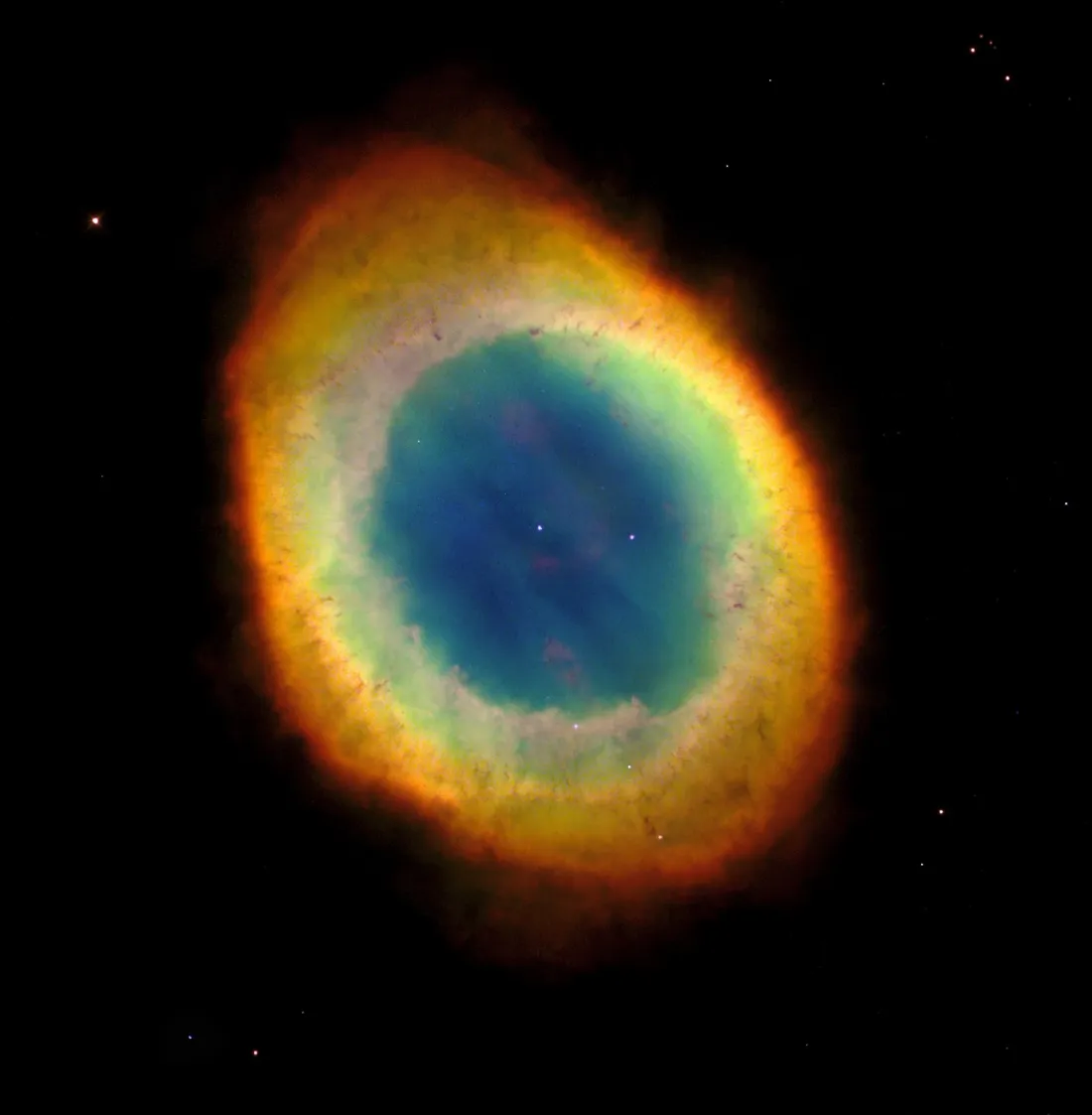
And stars die back into nebulae. A sun-like star, with its last breath, puffs its outer layers into space and leaves behind a glowing ring; the Ring Nebula and the Helix Nebula are exactly such dead suns, and they often glow a greenish hue. Larger stars explode as supernovae; the Crab Nebula is the still glowing wreckage of a star that detonated a thousand years ago.
And somewhere in there, so are we. The carbon in your bones, the iron in your blood, the oxygen you breathe were all once cooked inside a star and scattered into space by a nebula. You are, quite literally, stardust wearing a watch.
And that green? For decades astronomers saw a mysterious green glow in nebulae that matched no known element, and they named the phantom substance nebulium. The riddle was solved in 1927: the green is a forbidden light emitted by doubly ionised oxygen. It is a transition so rare that it can only occur in the near perfect vacuum of space, where an atom can drift for a long time without striking anything. On Earth, atoms collide far too often for that light ever to form. So the green of a nebula is a light impossible to make on Earth. And HYT chose exactly that green for its dial.

format_quote"The green of a nebula is a light impossible to make on Earth. HYT took that green, sealed it inside a glass tube, and strapped it to your wrist."
A Story That Began With Water, and Fluid Mechanics
Long before gears, humanity measured time with water. The clepsydra, Greek for water thief: the level of water dripping at a steady rate marked the passing hours. It was used in ancient Egypt at the temple of Karnak, in Babylon, in China and in Greece. Ctesibius of Alexandria perfected it with floats in the third century before our era; in Greek courts these water clocks timed the speakers. For more than three thousand years, water was our clock.
Then, in the seventeenth century, came the pendulum and the balance spring; mechanical clocks grew so precise that telling time with liquid was forgotten. HYT’s audacity was to bring liquid back to timekeeping four centuries later. But to do that you must master fluid mechanics. Let us take a short tour, because the whole magic of this watch hides in a handful of ideas.
Viscosity is a liquid’s resistance to flowing: honey is far more viscous than water, because it is stickier and flows more heavily. Surface tension is a kind of invisible skin formed by the molecules at a liquid’s surface clinging tightly to one another; it is why a water strider can walk on a pond, and why a droplet pulls itself into a sphere. Capillarity is the most magical of all: dip a thin tube, or the corner of a paper towel, into water, and the water climbs upward in defiance of gravity, because the liquid clings to the wall more strongly than it clings to itself, and hauls itself up.
And flow has two moods. Slow, orderly flow is called laminar, the layers sliding without mixing, like water gliding silently down a clear stream. Fast, chaotic flow is turbulent, like a foaming waterfall. Which one a liquid chooses is set by the Reynolds number, and here is the good news: in a tube finer than a strand of hair, flow is almost always laminar, perfectly smooth. All of HYT’s engineering is built on preserving that smoothness, hour after hour.
Meca-Fluide: How Does Liquid Become a Clock?
HYT calls this technology Meca-Fluide, mechanical and fluidic. The time is shown by two liquids inside a fine glass capillary tube that rings the dial like a band: one bright green, the other perfectly transparent. The two never mix. The curved boundary where they meet, the meniscus (like the little curve water makes in a measuring cylinder), is your hour hand.
So what pushes the liquids? At six o’clock sit two tiny bellows made of a flexible metal; think of them as two microscopic accordions. The hand wound HYT 501-CM calibre, beating at 28,800 vibrations an hour with a 72 hour reserve and engineered by the complications master Éric Coudray, slowly squeezes one bellows and pushes the green liquid forward through the tube. As the day advances, the green climbs from six upward and marks the hours; when the cycle ends the liquid retreats and the journey begins again. An endless tug of war between two liquids, refereed by surface tension.
The minutes are shown by a conventional hand on a subdial. So a perfectly classical mechanical movement drives a thoroughly unclassical display: the gears count, the liquid shows. Picture the mercury rising in a thermometer, but driven by a Swiss watch movement and reading you the hour.
Making the Liquid: Years in the Laboratory
Here is where the scientists truly get excited, because this is less watchmaking than an engineering feat at the crossroads of microfluidics, materials science and chemistry. HYT develops its liquids in its own laboratory, together with chemists and fluid engineers. Consider the work involved.
First, two liquids are formulated. They must be immiscible, refusing to blend like oil and water, yet share almost exactly the same density, so that when you tilt your wrist or turn the watch upside down, gravity does not pull one away from the other and break the meniscus. Their viscosity and surface tension are tuned to the third decimal place, so the hour advances neither too fast nor too slow. The fluorescent dye that gives the green its glow must shine without changing the flow of the liquid one bit.
Then these liquids endure years of testing. They are heated and cooled again and again, from freezing cold to desert heat (thermal cycling); exposed to the sun’s ultraviolet rays, because the dye must not fade; shaken, knocked and dropped. Years of aging tests measure whether the liquid evaporates, whether it reacts in the slightest with the glass or with the metal of the bellows, whether the two liquids slowly bleed into each other. Because a single air bubble would ruin the watch, the tubes are filled under vacuum so that not one bubble remains.
And then the tube itself. It is made of borosilicate, the same tough glass as laboratory ware, drawn to a bore finer than a millimetre. In a tube this narrow the enemy is physics itself: the liquid clings both to the glass and to itself, and the wetting angle set by that balance decides whether the liquid glides or snags and stutters. So the engineers polish the inner wall and tune its surface chemistry until the meniscus slides like a drop of water off a waxed leaf, in perfectly smooth laminar flow. Finally, to counter the liquid’s expansion with heat, a third chamber, a thermal compensation reservoir, swells and shrinks to swallow the change. This is why an HYT is not a watch with a liquid inside it. It is a tiny laboratory, running on your wrist.

format_quote"An HYT is not a watch with liquid inside it. It is a laboratory on your wrist, where several laws of physics are held in a fragile truce just to tell you the time."
Why Green? Why Only 27?
Green is no whim but an engineering decision. The human eye is most sensitive to green light, around 555 nanometres; green is the colour we see brightest and sharpest, the easiest to make out in dim light. HYT’s earliest liquids were hard to read in the dark, and green solved that real problem. That the green a nebula glows and the green our eyes drink in most easily are one and the same is poetry in itself.
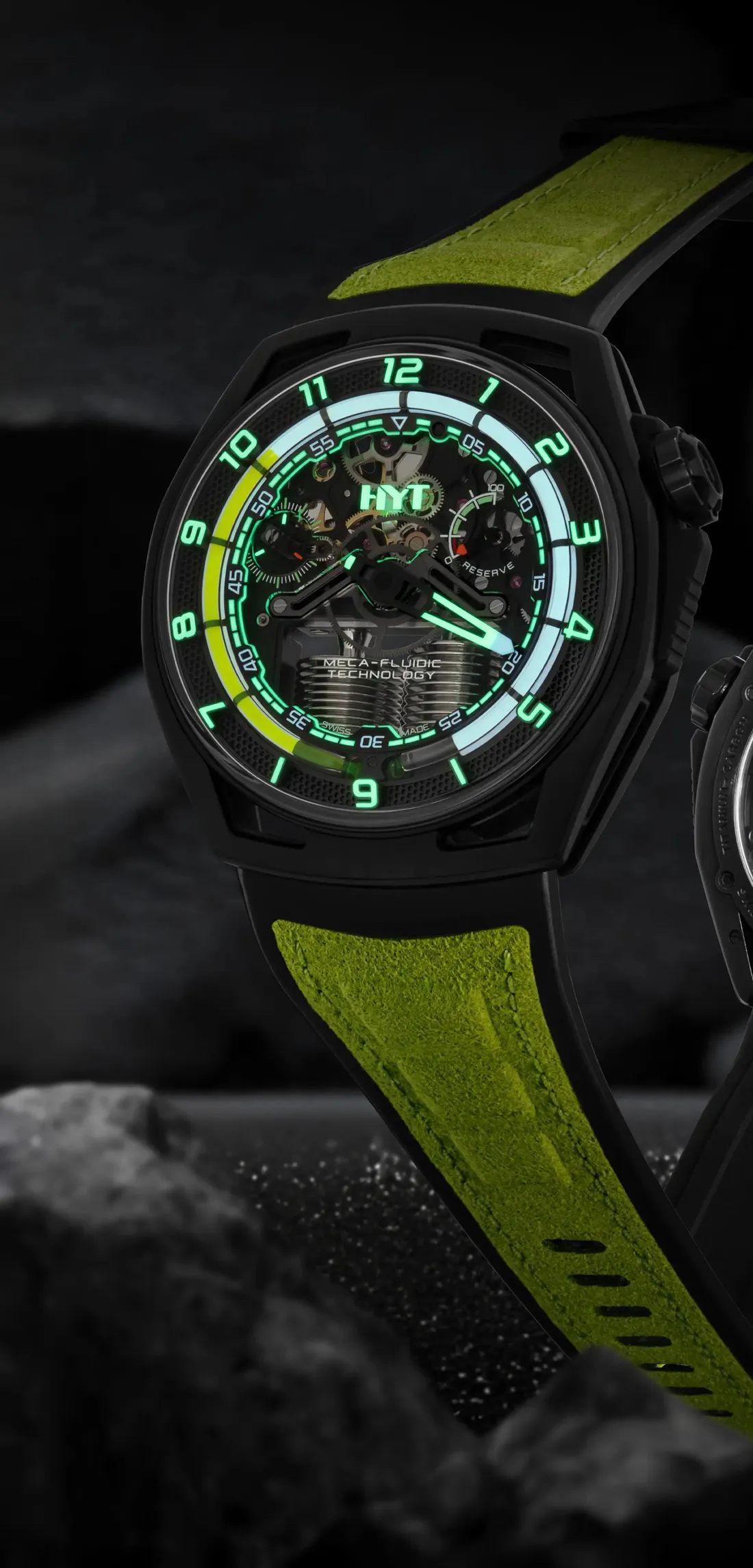
And they went further: the numerals and hands use Lumicast, a dense, cast form of Super-LumiNova, a phosphor that soaks up light and releases it slowly in the dark. Its crystals trap energised electrons and let them fall back little by little, glowing for hours. Green liquid and green phosphor together mean that in darkness the Hastroid lights up like a neon sign, like a nebula flaring in the black.
The case is black satin titanium and carbon; light, tough and dark as space, the perfect void to frame that glowing green. The strap is green down to its stitching. And the watch is truly rare: only 27 in the world. So the brand chose its boldest combination, black and green, to show the world what its Meca-Fluide could do. Priced at around 70,000 Swiss francs, it is less a watch than a manifesto.
A Celestial Stone, a Water Clock, a Laboratory
So on this single wrist you carry three wonders at once. A celestial stone: a futuristic body with an angular carbon case, named after the asteroids. A water clock: the oldest way humans ever measured time, reborn after four centuries. And a laboratory: where the laws of fluids are tamed so precisely that a single drop of liquid can keep an appointment.
HYT does not tell time the easy way. Perhaps it tells time the way the universe might: with a light that cannot exist on Earth, with a liquid that refuses to mix, with physics made visible. Look at that green creeping through the glass, and you are watching the very forces that ignite the stars, moving to the rhythm of a Swiss spring. This is not merely a watch. This is an entire cosmos, keeping time on your wrist.