
Before electric light, night was genuinely dark. Lighting a candle took time, striking a flint made noise, and anyone who woke and wanted to know the hour had either to revive the fire or wait for morning.
At the end of the eighteenth century somebody answered that problem mechanically. Push a slide on the side of the case and small hammers begin striking steel wires coiled inside it. First the full hours in a low tone, then the quarters in a double tone, then the remaining minutes in a high one. Nobody saw anything. Everybody heard.
Among the first buyers of that mechanism were people who could not see. Time had become independent of the eye for the first time, and it fitted in a pocket. Today a telephone tells us the hour, out loud if we ask. Which means a striking watch is, technically, an unnecessary object. But in watchmaking the unnecessary thing is usually the expensive one, because nobody is obliged to make it. You make it only because it is hard.
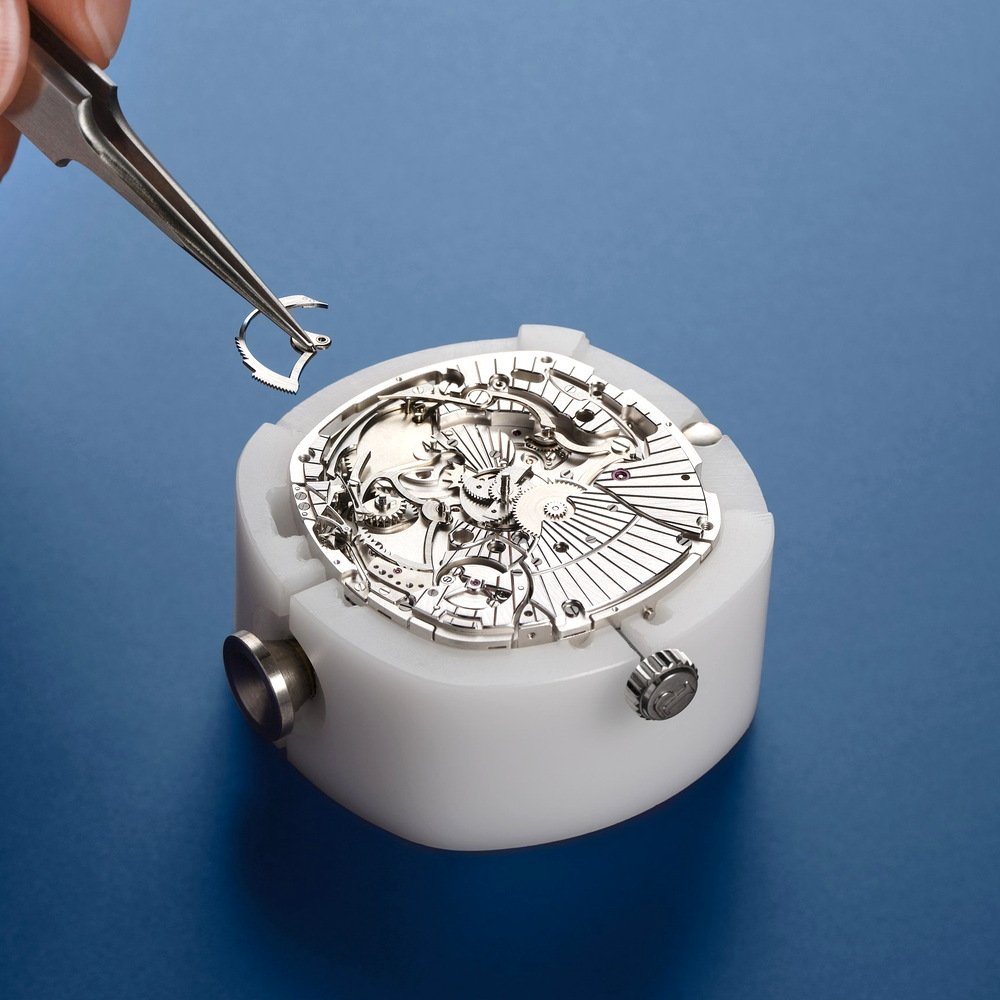
Understanding how a repeater works explains why it is so difficult. Push the slide and a spring is wound; that spring lets a set of notched discs be read, and levers falling into those notches decide how many times the hammers will strike. The watch does not read its own time. It counts it. Governing all that counting is a small regulator turning behind the dial, a brake that holds the striking speed steady and without which the tones would run into one another.
Then comes the real problem: sound. A struck steel wire vibrates, the vibration passes into the case, the case pushes the air, and you hear it. Every link in that chain wants mass and volume. A thicker case is more resonant surface, a taller case is more air, a longer wire is a deeper note.
Now consider a house that has spent its life wanting the opposite. Piaget’s entire history is built on thinness: the 9P in 1957, the self-winding 12P in 1960, and then a run of ultra-thin calibres. This is a manufacture that has spent seventy years learning to remove material. And the minute repeater is the one complication that punishes removal.
format_quote"For a striking watch thinness is not a virtue but an obstacle. Sound wants air, mass and volume, and a thin case withholds all three."
Hasan Bekmezci

Piaget’s answer to that argument is calibre 1290P: an ultra-thin, self-winding minute repeater 4.8 millimetres high and made of four hundred and thirty parts. When it appeared in 2013 it was the thinnest self-winding striking movement in the world, and the claim is still being argued over. It runs at 21,600 vibrations an hour, holds forty hours, and is designed and finished at the manufacture in La Côte-aux-Fées.
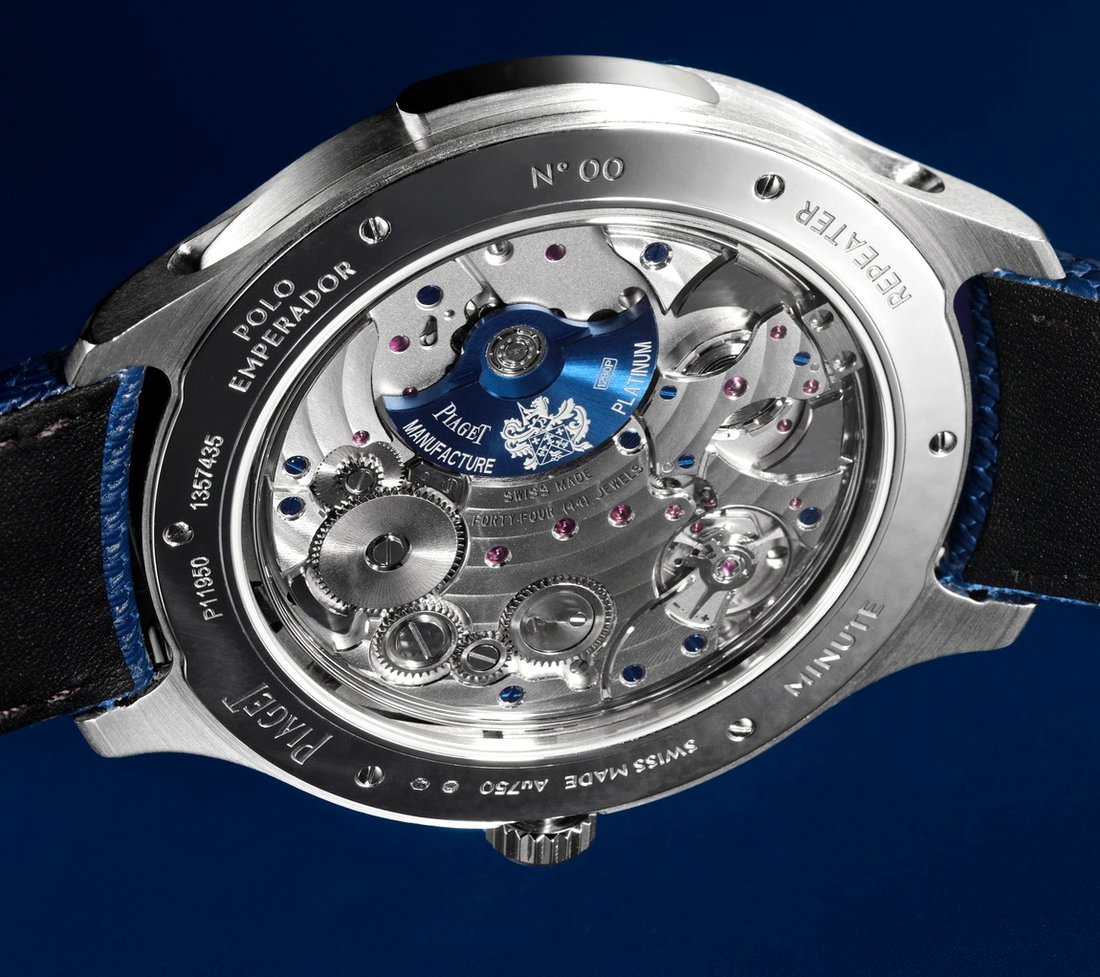
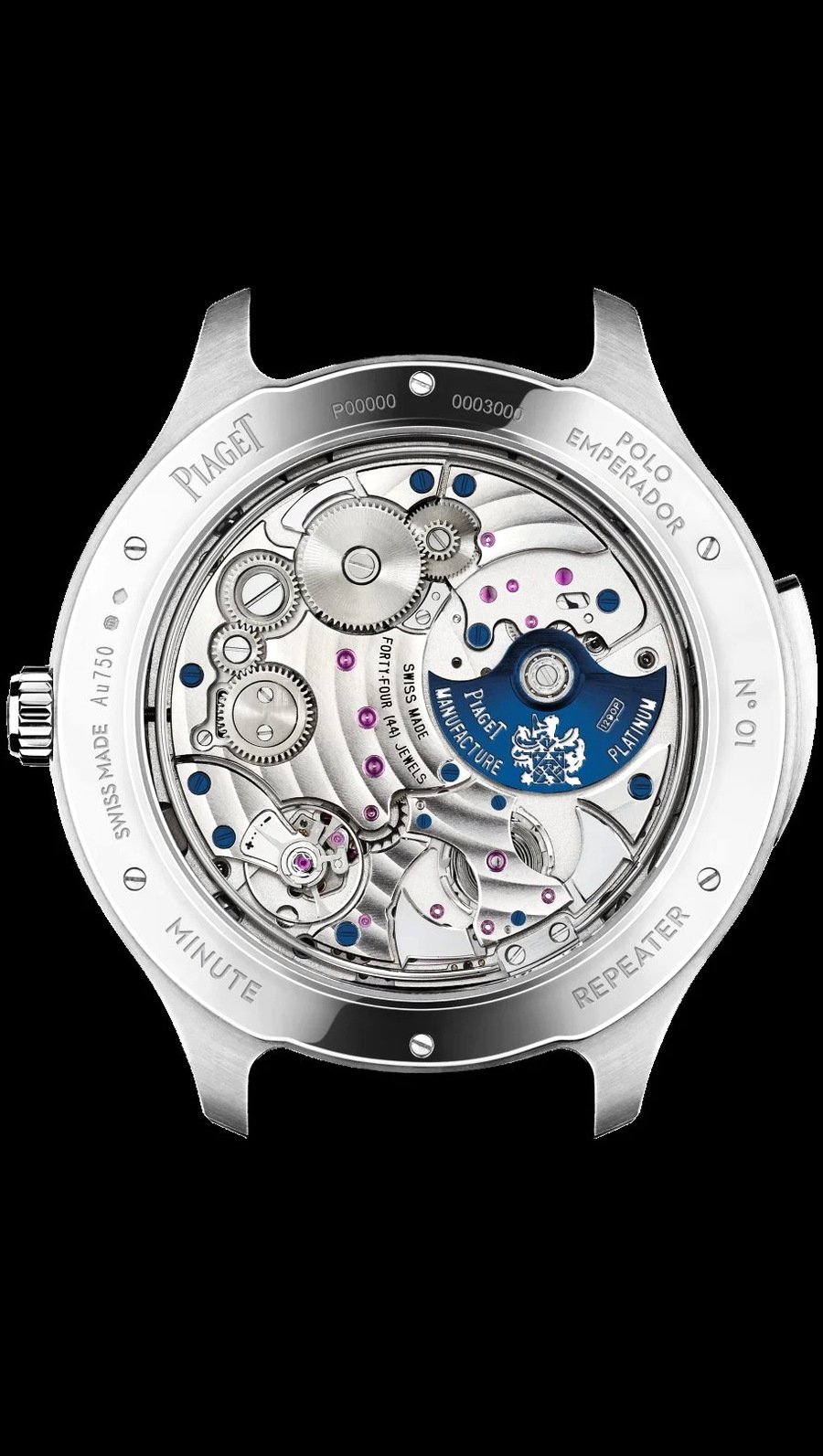
The decisive detail is in the winding. There is no full-size rotor sitting on top of the movement; instead a small micro-rotor is sunk into the mainplate, and that rotor is made of platinum. The reason is physics rather than luxury: platinum is heavier than gold and far heavier than steel, so a small disc can do the work of a large one. Where you cannot buy height you buy density. The same logic applies to sound, because a heavy thing vibrates well.
The gongs themselves are attached directly to the body of the case rather than to a plate inside it. That is not how a classical pocket repeater is built, and the aim is simple: carry the vibration outward without losing it to an intermediate layer. The hammers are finished to a mirror polish, the bridges are bevelled by hand, the mainplate is guilloché. Some of that finishing is visible and some of it is not, but none of it is ornament, because every surface that rubs swallows a part of the sound.
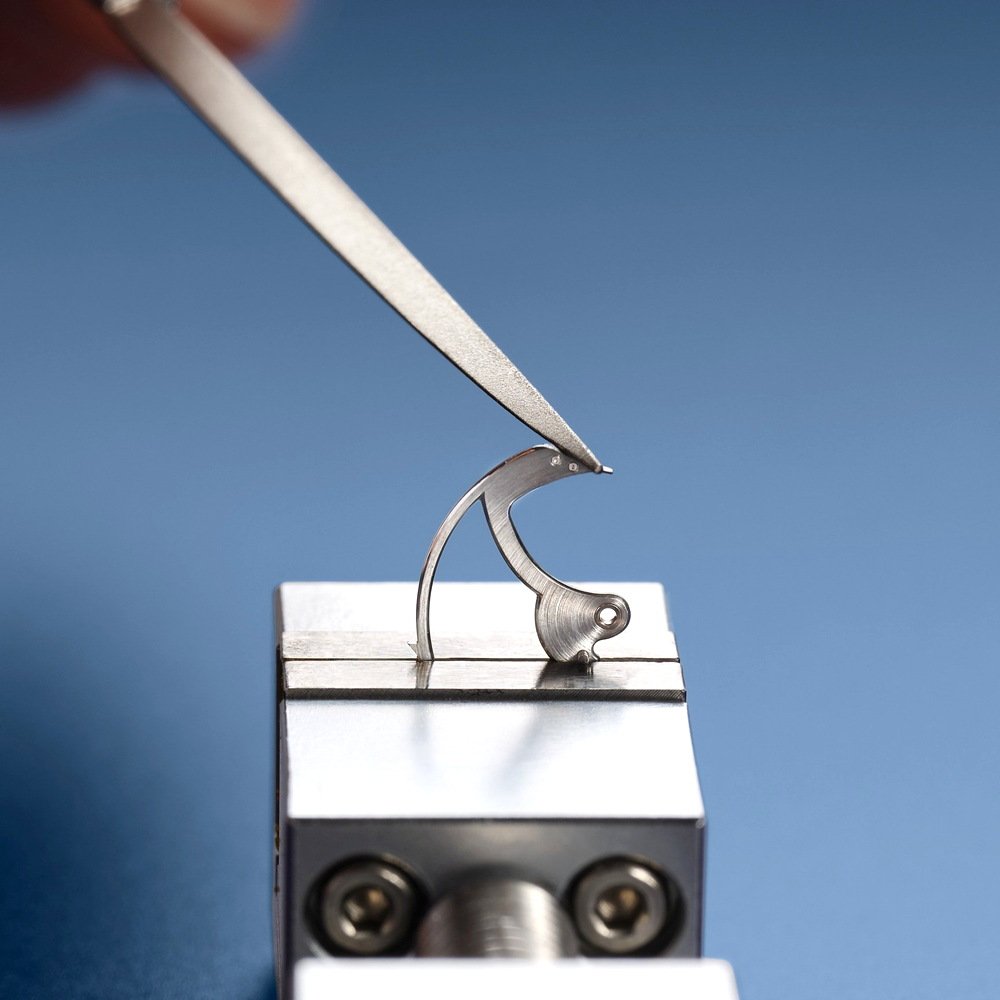
The result is measurable. Piaget quotes a sound intensity of sixty-four decibels for this watch: comfortably audible in a quiet room, lost in a café. More interesting is that the notes were chosen. The hours strike on G sharp and the minutes on A sharp, which leaves a whole tone between the two tones. That is the smallest distance at which the ear will not confuse them. Any closer and you would lose count; any further and the melody would fall apart.
Describing a watch’s sound in musical notes can look like marketing at first. It is not. A minute repeater is really a two-stringed instrument, and the tuning of those two strings is the most subjective decision a watchmaker gets to make. Dimensions can be calculated and gear ratios solved, but whether two notes belong together is settled by the ear alone.
format_quote"A minute repeater is a two-stringed instrument. Arithmetic settles the gear ratio, but only the ear decides whether two notes belong together."
Hasan Bekmezci

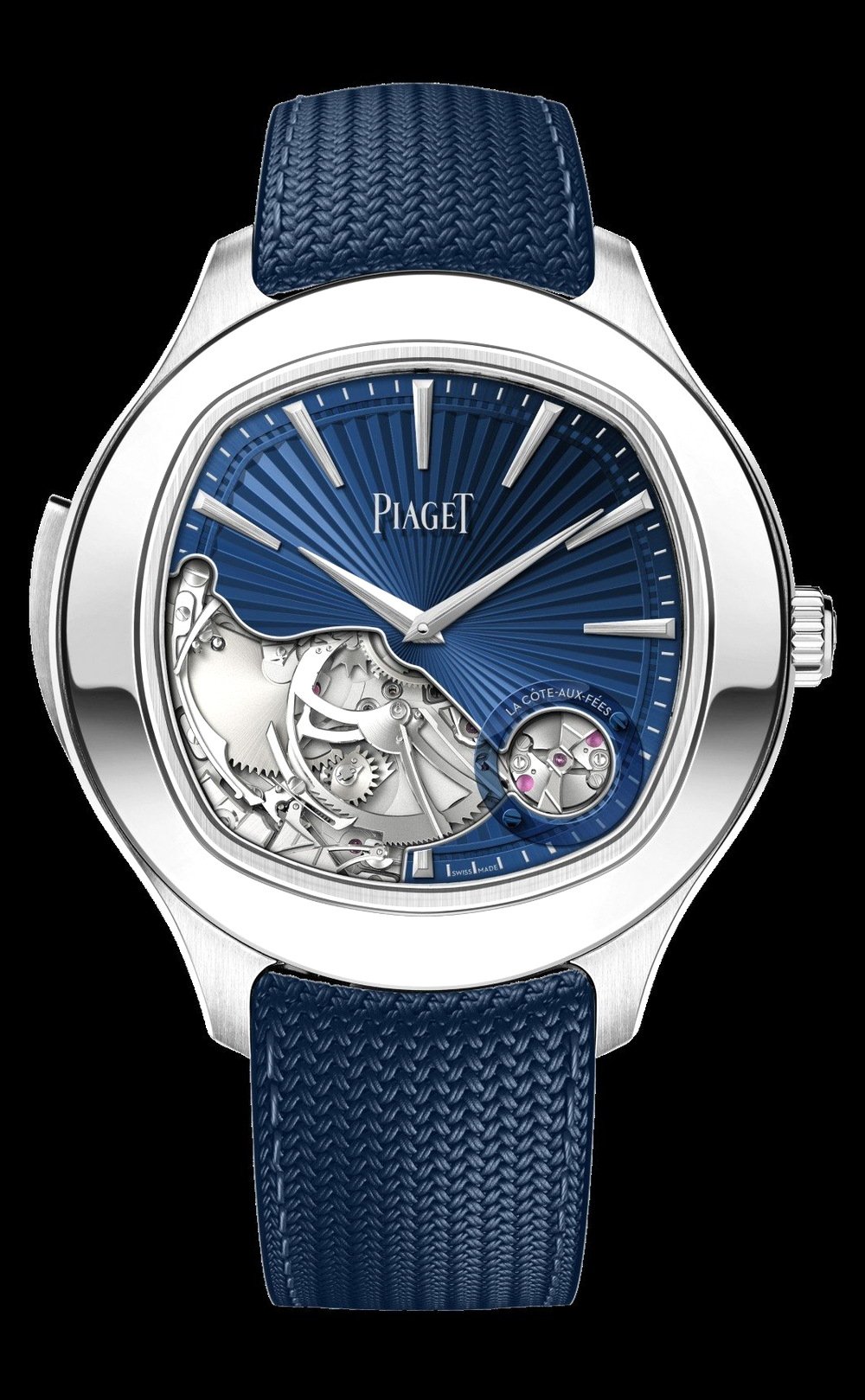
The dial is the most looked-at and least understood part of this watch. It is made of white gold, guilloché by hand and finished soleillé, which is to say with a texture radiating from the centre outward. Guillochage means cutting an unbroken web of lines into metal on a hand-turned rose engine, where a single hesitation ruins the whole surface and the work starts again. A blue coating goes over it, a blue sapphire ring is set around it, and one dial takes more than two hundred hours.
But the real decision is that the dial has been cut open. A section of the surface has been lifted away in an asymmetric aperture and the movement below left in view. At four o’clock the regulator that steadies the striking speed can be watched directly, inscribed with the name of the village where the manufacture stands. Push the slide and that small part begins to spin, so while the watch strikes you are not watching the source of the sound but its metronome.
That opening is also an acoustic choice. A closed dial is a wall in front of the sound; an open one puts a window in that wall. Piaget solved the decoration and the engineering with a single cut.


As for the case, forty-eight millimetres is an unusual figure for a Polo and it raises an eyebrow when you first hear it. Turn the watch over and the reason is written there: Polo Emperador. Emperador is Piaget’s large-case tradition, and for a striking watch a large case means more air, a longer gong and a wider vibrating surface. The size is not a fashion decision but an acoustic requirement. That the case is only 9.3 millimetres thick is the other half of the same sentence: widening the diameter while flattening the height is the only way to keep the thinness without surrendering the sound.
The caseback ring also carries a number. Five of these are made a year, and one of them is marked double zero. On the blue micro-rotor two stamps can be read: the name of the calibre and the metal it is made from.
format_quote"Showing the time is a private act. Striking it is a shared one."
Hasan Bekmezci
The strangest thing about a striking watch is that only you know whether it is working. Nobody needs to see the dial, and the case can stay under a cuff; but the moment that sound leaves your wrist and fills the room, the watch stops belonging to you and belongs to everyone present. Showing the time is a private act. Striking it is a shared one.
And there is one more detail. The tone you hear when you push that slide belongs to the same family as the tone somebody heard waking in the dark two hundred years ago. The whole difference is that what was then a necessity is now a choice. That a person will spend two hundred hours making something nobody needs is evidence of something that cannot be explained by need.