A green secret on the branch, undressing into an orange robe,
How beautifully the Great Artisan has written that scent onto a Mediterranean coin.
On the slopes of Sicily the leaf trembles whenever the breeze comes,
A healing packed in segments, waiting its hour for a human being.
That scent which drank the Sun in is a perfume held in the skin:
The Artist’s sealed cup, reminding us where our sustenance comes from.
The things we walk past every day, that we see on a market stall as an ordinary fruit, that we finish in a moment by peeling with our hands and whose skin we throw in the bin, are in fact among the highest works of engineering and of beauty in the universe. Yet the human being has a strange mastery in simplifying and devaluing the enormous phenomena that repeat endlessly in front of his eyes.
That orange mass ripening on the branch, drawing in the energy of the Sun and turning it into a chemical healing, we simply call an orange or a mandarin and walk on. Botanically it makes little difference; orange or mandarin, all these orange lanterns of the citrus family come off the same bench.
And yet the simple name we give the fruit is what makes us miss the immense art behind it and the signature of the Great Artisan. An orange tree rising from the mineral-rich volcanic soil of the Mediterranean, of the Sicilian slopes, is not a simple plant; it is a living factory composed on purpose for human biology, for the seasons and for the ecosystem.
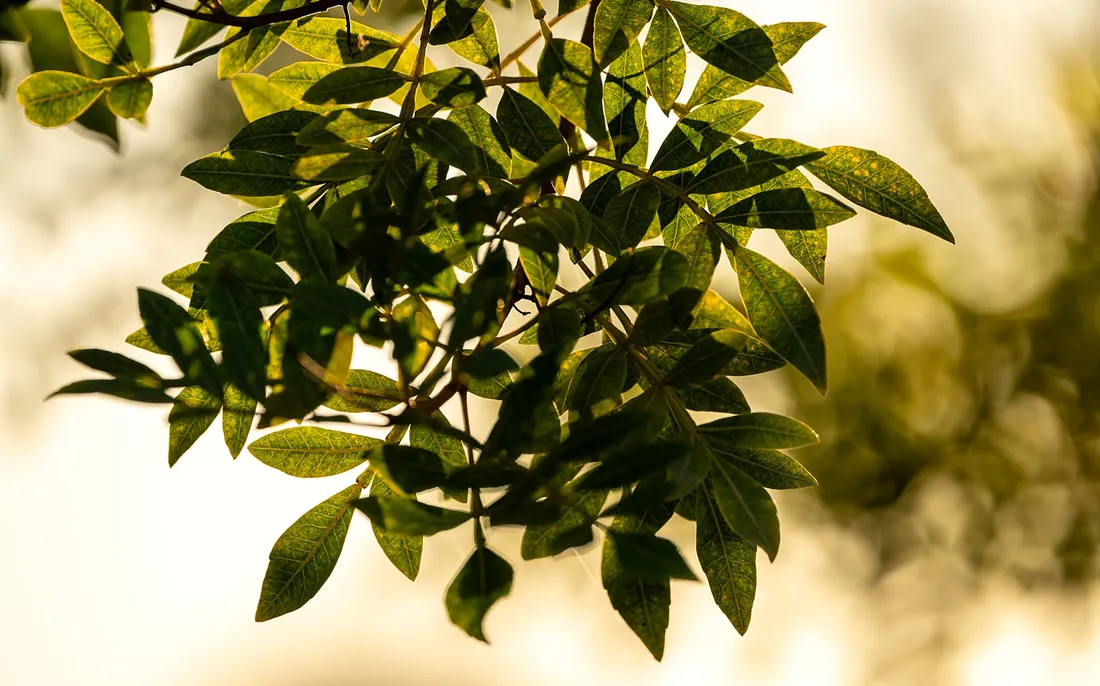
The existence of the orange is the result not of coincidence but of a conscious and merciful design. Every detail of the tree and the fruit works like a complication in high watchmaking.
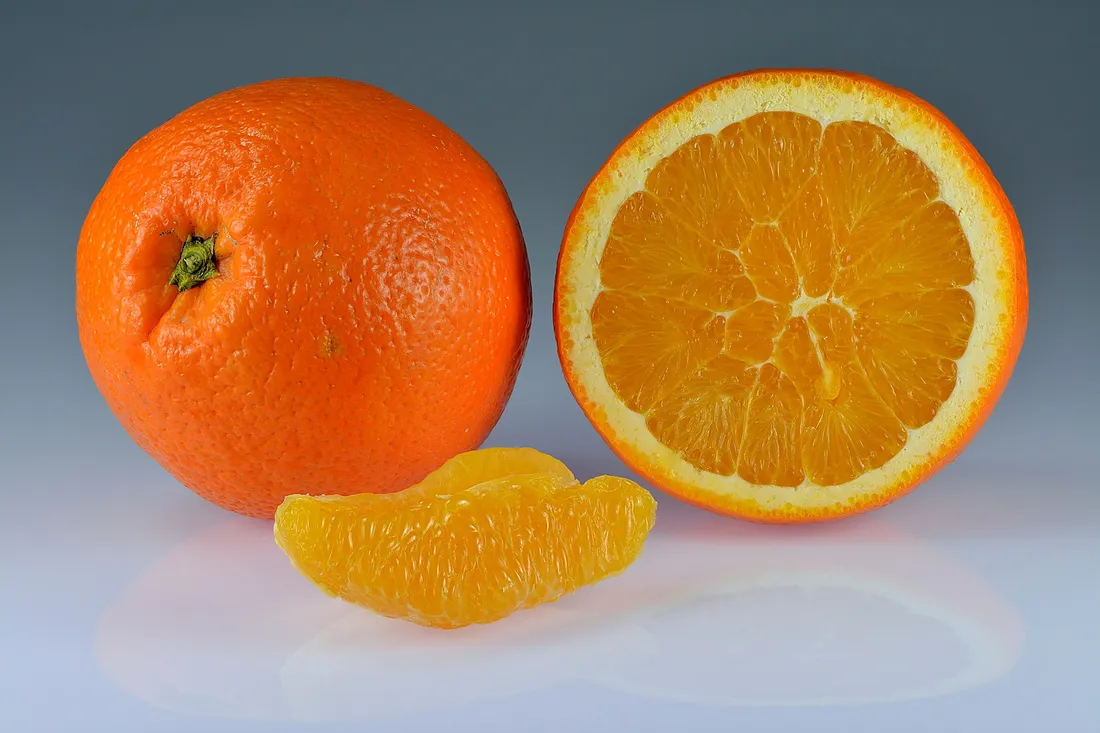
While a great many fruits are protected by hard shells, by single stoned masses or by outer layers that need a knife, the orange and the mandarin are sealed in a flexible, micro-porous skin that a person can take off without any knife at all.
What appears once the skin is off is an extraordinary piece of design. The fruit is packed not as one sphere full of liquid but in millimetric segments, the carpels, which come apart by themselves. Each segment is covered by a thin, harmless, easily digested membrane, and inside that membrane sit hundreds of microscopic juice vesicles.
It is as though the Infinite Architect had cut this offering into portions sized exactly for a human mouth and a human hand, locked the juice into microscopic sacs so that it would not spill, and closed the whole thing with an aromatic wrapping. This ready-sliced structure is an art of portioning that has the comfort and the nourishment of a human being in view.
Just as the mechanism of a fine table clock is sealed with domed glass and gaskets so that dust and damp cannot get in, the orange tree has put on a chemical armour to protect its own mechanism.
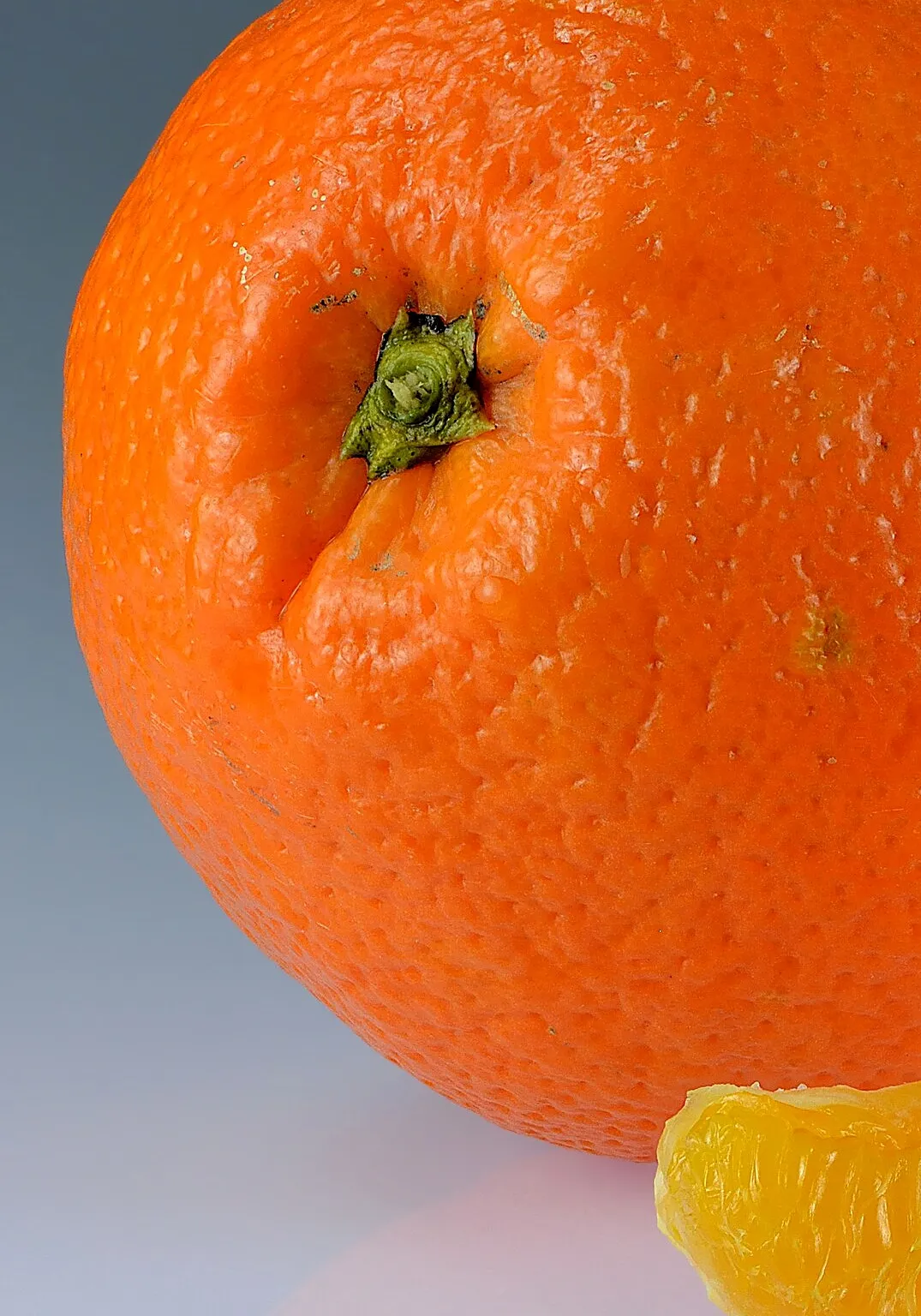
On the surface of the leaves and the skin of the orange there are thousands of secretory pockets visible under a microscope. These glands make volatile aromatic compounds such as limonene and linalool. The sharp scent that reaches your nose when you scratch the skin with a fingernail is, in fact, a few hundred microscopic oil sacs bursting.
Those scented compounds act as a deterrent shield against the herbivorous insects that try to attack the tree. Without needing any artificial help from outside, the tree puts its own existence and the photosynthetic panels in its leaves under protection.
Just as the wheels in a movement turn one another, living things have to touch for life to carry on. The orange blossom is the most lavishly funded filling station of that contact.
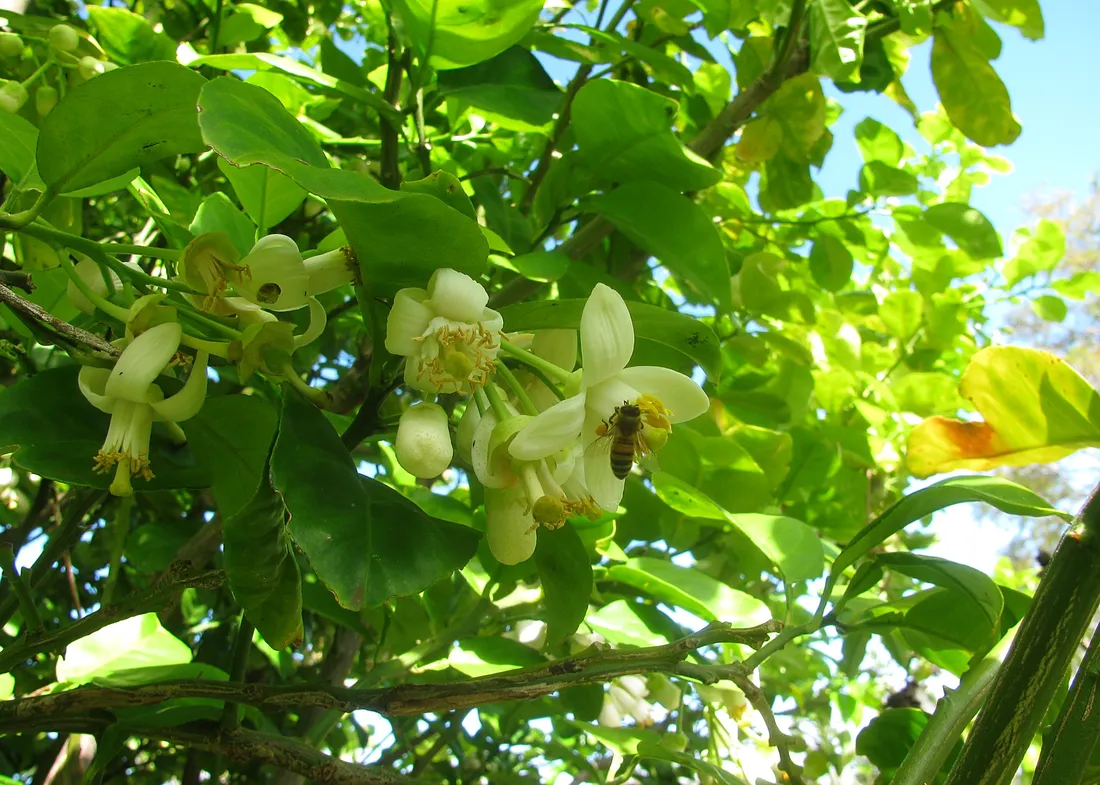
The pure white orange flowers that open in spring give off one of the densest scents in the universe. The nectar secreted deep inside the flower is a high calibre biological fuel for bees and for birds. When a honey bee settles on the flower to take that fuel, it carries pollen with it and makes the tree able to fruit. The bee is fed, the tree is got with fruit, and the wheels turn one another in perfect synchronisation.
Just as in fine watchmaking the dust of miniature enamels and the precious metals are not wasted but melted in special kilns and turned into a work of art, in that other workshop no skin is rubbish either.
Orange skins that are not harvested, or that fall to the ground, begin to be digested by the saprophytic microorganisms in the soil, in particular by certain fungi and by useful bacteria such as Trichoderma and Bacillus. As these organisms break the complex chains of cellulose and pectin in the skin with their enzymes, they release the basic minerals hidden in it, potassium, calcium and magnesium.
The citric acid and the minerals set free improve the acidity balance of the soil at a micro level, while the organic components raise the humus quality of the soil many times over, that is the blackish, water-saturated texture with a high capacity for holding nutrients. A rise in humus quality lifts both the water-holding capacity of the soil and the diversity of its microflora. The same soil then houses, for years to come, a rich cycle of life in which thousands of new microorganisms and root systems will compete and survive.
And just as potential mechanical energy enough for days is stored inside the mainspring of a table clock, the seed of the orange is a micro capsule storing the genetic code of an entire grove. The seed ripens safely inside that juicy, protective flesh. When it reaches the soil it stays asleep until it finds the right warmth and moisture. When its hour comes it bursts and rises as a new orange tree that will give people a healing for decades.
And it is exactly at this point that the great contradiction of the human being, and his blindness to beauty, come out.
The living orange, the aromatic miracle in its skin, the millimetric water sacs in its segments and the vitamin C it offers a human body in winter, we make ordinary by calling them a natural event. But the moment one of the temples of high watchmaking, Patek Philippe, works orange motifs in enamel onto a dome-shaped table clock, we are on our feet applauding.
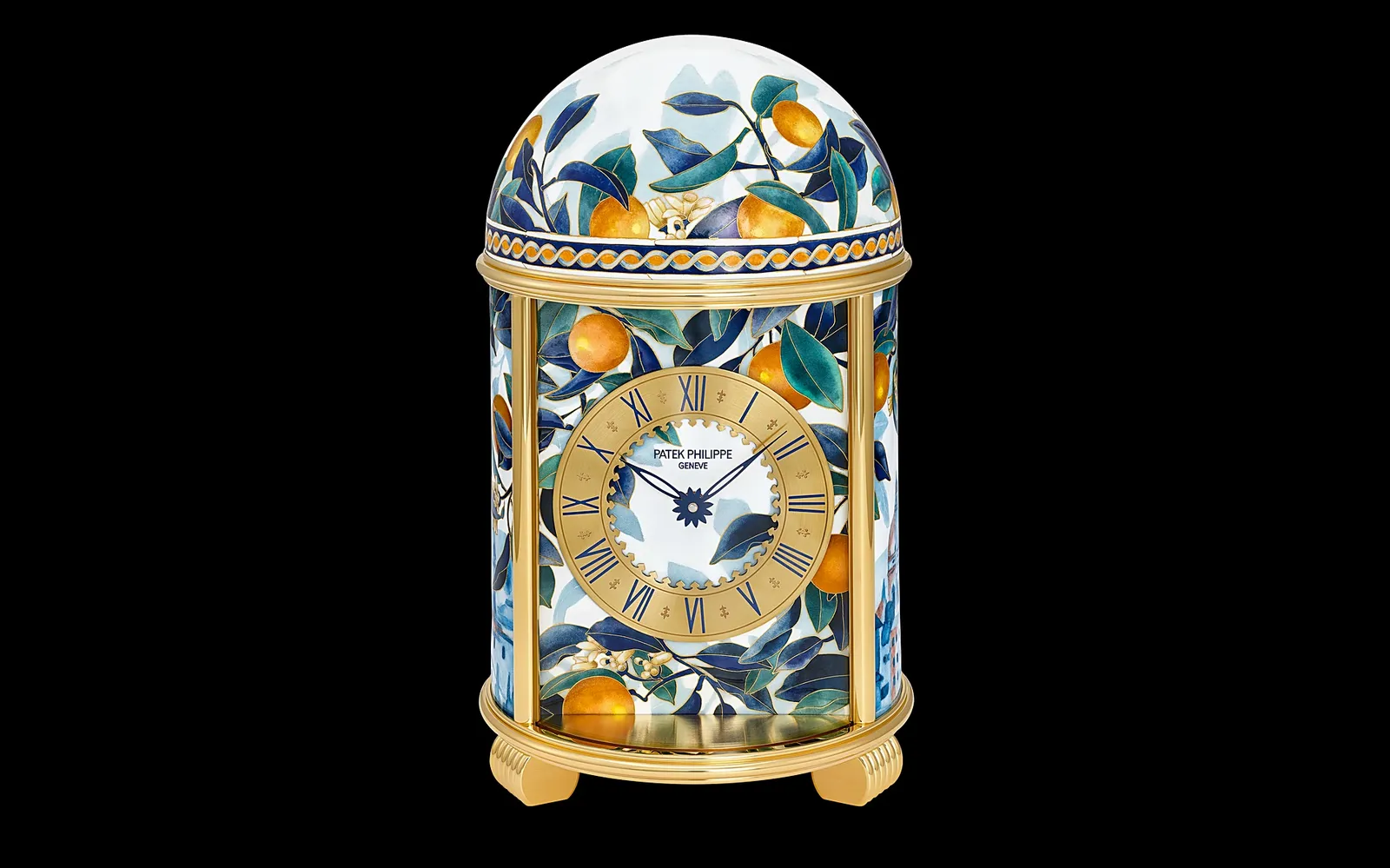
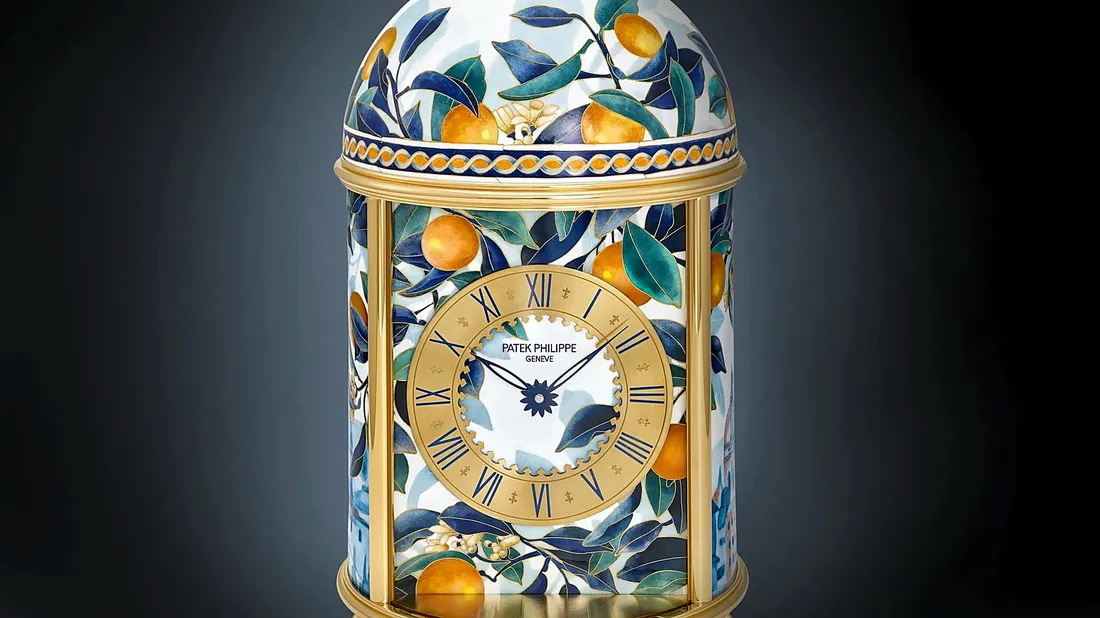
We look at the Patek Philippe Ref. 20179M-001 Sicilian Oranges dome table clock and sigh with admiration: what art, what workmanship.
But do we not stop and think? While we put the value of a fortune on that lifeless painted orange, a thing made of enamel colour on a domed glass, and declare its maker a master; how can we overlook the real artist who brought into being out of nothing the real one, the living one, the one with the scent, the one already cut into segments, the one with the taste, the one that keeps a human being alive?
format_quote"Art is not the enamel colour on a dial; it is the living thing that gave that colour its subject."
Hasan Bekmezci
There is another error. We forget the one who made time, and load the instruments that measure time with an excessive artistic value.
We look at Patek Philippe’s mechanical calibres, its gilded columns and its Grand Feu enamel, and heap great titles on these objects. We raise a storm of applause for the enameller of a clock that measures time; and we go blind to the Infinite Architect who made that time, who brings the day out of the night, who turns the Earth in its orbit at a hundred and seven thousand kilometres an hour. We look at an enamelled orange on a dial and call it art; and we forget the one who filtered the scent of that orange out of the soil and offered it to us.
format_quote"We raise a storm of applause for the enameller of a clock that measures time, and go blind to the one who made the time."
Hasan Bekmezci
Now let us look at the clock itself, because to criticise without giving a thing its due would be an injustice as well.
This piece takes the form not of a conventional wristwatch but of the domed table clock with which Patek Philippe shows the rare handcrafts that survive in the hands of only a few artisans in the world. In the maison’s own catalogue it is listed as a single piece at two hundred and eighty four thousand eight hundred euros. It stands two hundred and thirteen and a half millimetres high.
The decoration on the dome is not simple painting. By the maison’s own account the piece carries two separate visual planes, and that is the real technical achievement: the orange trees worked in cloisonné enamel in front, and the city of Palermo behind them in miniature painting on enamel. The enameller built the distance between the two planes with blurring and shading, so that there is an illusion of depth on the surface of the dome.
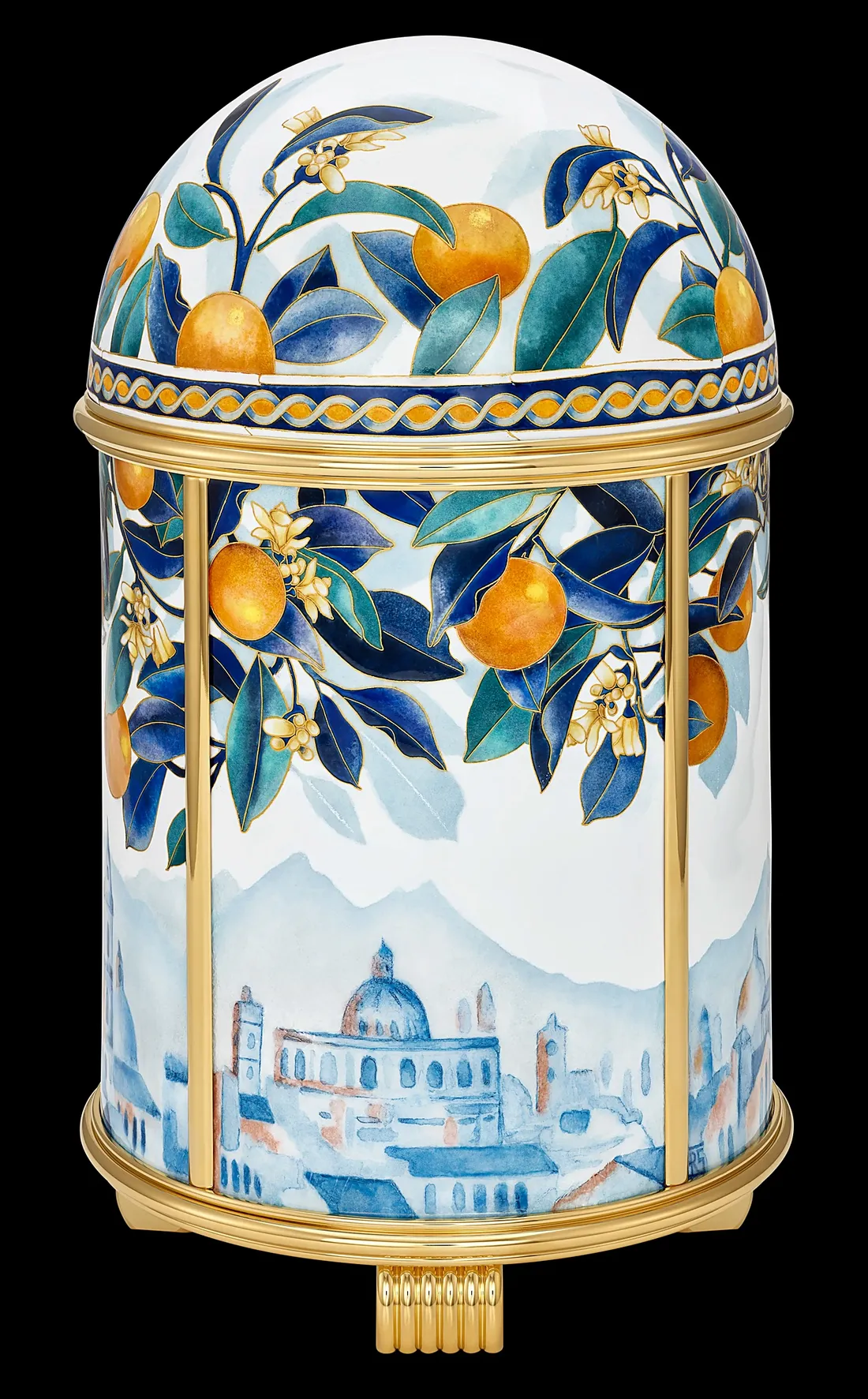
To draw every contour of the fruit, the leaves and the architectural lines in the design, about fifteen metres of gold wire weighing twenty six point eight grams in total was bent with tweezers and laid onto the piece. Fixing these wires, finer than a human hair, onto a domed surface in perfect symmetry so that they form the cells of the enamel takes weeks of patience. A millimetre of deviation in the wire ruins the proportion of the whole composition.
To bring the Sicilian landscape, the sky, the texture of the Mediterranean and the leaves of the orange trees to life, enamels in forty nine different transparent, opalescent and opaque colours were blended. In the stage of miniature painting on enamel a further four to five pastel colours were added to them. Each enamel colour melts at a different temperature in the kiln and expands by a different coefficient; to bring forty nine tones into perfect agreement on one dome calls for genius in chemistry as much as in craft.
The piece did not go through any ordinary firing. Each domed enamel plate was fired nine to eleven times at temperatures between nine hundred and nine hundred and ten degrees. Enamel powder vitrifies and melts at every entry into and exit from the kiln, and on a curved surface that has been through that heat cycle eleven times the risk of cracking, blistering or losing colour multiplies. The enameller has to manage the heat to the last degree so that the work is not destroyed at the final stage.
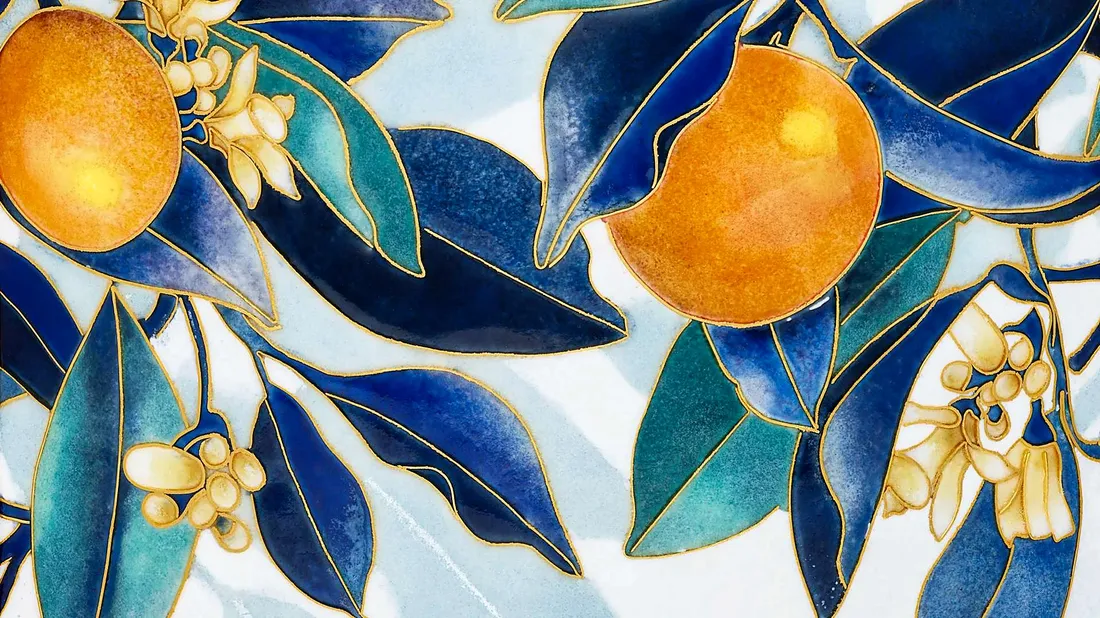
The Patek Philippe artisan works for months to bend fifteen metres of gold wire, to blend forty nine colours and to sweat this dome through eleven passes of a kiln at nine hundred and ten degrees. And the orange tree in that same garden weaves, out of the breast of the soil, cell walls many times finer than those gold wires. While the artisan’s kiln bakes at nine hundred and ten degrees, the real Artist filters the fifteen million degrees in the core of the Sun across a hundred and fifty million kilometres and bakes it into the skin of the orange and into its ready-cut segments, without a crack, to a perfect consistency.
The dial has a story of its own. The hour circle is modelled on the clock of a Sicilian church; applied Roman numerals are transfer-printed in blue, and the hands are pierced, blue-lacquered and leaf-shaped. At the very centre of the circle stands an ornament cut out of metal in the form of the sun. So the Sun that ripens the oranges on the dome has been set once more at the centre of the dial, this time cut out of metal.
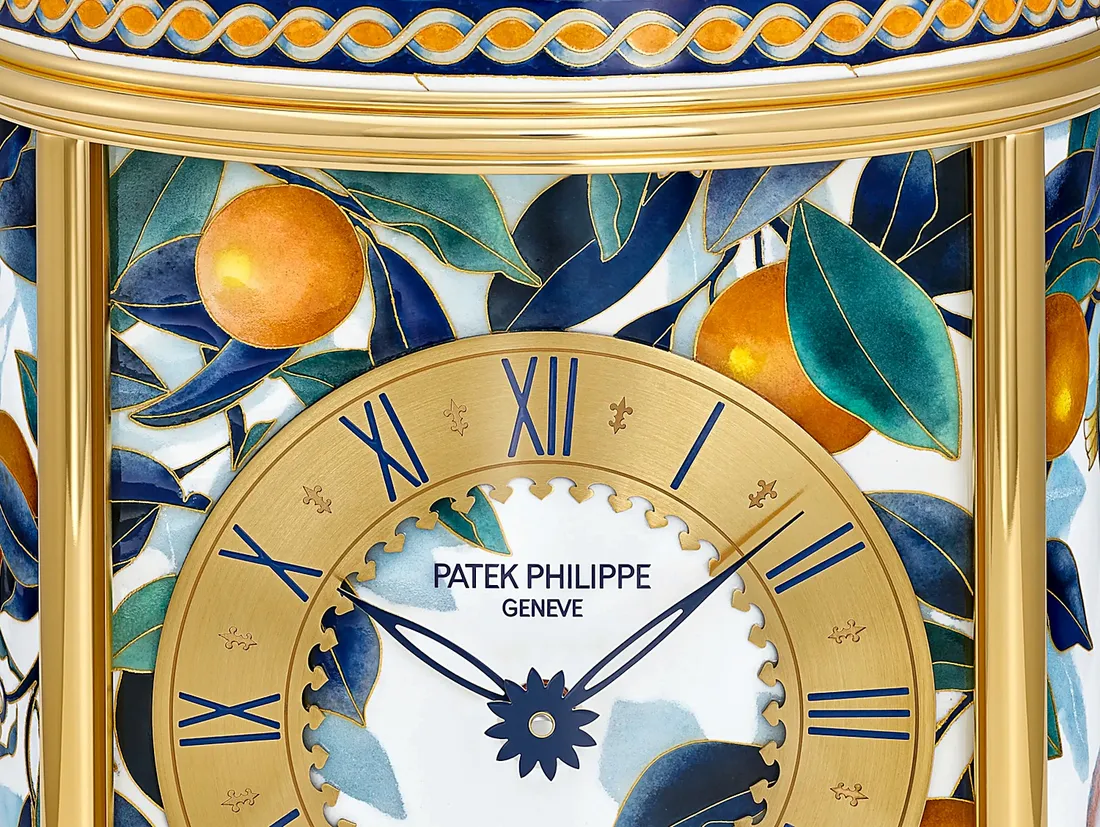
Inside runs the calibre 17 lignes PEND. It is mechanical, but its winding is done by an electric motor, so the mainspring is wound not by hand but quietly and continuously. The movement is thirty eight point six five millimetres across and three point seven millimetres thick.
The motor and the wheels measure time without stopping. But however magnificent the columns of that mechanism may be, they cannot carry out the circulation of water inside a fruit, the wheels of photosynthesis, or the making of energy in a cell. The mechanism of the clock was built to measure time; the orange in the garden was built to keep a human being alive inside time.
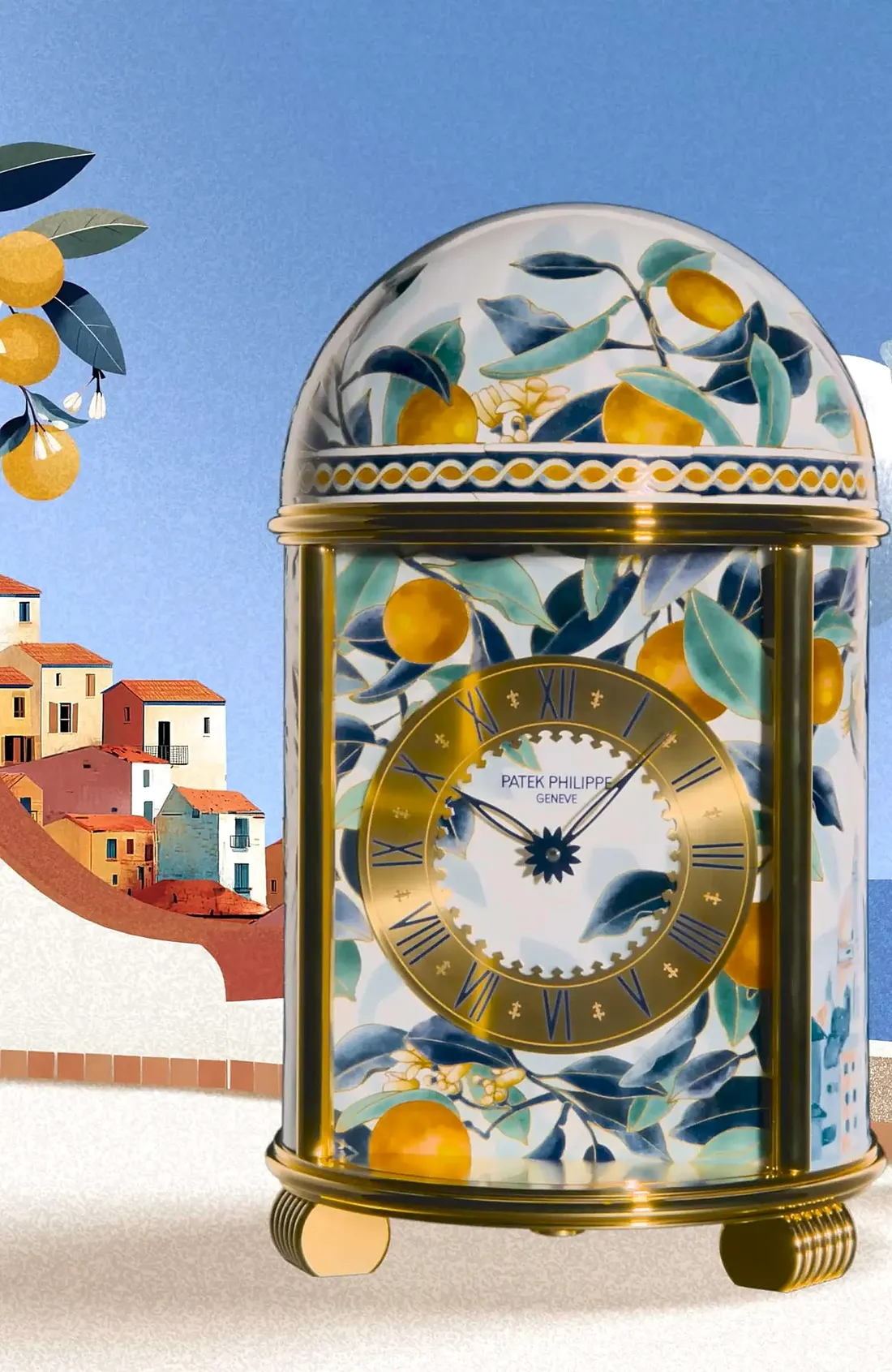
The piece can be seen at this moment. Patek Philippe’s Watch Art Grand Exhibition in Milan is the seventh of the series and the first in Italy; it is open at the CityOval in the CityLife district from 2 to 18 October 2026, and entry is free. Some five hundred timepieces and objects are on show, along with more than ninety pieces lent by the Patek Philippe Museum in Geneva.
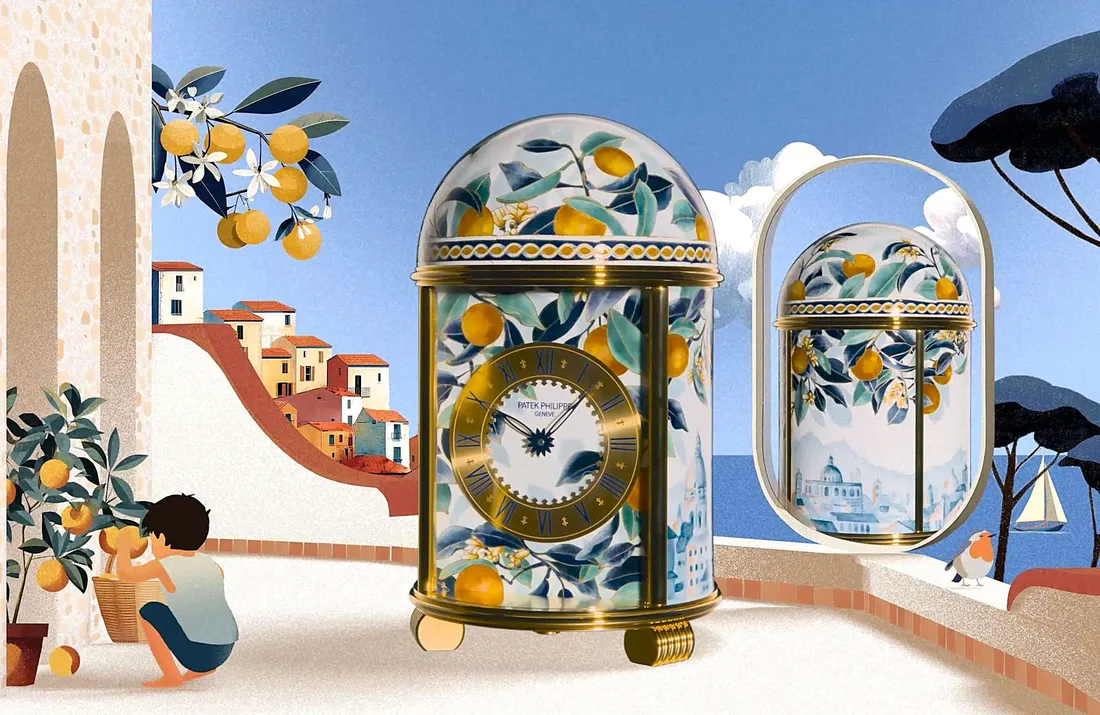
Looking at this dome, and at the same moment thinking of a living orange swinging from a branch on a Sicilian slope, this is what should come to mind: art is not the enamel colour on a dial; it is the living thing that gave that colour its subject. Just as that orange motif worked onto Patek Philippe’s dome clock with fifteen metres of gold wire and a palette of forty nine colours could not exist without a master enameller, so the one who brought into being the living orange, its segmented architecture, its taste, its scent and its soil is the Great Artisan.
However magnificent the instruments that measure time and the luxurious table clocks may be, they are only servants of a created time. The real applause, the real contemplation and the real wonder belong to the one who made time, who turns the seasons, who draws orange healings out of the soil and who gave the human heart this sense of beauty.
All of existence is a living and sealed dial, crying out His art.
format_quote"All of existence is a living and sealed dial, crying out His art."
Hasan Bekmezci
The clock on its maker’s own site: Patek Philippe, Ref. 20179M-001 Sicilian Oranges