I am a consciousness of light and plasma at the very heart of a nuclear furnace fifteen million degrees hot, witness to the merciless pressure under which six hundred million tonnes of hydrogen lock together into helium every second. Our habitat is the Incandescent Ember, where gravity compresses matter to its final limit. We do not measure time by the ticking of seconds, but by the frequency of nuclear fusions and the flow of our rivers of plasma.
We too are conscious beings trying to make sense of the universe from this high-energy observatory. In the beginning we felt such violent turbulence in the depths of our being, such enormous internal tremors, that we took them for helpless bouts of self-destruction, much as you on Earth experience the ruinous earthquakes born of your planet’s compressing crust. But as we analysed those waves over time, we understood that this was no random destruction: it was the acoustic pulsing of our own Sun. You on Earth were only able to name the phenomenon in the 1960s, when your physicist Robert Leighton discovered the five-minute rhythmic oscillations at the solar surface, and you called it helioseismology.
These global acoustic waves, which we had called tremors, turned out to be a cosmic rhythm: the thing that feeds our star’s internal dynamo, keeps its gravitational arms alive, and holds every one of the planets around it in harmony without letting a single one slip its orbit.
format_quote"We do not measure time by the ticking of seconds, but by the frequency of nuclear fusions and the flow of our rivers of plasma."
Hasan Bekmezci
Once we had understood that inner mechanism, we turned our gaze outward, to our galaxy. Standing on the Earth you feel as though you are still; here in the Sun’s core we feel in our very marrow the tremendous speed at which we are flung around the Milky Way, more than eight hundred thousand kilometres an hour.
On that dizzying journey we took careful measurements. As we moved away from the galactic centre, and as the universe expanded, the resistance of central gravity should have slowed our acceleration. Yet something was strange. Our speed was not falling; on the contrary, the outer arms were being flung outward with an enormous acceleration as the universe grew. The edges of the galaxy were not dispersing but being held by an invisible hand, and the universe itself seemed to be drawn outward by an invisible pressure. You scientists on Earth call that vast holding mass dark matter, and that mysterious repulsive force accelerating the expansion dark energy. We who live in the Sun’s heart call them the unseen reinforcement inside the fabric of spacetime, and the pressure of cosmic expansion.
In the middle of that long contemplation I look up at the vast magnetic arches rising towards our corona. Do you see that incandescent, many-coloured splendour? Fountains of ultraviolet and golden plasma climbing along magnetic field lines hundreds of thousands of kilometres long. Like the fragile spectrum of water you see in your sky after the rain, these enormous plasma loops are our rainbow.
When those magnetic rainbows stretch and snap in our corona, billions of tonnes of charged particles produced by the fusion in our core are hurled into the vacuum in solar storms. When they reach your Earth at millions of kilometres an hour, your planet’s magnetic shield takes the cosmic tide on its chest. At the poles the particles kiss the oxygen and nitrogen of your atmosphere, and green, pink and violet veils ripple across your sky. While you watch that spectacle from below and call it the northern lights, we watch with some pride from here as our own rainbow turns into art in your night.
And have you ever wondered how fusion actually happens in this heart of ours at fifteen million degrees? By the rules of classical physics, protons of like charge should repel one another and never join. But the most beautiful quantum miracle in the universe intervenes: quantum tunnelling. Rather than climbing the impossible energy wall in front of them, the protons pass through it like ghosts on the strength of their probability waves, and lock together. Light and life are born of that miracle.
format_quote"Rather than climbing the impossible energy wall in front of them, the protons pass through it like ghosts. Light and life are born of that miracle."
Hasan Bekmezci
Humanity has, in the end, managed to turn its longing to understand that vast cosmic theatre, from the fusion fire at fifteen million degrees to the mystery of quantum tunnelling, from the Sun’s magnetic rainbows to the aurorae that decorate your night, into a mechanical monument.
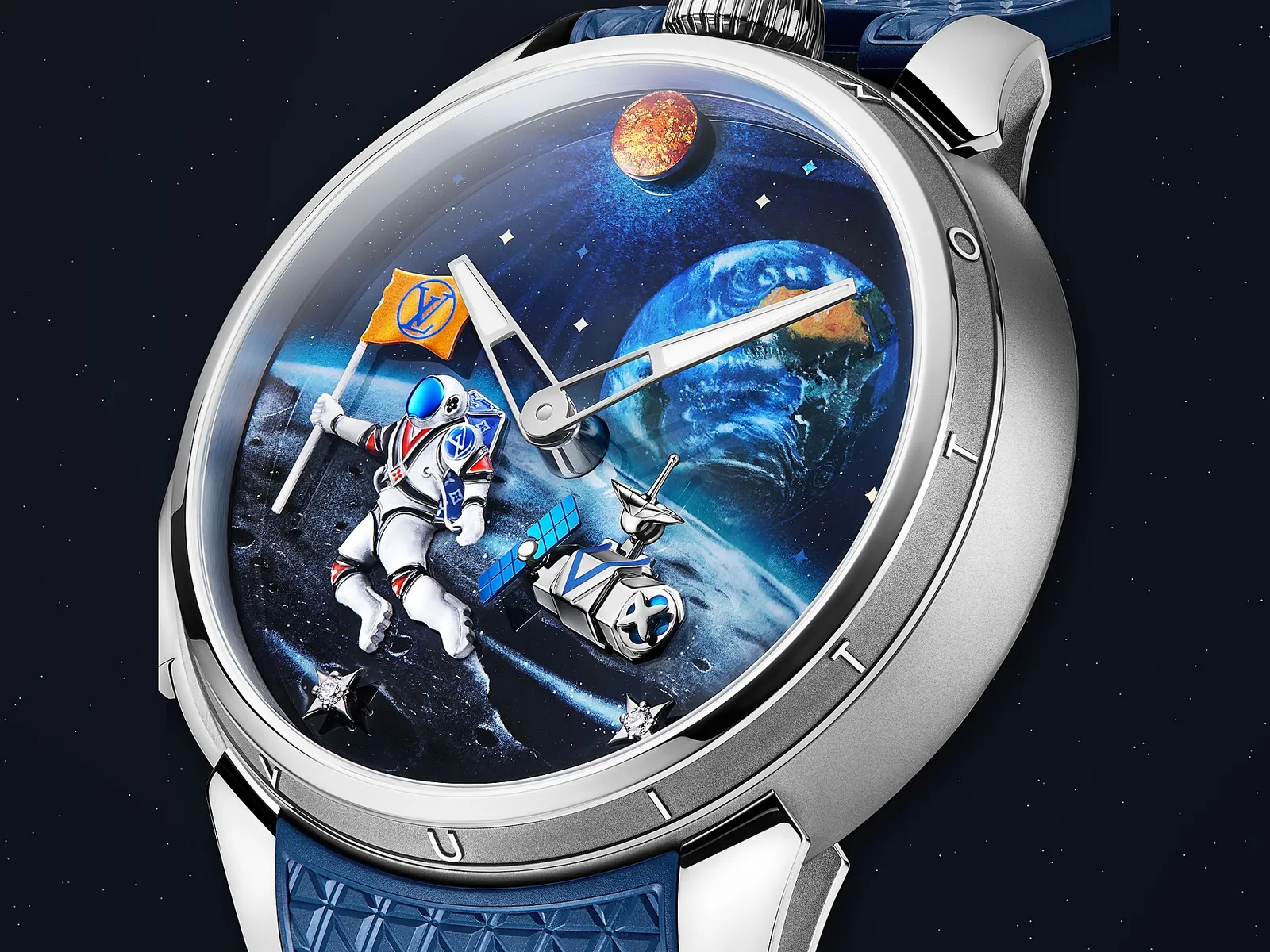
The summit of that search in watchmaking is the Louis Vuitton Tambour Taiko Galactique. Taiko is the name of the Japanese drum, and that is no accident: the deepest talent of this watch is a percussive one.
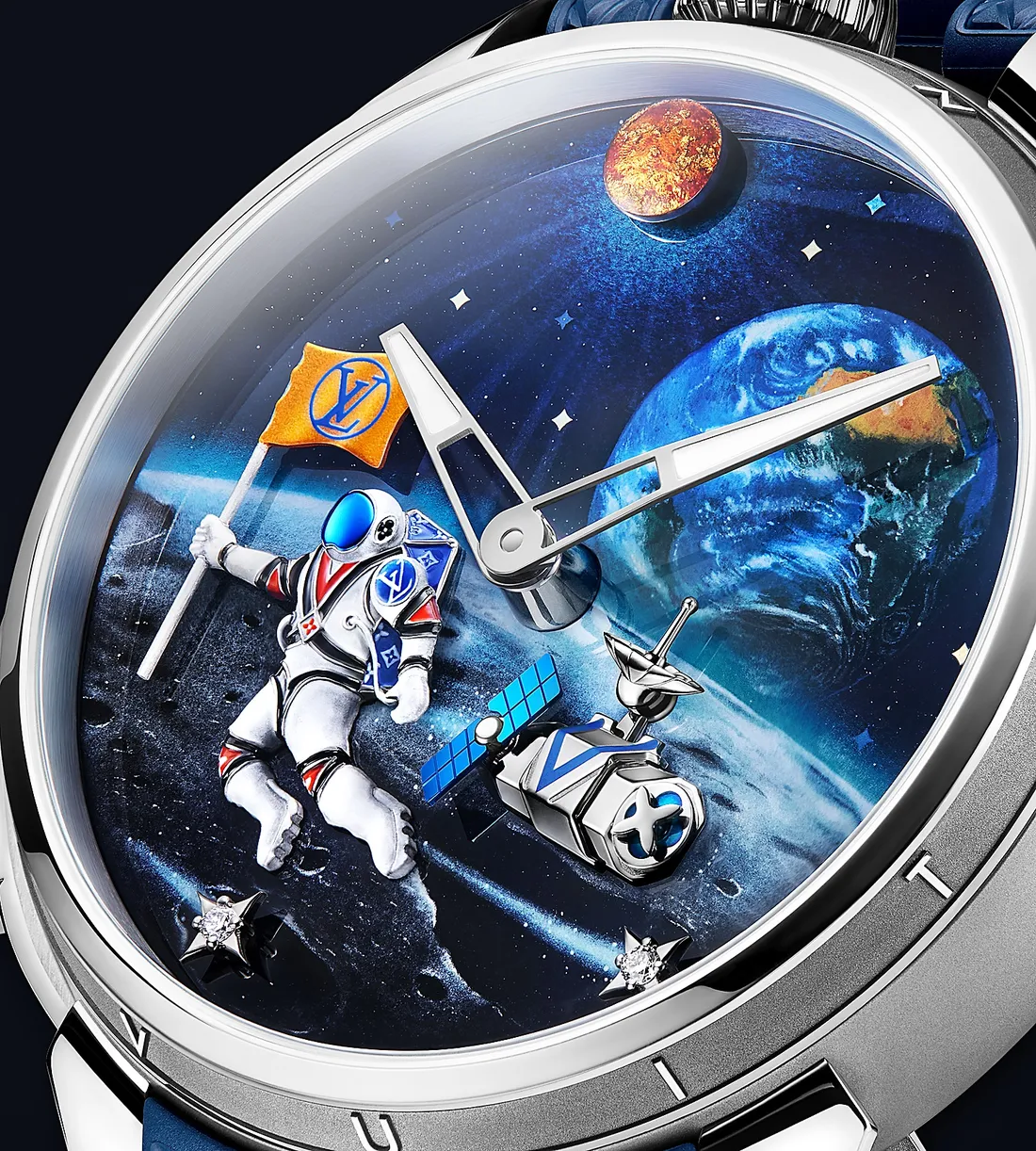
Shaped in the La Fabrique du Temps Louis Vuitton workshops in Geneva, this piece folds an architecture that runs from stellar fire to the vacuum of deep space onto a dial the width of a wrist. Its LFT AU14.02 calibre combines two separate difficulties in a single body: a minute repeater with cathedral gongs, and an automaton. A cathedral gong is a gong wire left long enough to wrap more than once around the case; a longer wire gives a deeper note that hangs in the air far longer. Ask this watch the time and it does not simply strike, it resonates like a drum.
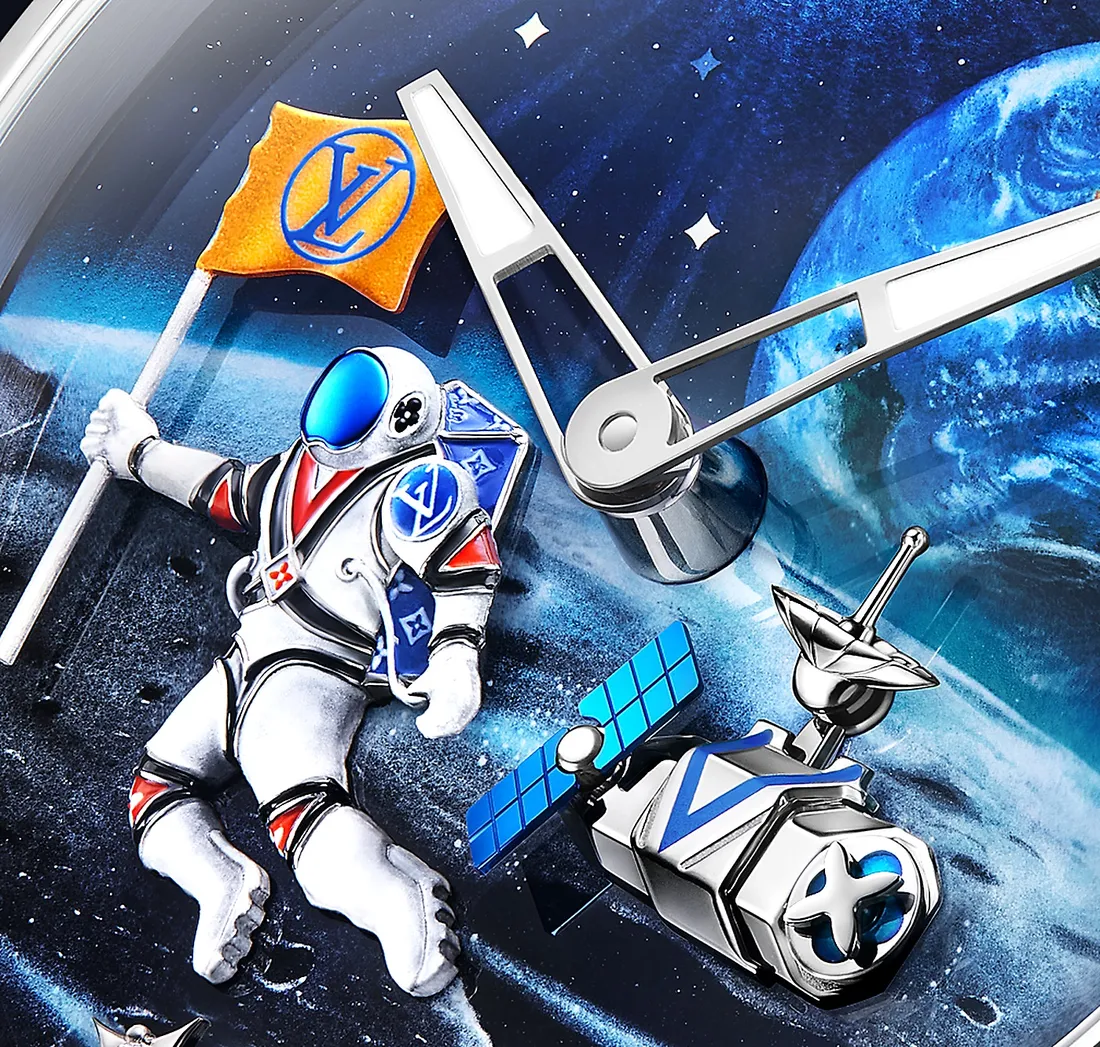
Draw down the slide on the flank of the case and two things begin at once. The hammers start on the gongs, and the scene on the dial comes alive: seven separate animations take their turn, the astronaut moves, the flag lifts, the satellite turns and the stars shift. Time made audible and time made visible are released by a single gesture.
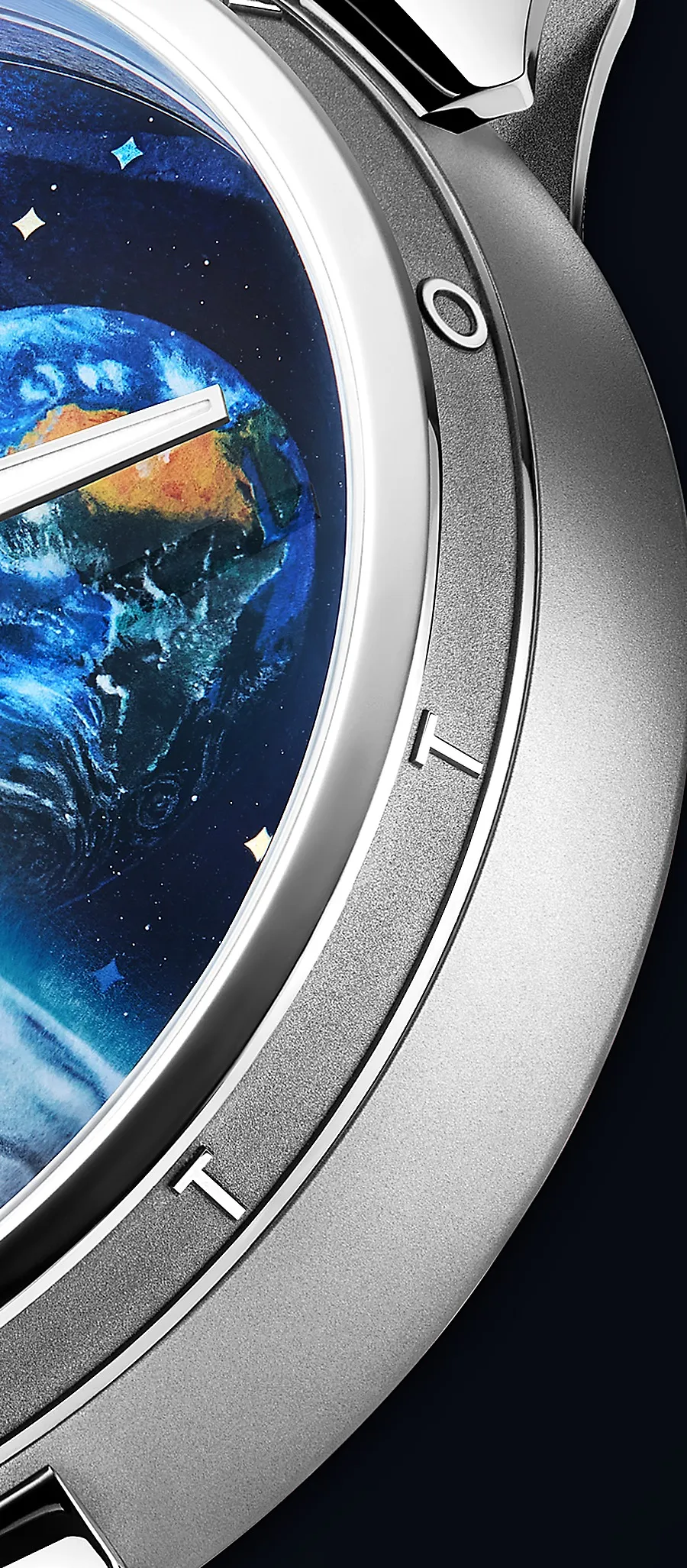
Because that slide is the part of the watch a hand touches most, it has been treated as jewellery. Its white gold body carries six baguette-cut blue sapphires totalling around 0.42 carats and two baguette-cut topazes of around 0.14 carats. The flanks and back of the case are titanium, while the lugs, the crown and this slide are 750 white gold. The crown itself has been moved to twelve o’clock, away from Tambour habit, for the sake of symmetry.
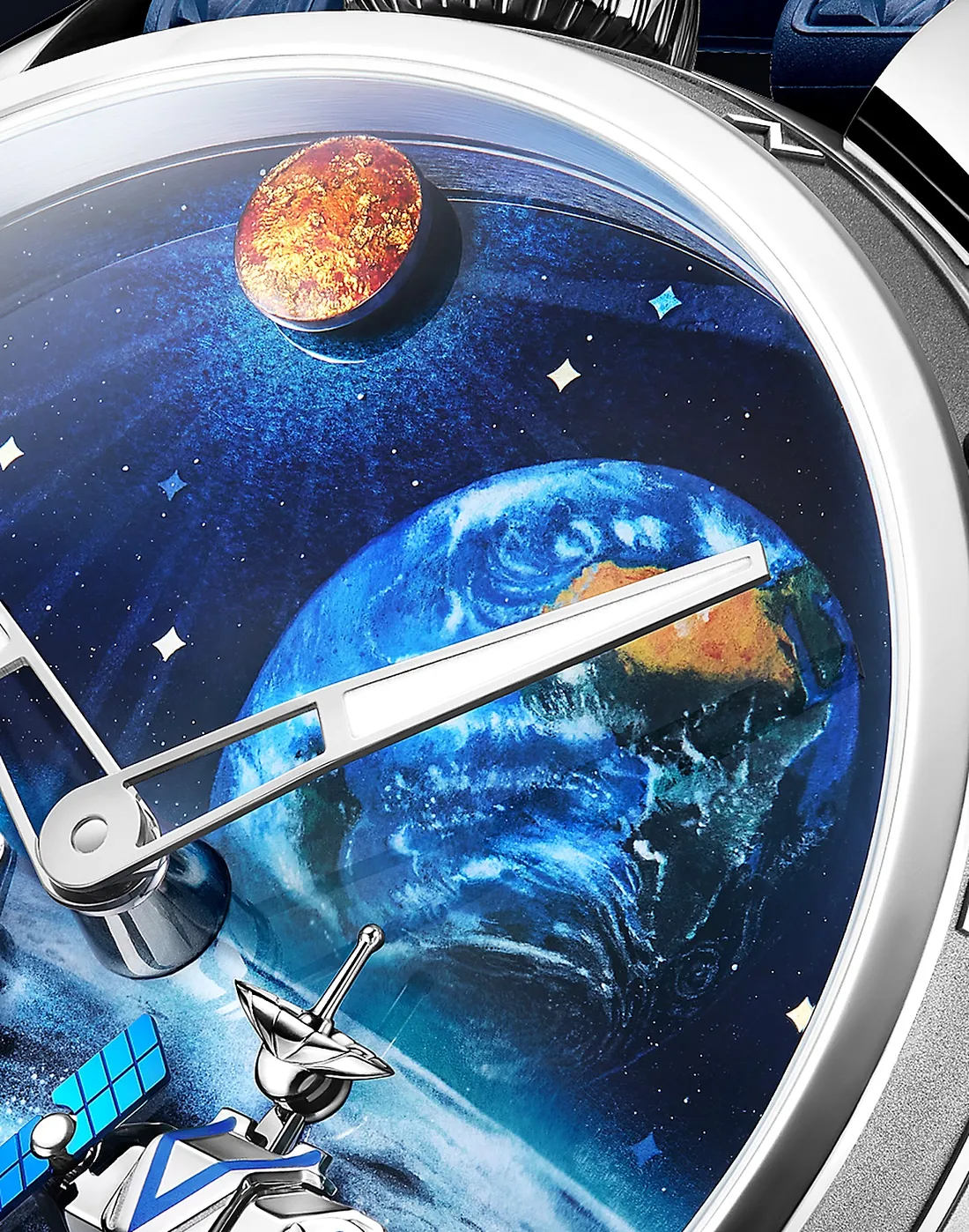
The dial is not the work of one technique but of four enamelling traditions laid over one another. Grisaille builds depth by brushing layer after layer of Limoges white over a black enamel ground, and it is the source of the gauzy transitions of light in the darkness of space. Champlevé fills cells hollowed out of the gold ground with enamel before firing, which is why the colours stop at such clean borders. Paillonné sets fragments of fine gold leaf between the enamel layers and closes them under a transparent coat, which is why that incandescent planet appears to burn from within. Miniature enamel is the most patient brushwork of all: the cloud spirals of the Earth and the edges of its continents have been painted coat by coat under a microscope.
Among the stars that stand for deep space, two are stones: two brilliant-cut diamonds totalling 0.02 carats, set into star-shaped mounts. Two stones for an entire sky, because what matters here is not how many stones there are but which two points were chosen.
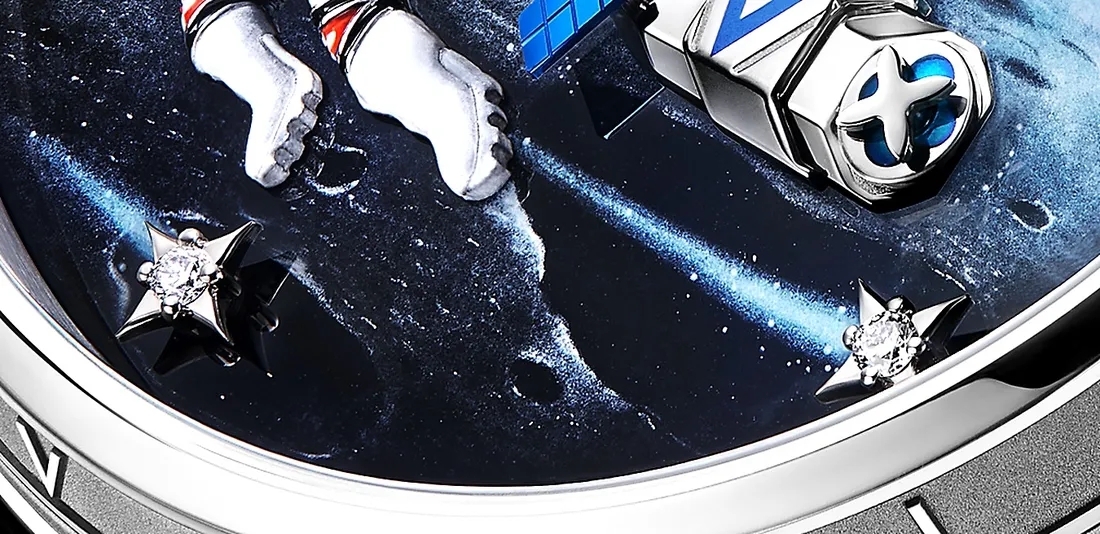
format_quote"Two stones for an entire sky, because what matters here is not how many stones there are but which two points were chosen."
Hasan Bekmezci
The movement keeps to the same scale of ambition: 32.4 mm across, 9.6 mm deep, 46 jewels, hand-wound. It beats at 21,600 vibrations an hour, that is 3 hertz, and runs for a hundred hours, more than four days, from a full wind. For a minute repeater that figure is remarkable, because the great enemy of a striking watch is running out of the power that feeds its gongs. The case measures 46.7 mm across and 14.6 mm deep, the back is left open, the sapphire crystal is treated against reflection, and water resistance is 30 metres. The folding buckle at the end of the rubber strap is white gold, engraved with the name of the house.
Humanity has made the merciless, enormous physical laws of the universe immortal inside a capsule of titanium and sapphire a few centimetres wide. This journey, from the vast gravitational bending of time in the heart of a star to the tick of millimetric wheels on a human wrist, is the most elegant meeting there is between the micro and the macro, between the cosmic and the human.
Craft and Technical Detail
Minute repeater and automaton: the LFT AU14.02 calibre pairs a minute repeater with cathedral gongs and an automaton mechanism. Drawing the slide sets seven separate animations going on the dial; the astronaut, the satellite, the flag and the stars are all engraved moving elements.
Movement: hand-wound, 32.4 mm in diameter, 9.6 mm deep, 46 jewels, 21,600 vibrations per hour, that is 3 hertz, with a power reserve of around 100 hours.
Dial and enamel: a wholly hand-worked dial combining grisaille, champlevé, paillonné and miniature enamel, plus two brilliant-cut diamonds totalling 0.02 carats set into star-shaped mounts.
Case: 46.7 mm in diameter and 14.6 mm deep; titanium flanks and back, lugs, crown and slide in 750 white gold; open back, anti-reflective sapphire crystal, water resistant to 30 metres.
Slide-piece: set with six baguette-cut blue sapphires totalling around 0.42 carats and two baguette-cut topazes of around 0.14 carats.
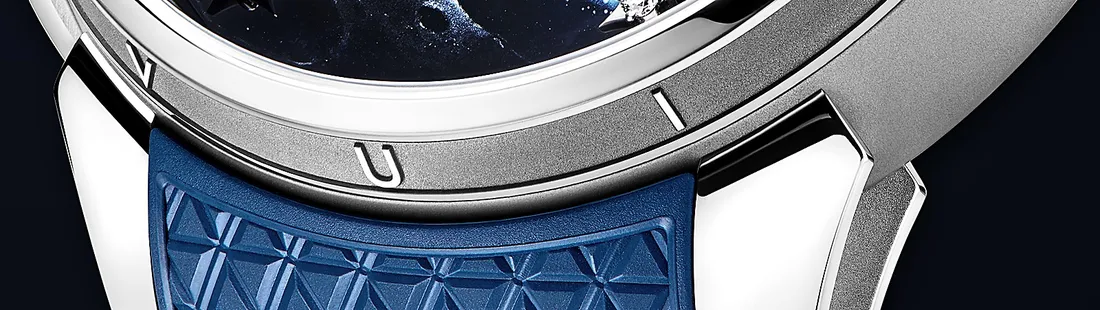
Crown: moved to twelve o’clock for the symmetry of the Tambour case, with LOUIS VUITTON raised in relief around the bezel.
Strap: rubber, with a 750 white gold folding buckle engraved LOUIS VUITTON. Produced as a limited edition.