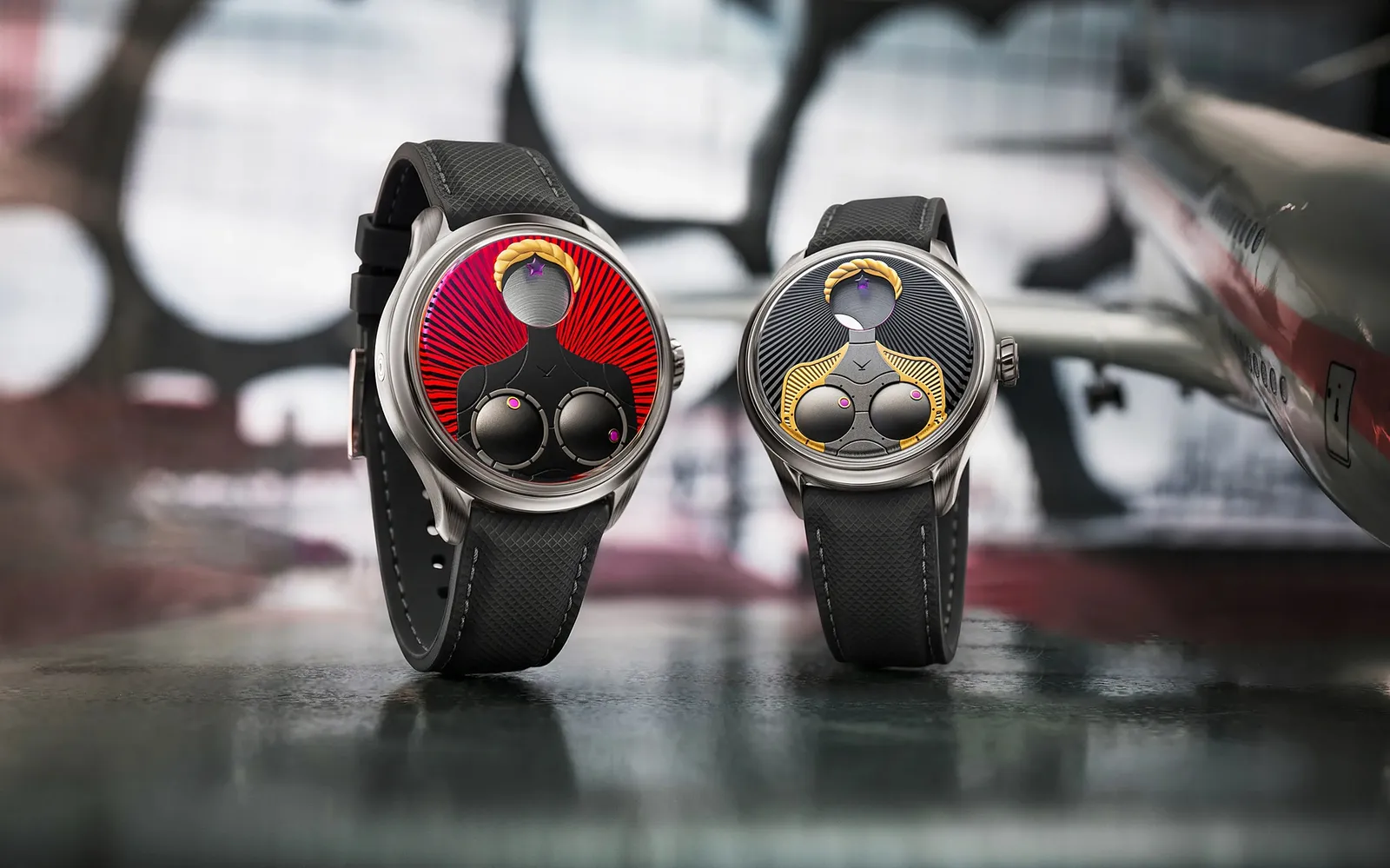
One of the oldest paradoxes in human history is the fine line between the unerring order of the universe and the freedom a person finds in their own choices. Our minds fall now and then into the error of reducing the universe to an absolute mechanism, and the human being to an automaton among its wheels, carrying out the commands it is given.
A contemporary and aesthetic reflection of that error meets us in the retro-futurist atmosphere of Atomic Heart, the neo-brutalist masterwork of the video game world, while Konstantin Chaykin, the boundless genius of independent watchmaking, turns the same ontological question into a micromechanical object that brings it together with high watchmaking.
The game, by the Mundfish studio, is set in an alternative Soviet Union of 1955, a retro-futurist world of advanced technology and humanoid robots. The twin ballerinas move as the personal guards of Professor Dmitry Sechenov; they glide with a dancer’s grace and remain fighting machines. The cold shine of their metal bodies, their golden braids and the red star on each forehead are at once alluring and unsettling.
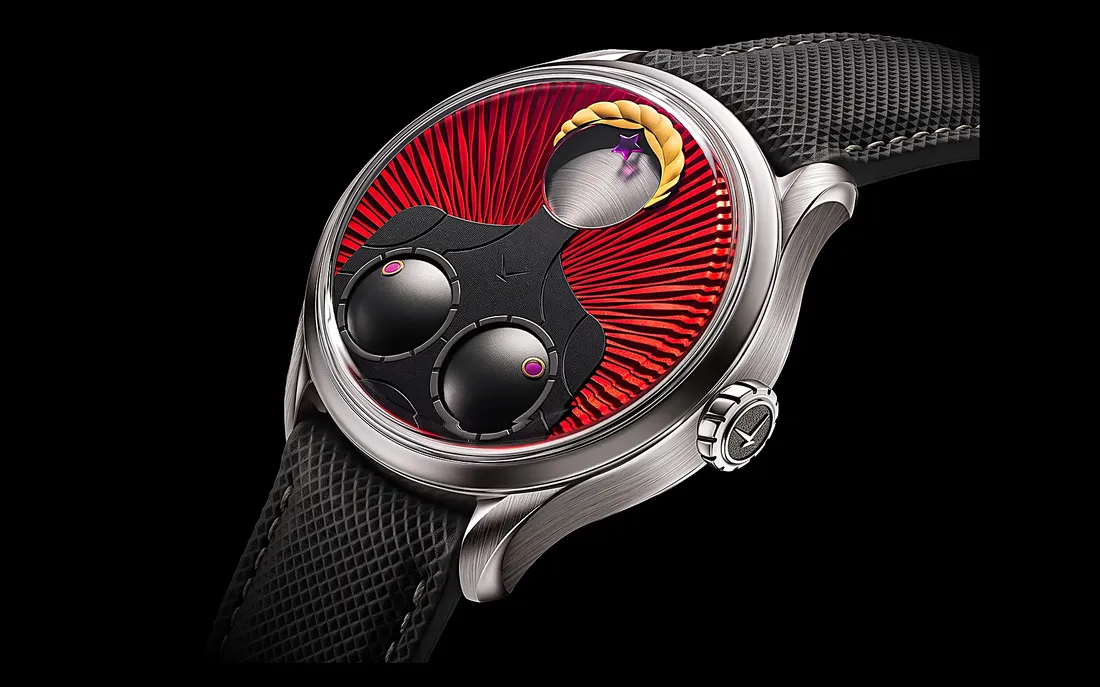
The twin ballerinas, the most memorable figures of the Atomic Heart universe, are emblems of flawless mechanical structure and of a cold, rigid determinism. These smooth, faceless titanium automatons do not age, do not hesitate, do not err. Yet their perfection comes not from a free will but entirely from the absolute necessity into which they were coded.
In philosophical and theological terms this is a portrait of the fatalist position that denies the will, and of hard mechanistic determinism. In the fatalist view a person is like a leaf tossed before the wind, or an automaton obliged to run exactly as it was wound. But in real existence the universe is not a prison of absolute necessity.
The faceless robotic aesthetic Chaykin has set on the dial reminds us plainly of that unfeeling, will-less mechanical world into which absolute determinism turns a human being.
format_quote"In the fatalist view a person is a leaf tossed before the wind, or an automaton obliged to run exactly as it was wound."
Hasan Bekmezci
Mechanical watchmaking is deterministic by nature; every wheel drives the next with care. But just as the universe we live in was brought into being by the Creator with an immense fine-tuning of the gravitational constant, the electron mass and the cosmological constant, high watchmaking too is a micro-scale imitation of a divine architecture that leaves nothing to chance.
The Creator furnished the universe with constants and laws, yet left within that order a field of free will proper to the human being. The fine-tuning of the universe is not evidence for fatalism but, on the contrary, an immense stage built so that beings possessed of a will might make sense of it.
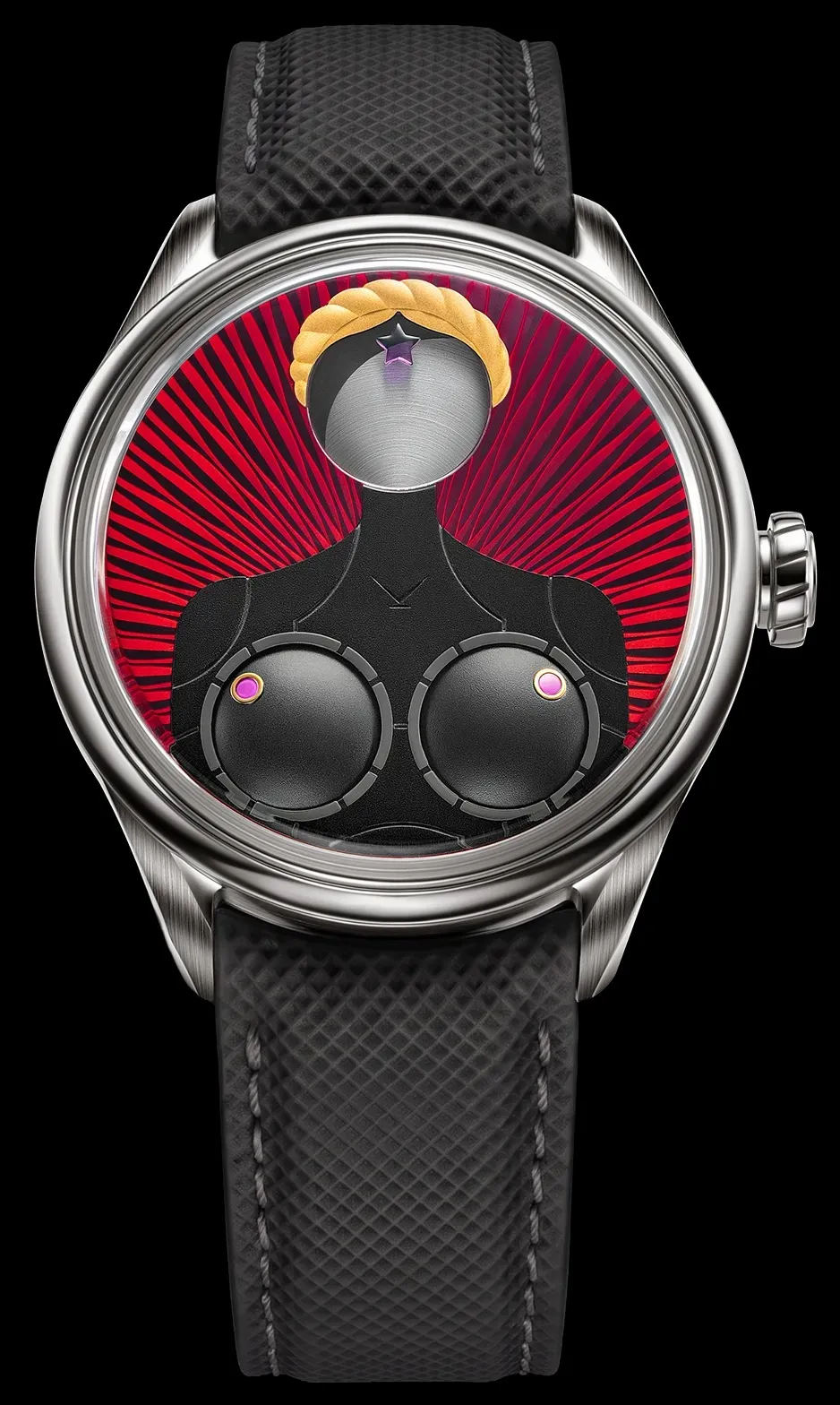
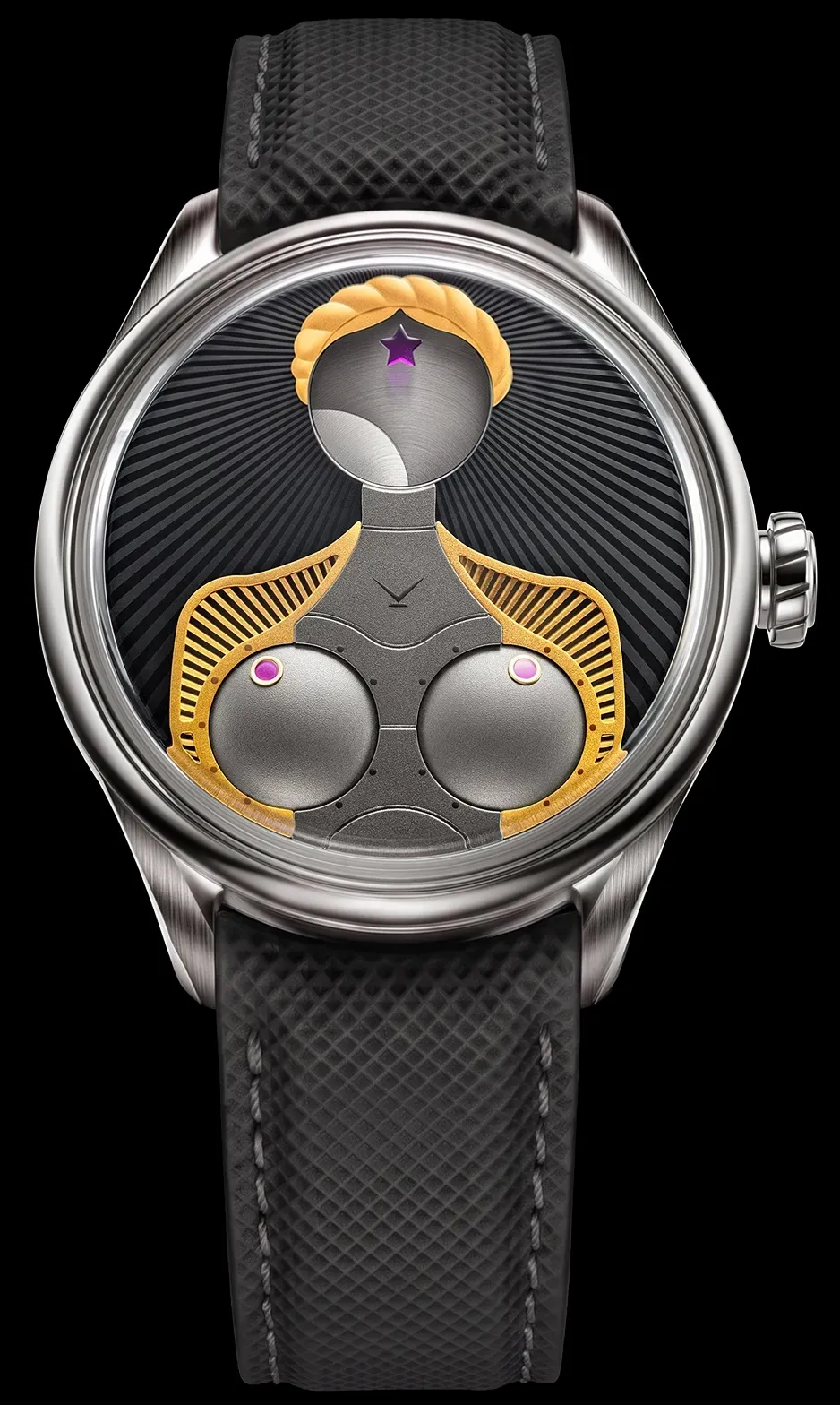
Chaykin lets time run through discs turning at the bust of the robotic twins and the synthetic rubies set upon them. While the hour and the minute turn by a mechanical calibration, the capacity to look at that time and turn it into an act, a decision or a kindness is left entirely to the human being and to their partial will.
Precious stones are not often a functional part of a watch display. Here two synthetic rubies, in gilt brass settings, serve as the pointers of the hour and minute discs. A third ruby, cut as a star, is mounted on the moonphase indicator’s own sapphire crystal and repeats the red star on each Twin’s forehead.
format_quote"The fine-tuning of the universe is not evidence for fatalism but an immense stage built so that beings with a will might make sense of it."
Hasan Bekmezci

The great moonphase indicator set into the smooth, faceless head of the robots is the manifestation in time of divine cosmic order and of fine-tuning. Just as the phases in the sky turn by an unerring law, the moon on the dial keeps to that same calibration. Although it has no separate features, the expression of this face changes with the movement of the disc, the light and dark parts slowly trading places across the lunar cycle. The disc completes one full turn in twenty nine and a half days, the length of a synodic month, and is protected by a sapphire crystal of its own.
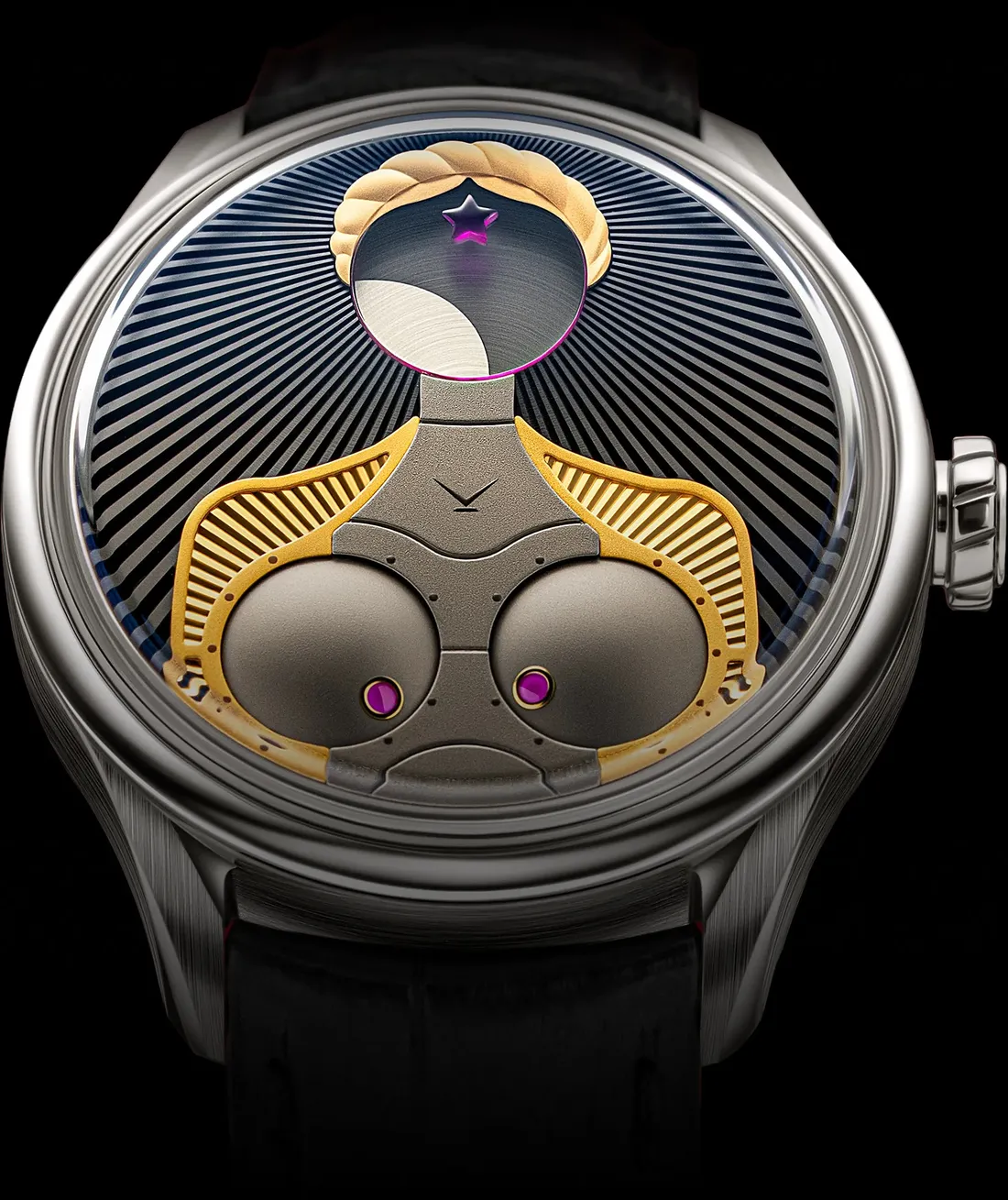
The forty millimetre titanium case is built from thirty parts and alludes to the cold, unbreakable structure of the automatons; the matt textures on it call industrial determinism to mind. A narrow, smooth bezel leaves more room for the multi-layered dial and preserves the proportions of the female silhouette. A single crown sits at 3 o’clock. The caseback is held by six screws and leaves the movement open behind a sapphire window.
Both versions run on the self-winding calibre K.18-25, built on the G200 of the Swiss manufacturer La Joux-Perret in an exclusive version developed for the manufacture. A module of sixty eight parts, designed and made by Chaykin, made it possible to place the hour and minute discs at the foot of the dial and the moonphase indicator at its head. The balance beats twenty eight thousand eight hundred times an hour, and the power reserve is sixty eight hours.
The watch appeared in the digital world before its physical premiere. In Blood on Crystal, the final story expansion of Atomic Heart released on 16 April 2026, the model can be seen on the wrist of Professor Lebedev.
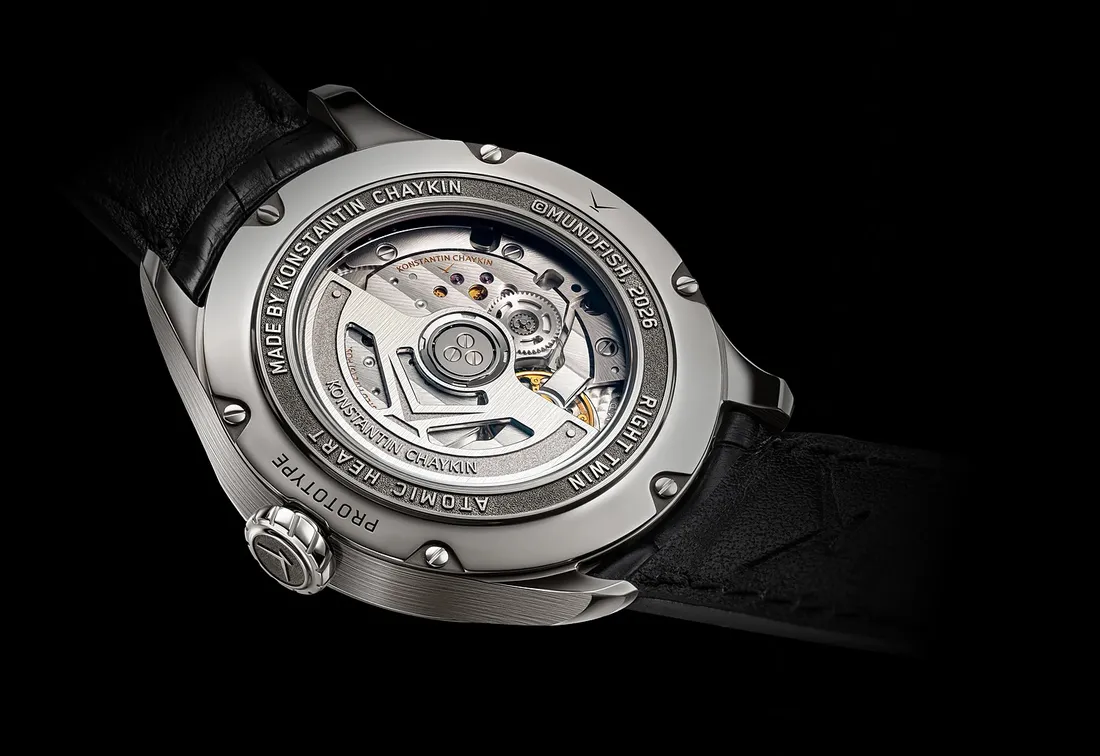
Limited to sixty nine pieces of each version, the Konstantin Chaykin Atomic Heart “Ballerina Twins” is not merely a tribute to popular culture written into independent watchmaking.
Worn on the wrist, this object whispers to the human being that they are not an absolute automaton, and that destiny is not compulsion but a field of free will granted to a person on the ground of a divine fine-tuning.
format_quote"The wheels turn by a fine calibration and the lunar phases change by cosmic law; but what draws its own path inside that time is the free will of a human being."
Hasan Bekmezci
The watch on its maker’s own site: Konstantin Chaykin, Atomic Heart Twins