A Dinner in Napa Valley
The year is 2012, California, Napa Valley. At the dinner table of a house set among the vines sits one of the greatest directors in the history of cinema: Francis Ford Coppola. Across from him sits one of the greatest living watchmakers, François-Paul Journe. As the talk turns to wine, Coppola leans in like a man writing a scene and asks a strange question: could time be shown on the five fingers of a hand, the way the ancients once counted the hours on theirs?
An ordinary craftsman would have taken the question for the pleasant idleness of a dinner and let it pass. But Journe is bewitched. That single sentence, left hanging over the table that night, becomes the opening frame of an obsession that will last for years, and of one of the most extraordinary masterpieces in the history of watchmaking. To understand the story, we must first know the man who asked the question.
The Man Who Asked: Coppola
Francis Ford Coppola (b. 1939) is one of the handful of names who rewrote cinema. With the Godfather trilogy he turned the saga of a crime family into something close to an American founding myth; with Apocalypse Now he carried the hell of Vietnam to the screen; with The Conversation he composed a study in surveillance paranoia. Over his career he won five Academy Awards and reached the Palme d'Or at Cannes twice.
But what binds Coppola to the story of this watch is not his prizes; it is his temperament. He is an inventor who forever asks, 'could it be done otherwise?' He founded his own studio, American Zoetrope; he experimented with electronic editing and digital cinema before anyone else dreamed of them, and nearly bankrupted himself doing so. In his eighties he was stubborn enough to finance the project of his life, Megalopolis, from his own pocket. That a man who grows his own wine at his Napa estate, who takes every form apart and rebuilds it, should look at a watch and ask 'why do we always do this with the same two hands?' is, in truth, no surprise at all. His question was not a hobbyist's whim, but an artist's instinct.
A Seven-Year Obsession
When Journe returned home the idea would not let him go, for hidden within the question was one of watchmaking's most treacherous traps. To move the fingers of a hand all at once, every hour, sounds simple; mechanically, it is a small earthquake. Consider it: each of five separate fingers, with its own lever and cam, must spring upward in the tiniest sliver of a second, and in exactly the right combination.
That sudden movement demands a burst of energy, and in an ordinary movement such a burst throws off the balance, drives the rate fast and slow, and drains the power. Journe gave years to taming that burst. He redesigned again and again the titanium hand carved by hand, the mechanism that drives each finger, and the system that manages the energy without loss. The distance from the idea born at that table to the first working watch came to nearly seven years, seven years of trial, error and patience.
That first watch, the blue-handed FFC Blue, sold at the Only Watch auction in 2021 for 4.5 million Swiss francs. That Only Watch is a charity auction raising funds for research into muscular dystrophy (Duchenne) seals the medical vein of the story from the very start: a watch about the fragility of the body is born for the cause of healing. The final act was written only recently: in December 2025, Coppola's own personal prototype sold for 10.75 million dollars, breaking the record for the most expensive watch ever made by an independent watchmaker.
The Ancient Language of Fingers: Dactylonomy
But why a hand? Because long before humankind committed numbers to writing, it learned to count on its fingers. This is called dactylonomy, the art of counting with the fingers. Medieval merchants kept accounts in the marketplace, monks in the monastery; in the 8th century the English scholar the Venerable Bede set down the rules for counting to hundreds on one hand and to thousands on two. The fingers were humanity's first calculator. The FFC takes this ancient and nearly forgotten language and brings it back to the wrist.
The Physician Who Designed the Hand: Ambroise Paré
And who was the physician behind the hand on the dial? Ambroise Paré (c. 1510-1590) began at the very bottom of medicine, as the apprentice of a barber-surgeon; for in that age surgeons, who dealt in blood and bone, were held to be second-class in the eyes of physicians. Paré mastered his craft at the Hôtel-Dieu hospital in Paris, and then found himself on the battlefield.
In 1536-37, cauterising gunshot wounds with boiling oil was the 'science' of the day; gunpowder was thought poisonous, and wounds were seared with red-hot iron or bubbling oil. One day Paré's oil ran out. In desperation he mixed a gentle salve of egg yolk, oil of roses and turpentine, dressed the wounds with it, and slept. Rushing back in dread the next morning, he found the cauterised men writhing in fever while those he had merely dressed slept peacefully, their wounds healing better. That day, surgery changed forever. Paré revived the practice of stopping bleeding in amputations by tying off the vessels (ligature) rather than by the red-hot iron; he held that easing pain was the physician's duty, and left us that famous line: 'I dressed him, and God healed him.'
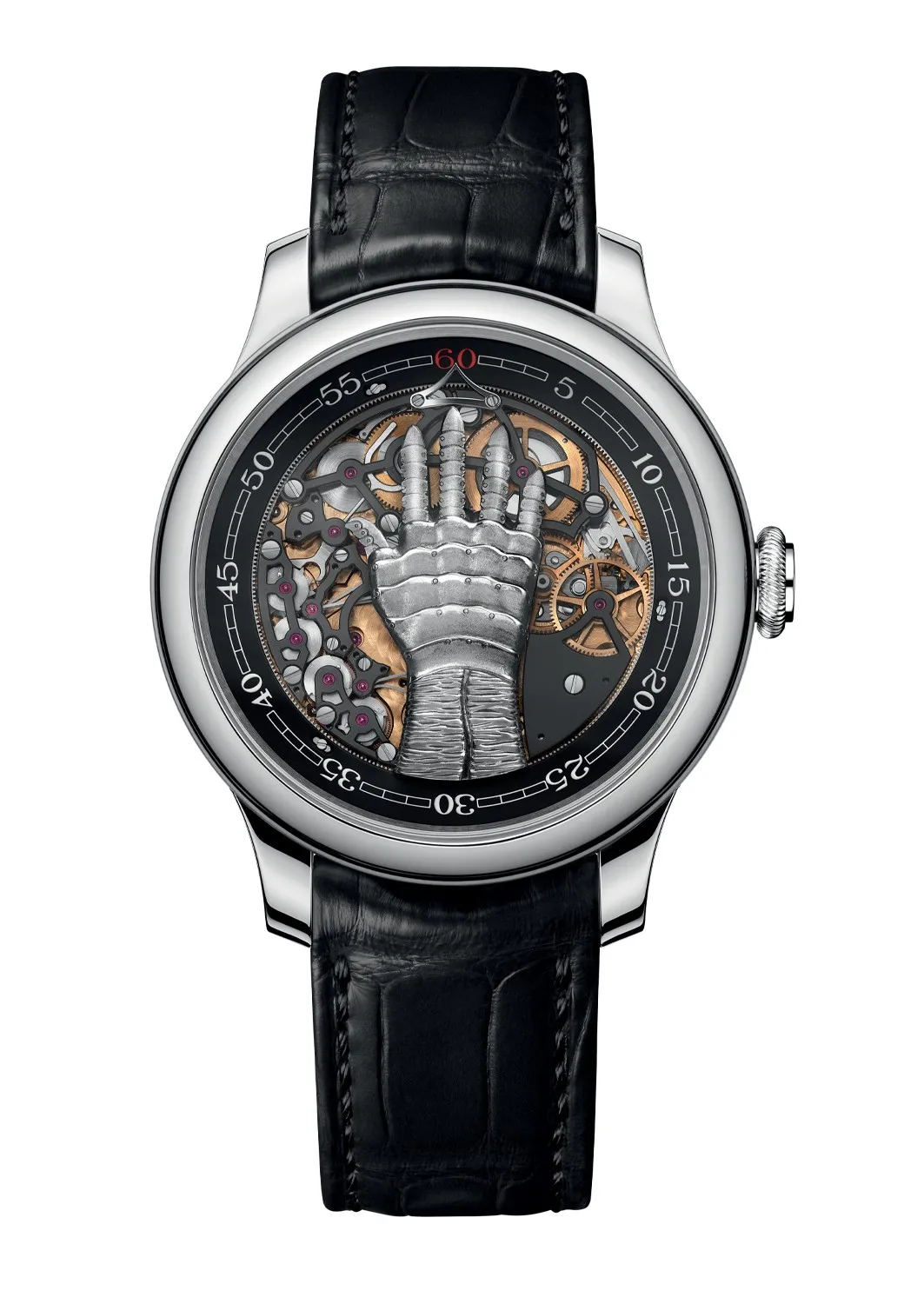
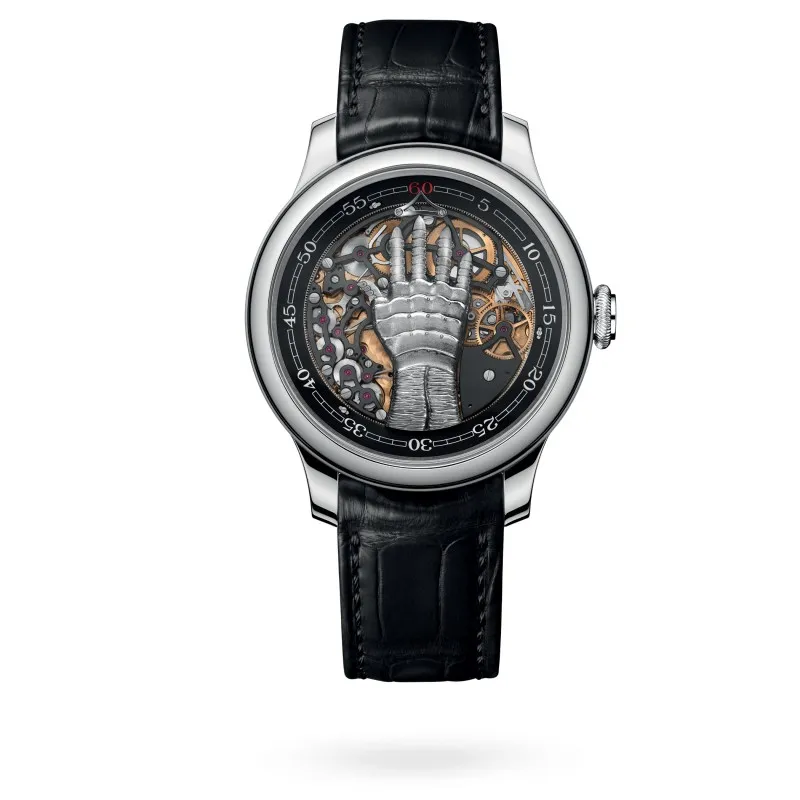
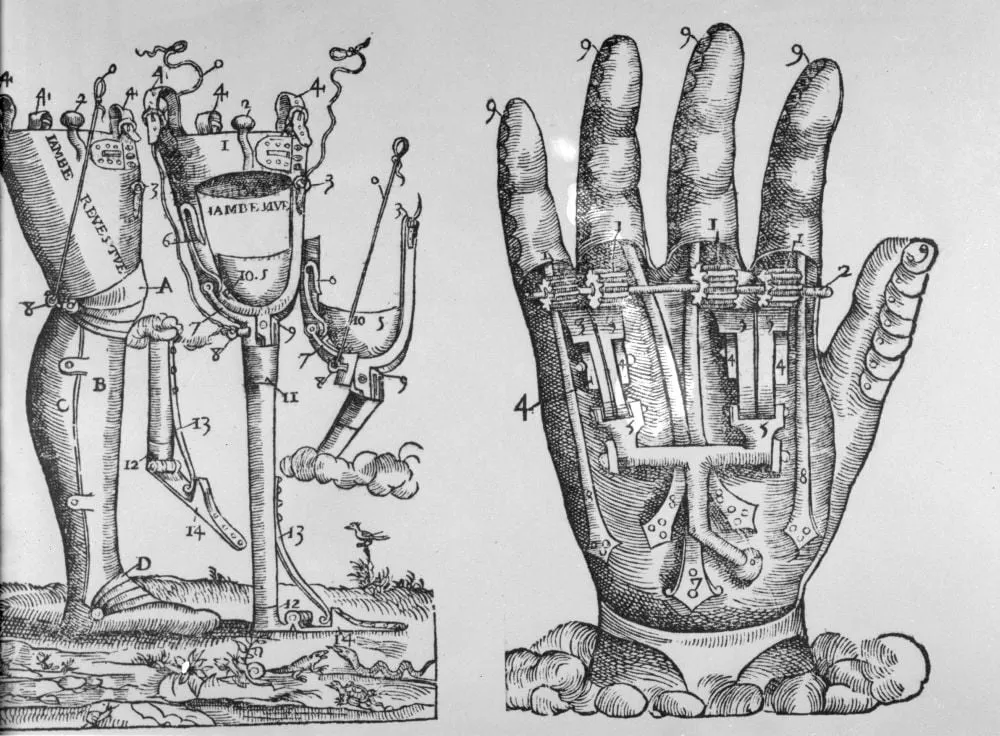
Surgeon to four kings of France, Paré wrote his knowledge not in Latin but in plain French, so that ordinary surgeons too might read it. And for soldiers who had lost their limbs in war he designed some of history's first functional mechanical prostheses: hands of iron whose fingers could move, containing catches, springs and gears within; a hand he named 'Le Petit Lorrain', along with mechanical arms and legs. The titanium hand on Journe's dial springs directly from these very drawings. A hand a surgeon designed five hundred years ago to ease suffering now tells the time.
How Does the Hand Tell the Time?
The logic is digital. On every hour the fingers change position all at once, in the blink of an eye. For one o'clock only the index finger rises; for five, the hand opens fully; for the hours from six to twelve, special combinations of fingers come into play, just as in dactylonomy. The minutes are shown by the ring around the hand, turning counter-clockwise; the fixed triangular window at twelve marks the current minute.
The hand does not raise its fingers slowly; like a hard cut in a film edit, it jumps from one frame to the next. This is not the glide of a minute hand but the change of scene in a film; it is as if Journe answered Coppola in the language of a director.
The Engineering of a Miracle: Calibre 1300.3
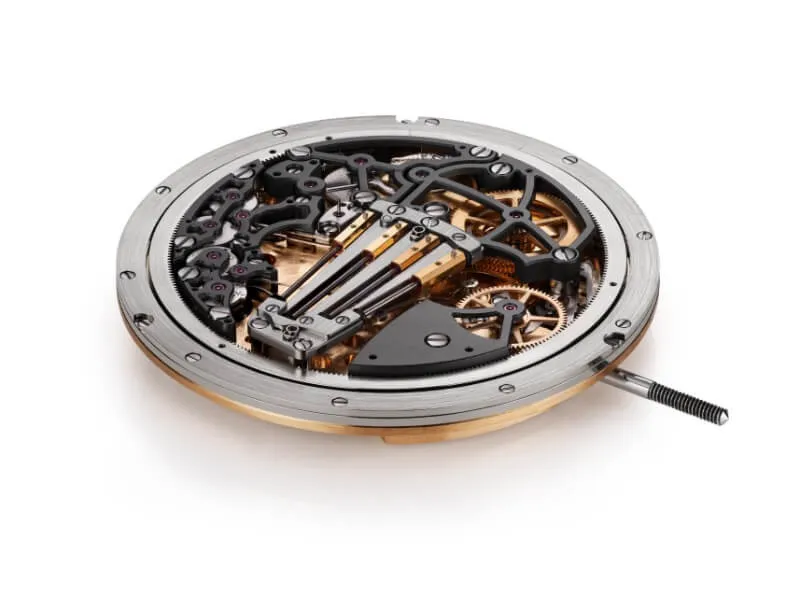
Beneath this 'instantaneous' leap, the limits of watchmaking are pushed. At its heart beats the Octa Calibre 1300.3, the brand's legendary automatic platform, entirely reworked for this model. The cam-and-lever system Journe devised stores the energy needed for the hand's leap in advance, in a small spring, like a bow drawn back. When the hour arrives, that energy is released all at once, the fingers jump, and the spring is immediately re-cocked.
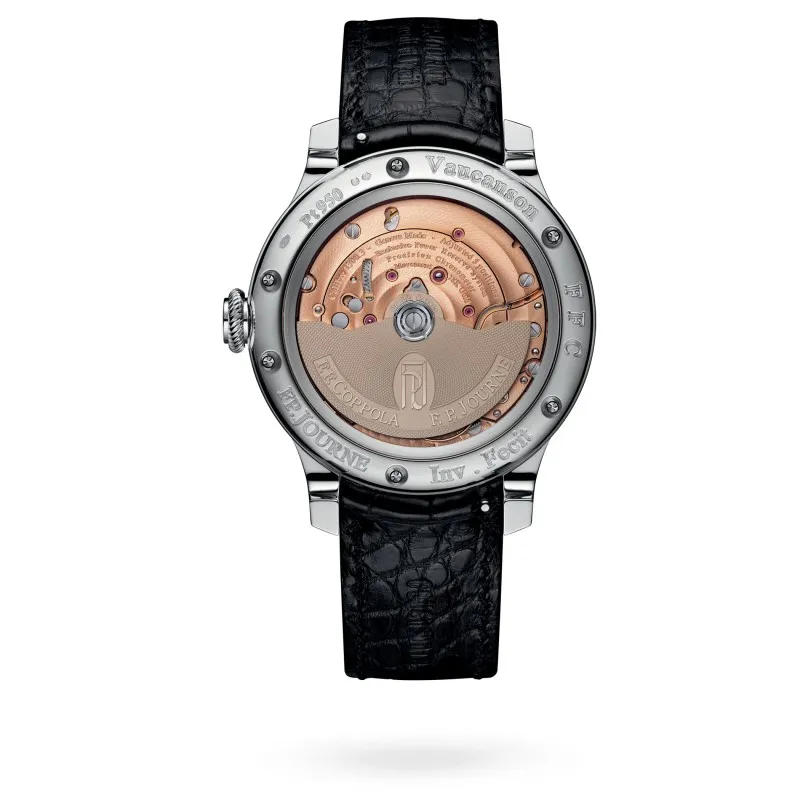
The result is almost miraculous: this violent movement does not touch the watch's precision, and does not shorten by a single second its immense 120-hour, that is, five-day power reserve. Like a master stage manager changing the set behind the curtain without the audience noticing, the movement conducts the whole performance with surgical calm. Made of 396 parts, this mechanism beats at 21,600 vibrations per hour (3 Hz).
Titanium, Rose Gold and Two Names
The materials and the finishing carry Journe's signature. Those dark, anthracite skeleton bridges on the dial are made of titanium treated with Titalyt®; light, yet hard. Behind them glows the 18k solid rose-gold main plate and bridges of the Octa 1300.3, the maker's hallmark. And upon the 22k gold rotor at the back of the watch, two names are engraved: Ambroise Paré and Francis Ford Coppola. Medicine and cinema, in other words, turn side by side upon the same rotor. This entire world lives inside a platinum case 42 mm across and, despite its complexity, only 10.70 mm thin.
When You Raise Your Arm
And it is then that you think anew about what that little hand at the centre of the dial truly means. A question asked at a director's dinner table; the merciful hand a Renaissance surgeon extended to soldiers lost on the battlefield; and a watchmaker's seven-year stubbornness. All three meet within a single 42-millimetre disc of platinum.
This watch tells you the time as our ancestors counted it on their fingers thousands of years ago; but in doing so it gathers cinema, medicine and engineering into a single gesture. When you raise your arm and look at those fingers, you see not merely the hour, but all the answers humankind has given, for five hundred years, to the question 'could it be done otherwise?' And it is precisely then that you understand the thing in your hand is far more than a watch, draw a deep breath, and quietly say: wow.