There is no way to transmit the colour you are seeing to somebody else. Nobody can measure what is happening inside the heads of two people looking at the same sky; the only thing they share is that both of them learned to call it blue. The word is an agreement, not a description.
That sounds like a philosophical amusement until the day it becomes a commercial problem. In the middle of the twentieth century a printer noticed that a blue printed in one city did not come out as the blue printed in another. The client was angry, the run was repeated, and nobody was in the wrong, because everybody had said blue.
The solution was to give up on describing the colour at all. Each shade was given a number instead, and the exact ink mixture behind that number was written down. Nobody said blue any more; everybody quoted a figure. Humanity got past a perception it could not transmit by numbering it.
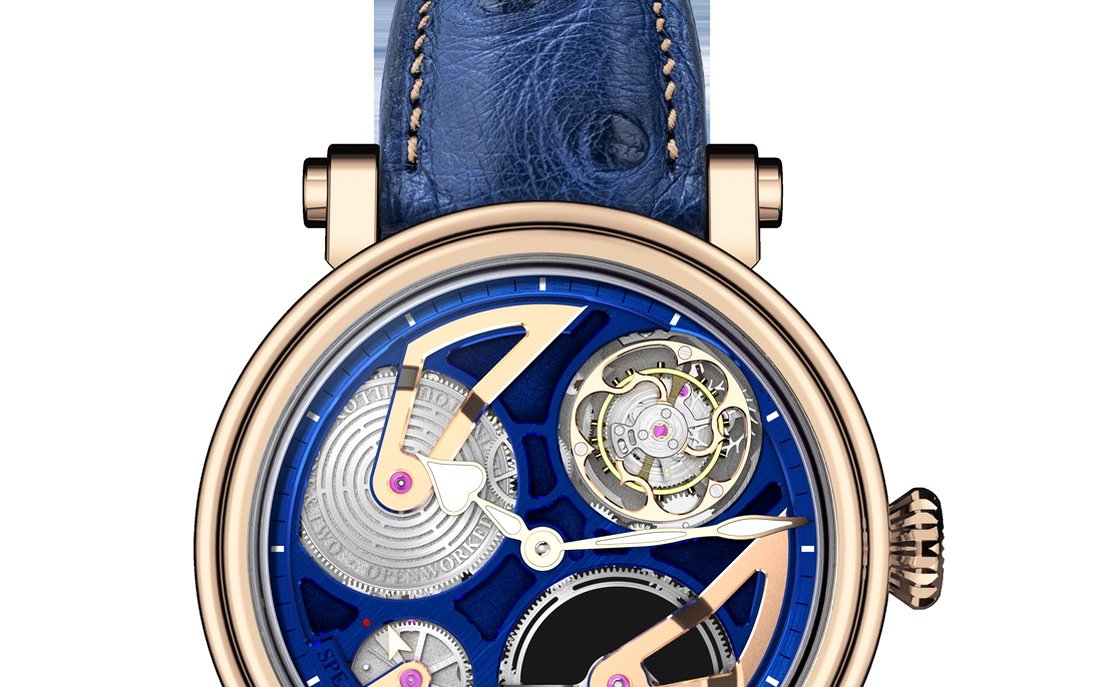
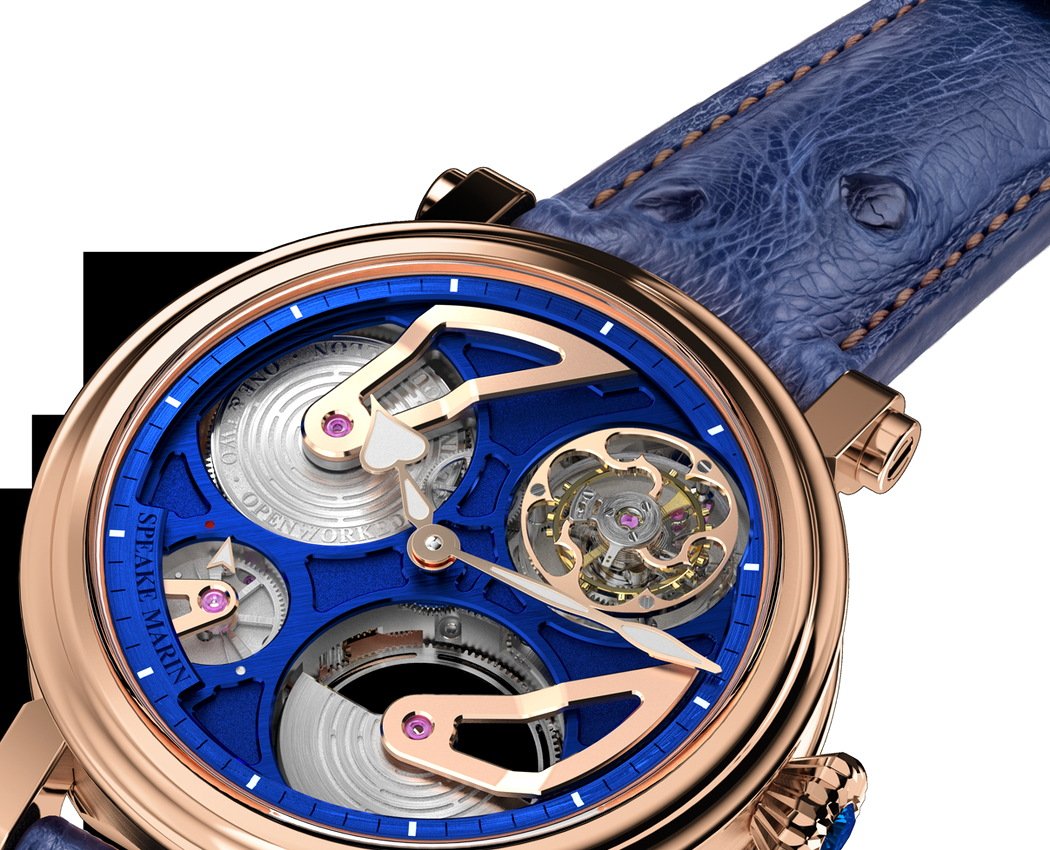
The shade Speake-Marin calls Royal Blue rests on exactly such a number. The house’s signature blue comes from the printing world’s 287 C.
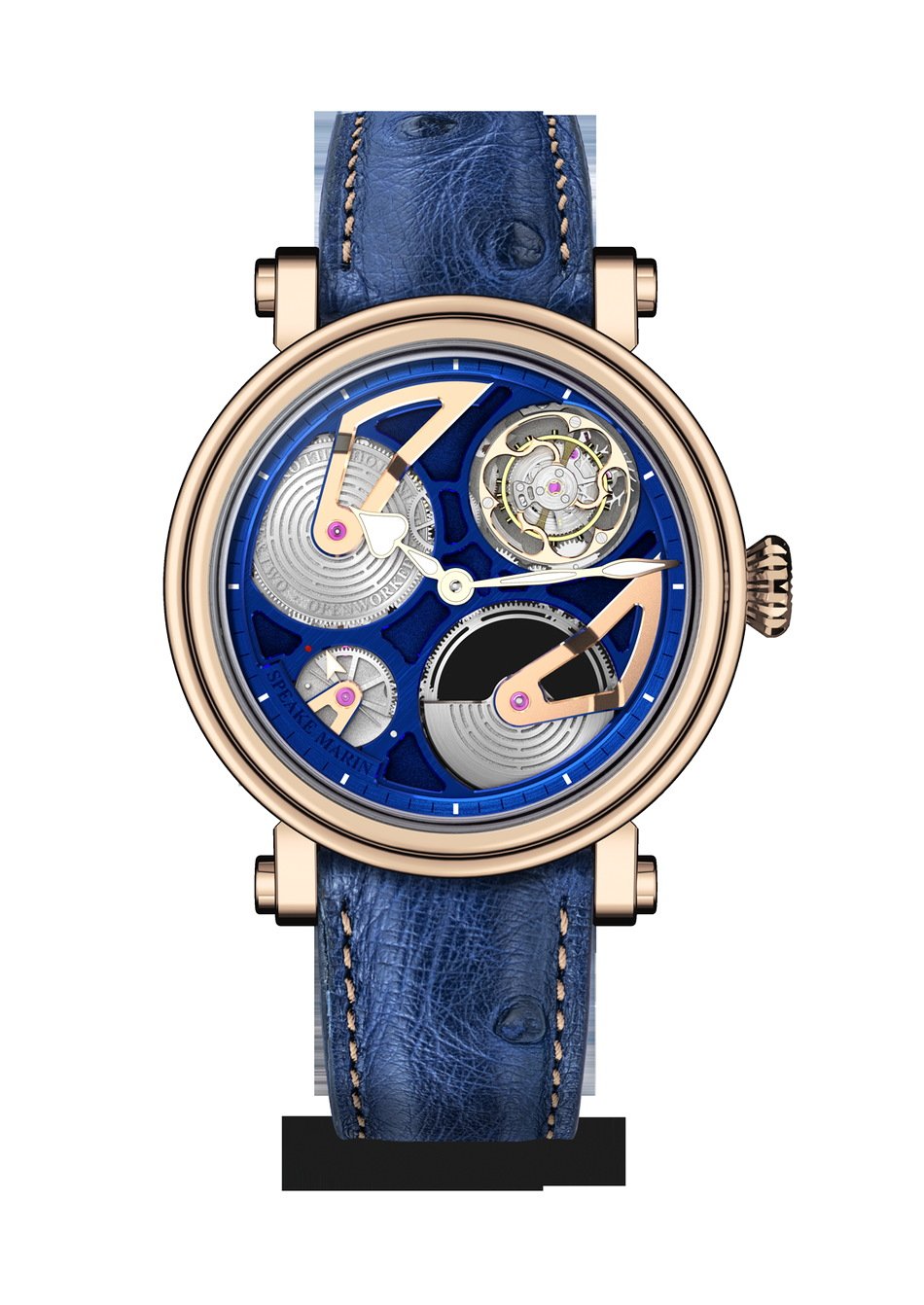
Making a colour your brand identity is not an easy decision, because colour is the fastest-ageing thing in watchmaking. A case shape lives a decade; a dial colour sometimes lasts two seasons. Speake-Marin inverted that: the case shape is fixed and so is the colour. The round case called Piccadilly has carried the same silhouette since the house began, here at forty-two millimetres and in 18K 5N red gold.
Putting red gold next to deep blue is not an accident of taste but an optical calculation. Blue is a cold, receding colour and the eye reads it as far away. Red gold is warm and advances. Use them together and the dial looks deeper than it is, because the eye takes the frame as near and the interior as distant. In a white gold case the same blue would sit flat.
format_quote"There is no way to tell another person what blue you are seeing. Humanity did not solve that impossibility. It numbered it."
Hasan Bekmezci
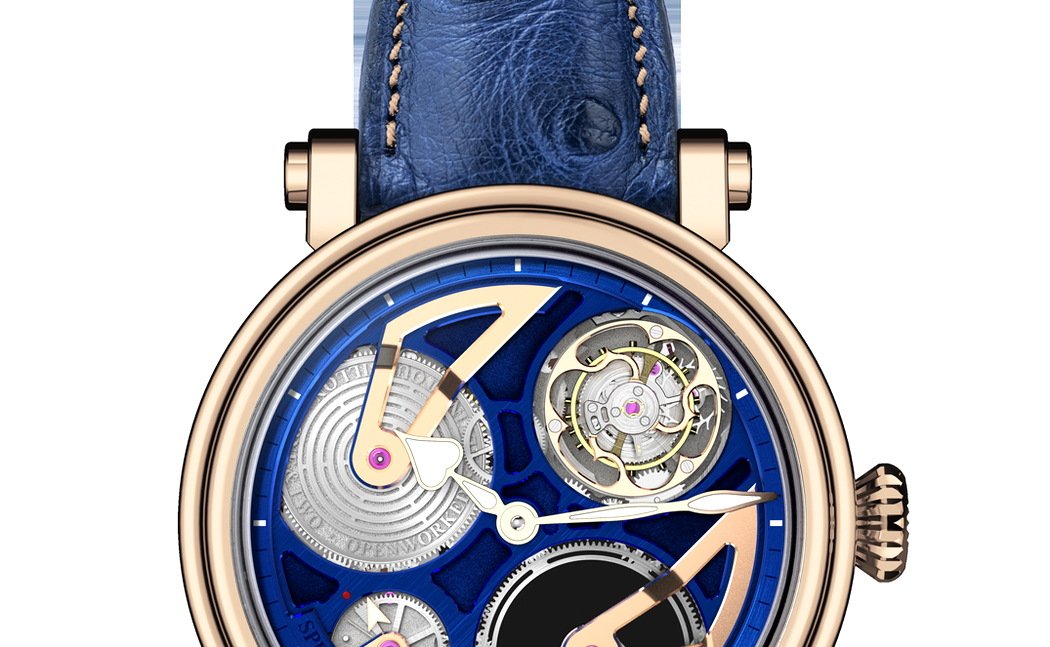
The dial itself is not a surface but a skeleton. Openworking is done not to decorate a dial but to take it away: material is removed and only what carries load is left behind. That is precisely why it is harder than it looks. As you cut metal out of a plate its resistance to flexing falls, while the force applied by the springs and wheels above it does not change. Every bridge that remains has to absorb the work of the metal that was removed.
Good openworking therefore never cuts at random. The regions where the force lines do not run are taken out; the ones where they do are left. When the dial is finished the pattern looks like a designer’s line. It is in fact a map of loads.
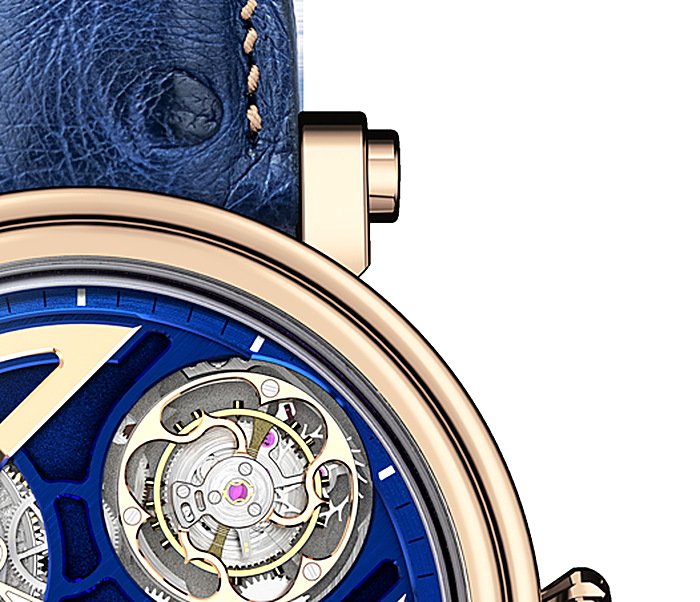
The cage turning in the upper half of the dial is a flying tourbillon. In a classical tourbillon the cage is held at both ends: a carrier below, a bridge above, and the cage turns between them. In a flying tourbillon the upper bridge is gone and the whole load is taken by a single bearing underneath.
That is not a simple visual preference. The moment the upper bridge is removed the cage becomes a cantilever loaded from one side, far more sensitive to imbalance, to shock and to any deviation of its axis. The cage has to be made as light as possible, the bearing enlarged, and the axis of rotation held exactly at the centre. What you gain in return is one thing only: an unobstructed view.
The same logic governs the winding. The calibre SMA05 inside is self-winding, but there is no full-size rotor sitting on top of the movement; the rotor is a micro-rotor sunk into the calibre itself. On a conventional automatic, that large disc covers everything beneath it while it sweeps. A micro-rotor lifts the cover and gives up some winding efficiency in exchange. Both of this watch’s fundamental decisions say the same sentence: performance conceded for the sake of visibility.
format_quote"Both of this watch’s fundamental decisions say the same sentence: performance conceded for the sake of visibility."
Hasan Bekmezci
Through the back the other face of the movement appears, and the finishing there does not fall behind the dial. The bridges are bevelled at the edges, the surfaces are brushed, the screw heads are polished. To finish the back of a watch is to finish what is not seen, and in watchmaking nothing shows the seriousness of a house more clearly, because nobody compels it.
Five are being made. That figure is not a scarcity tactic but an admission of capacity: it says how many hand-finished tourbillon dials a year is realistic.

format_quote"A good object is one that can hold the measurable and the unmeasurable on the same surface."
Hasan Bekmezci
When the printer numbered the colour he did in fact lose something. The same ink now prints in two cities, but what two people feel while looking at that ink is still unknown and will stay unknown. The number did not solve what cannot be transmitted. It went around it.
The blue you see on this dial is the same kind of thing: the answer to a code, the output of a formula, a measurable tone. What it does to you, only you can know. A good object is one that can hold the measurable and the unmeasurable on the same surface.