The most radical shift in architecture and structural engineering came at the moment builders stopped stacking stone and started framing in steel. The principle behind Gustave Eiffel’s tower, and behind Santiago Calatrava’s biomorphic bridges, was a simple one: a structure draws its strength not from its mass, but from the geometry of the lines that carry the load and the voids left between them. The roughly 7,300 tonnes of iron in the Eiffel Tower are more than eighteen thousand separate pieces held together by some two and a half million rivets, and most of what you are looking at is calculated emptiness. Scrape away every gram of metal that does nothing, and what remains is the building’s musculature: the naked truth of its force vectors.
In fine watchmaking, skeletonising a movement is that same structural philosophy applied to a world a few centimetres wide. A conventional watch hides the enormous kinetic activity of its movement behind a dial and a caseband. A skeletonised watch puts the anatomy of the organs that carry time on open display, without flinching.
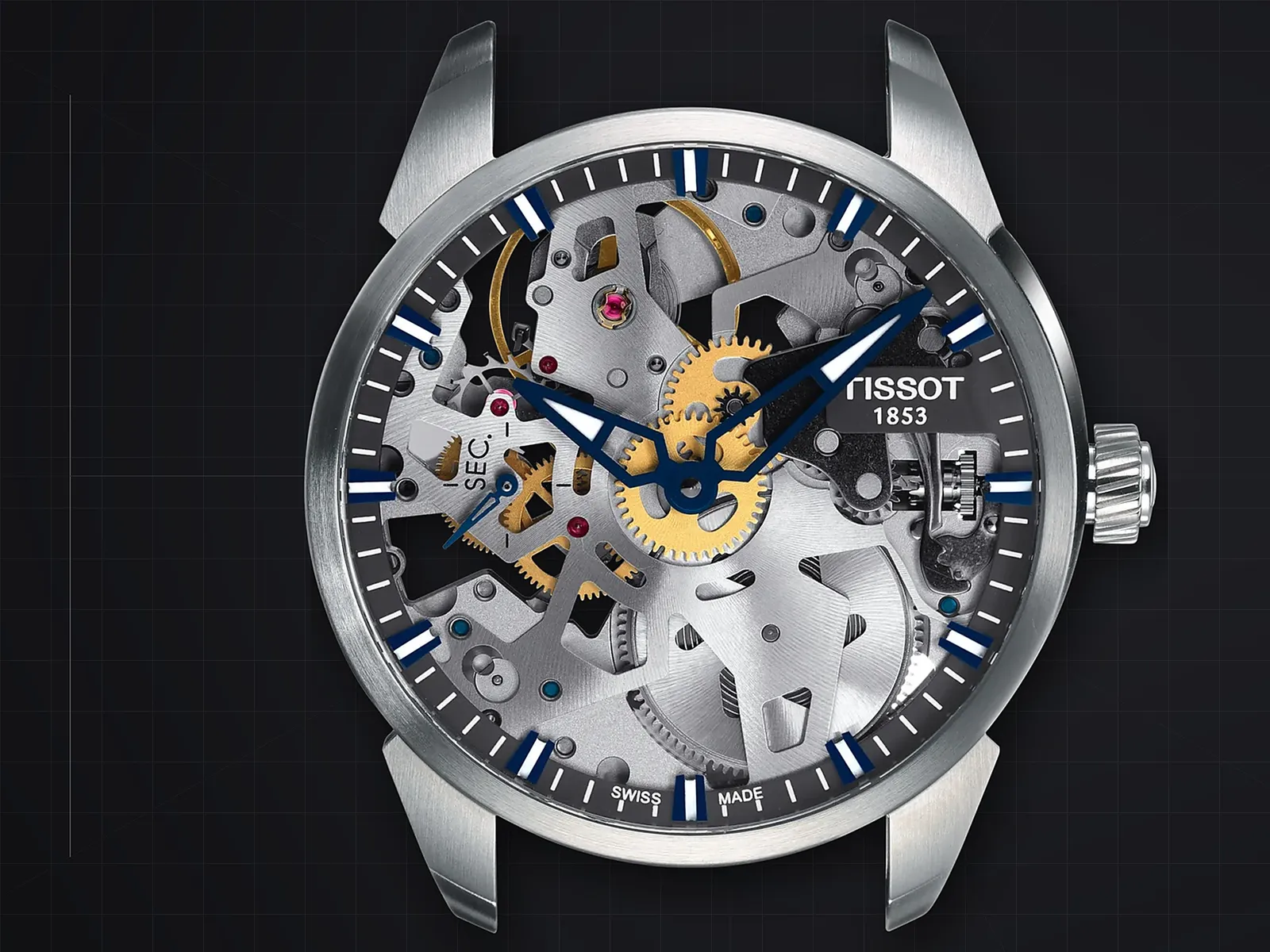
The T-Complication Squelette is where Tissot states its mechanical nerve. It walks away from the curling, foliate Baroque idea of the skeleton watch entirely, and speaks instead in a modern, industrial, transparent architectural language.

Skeletonising as a Question of Statics
Openworking a movement is not a matter of carving the bridges wherever the eye fancies. As the watchmaker shaves metal off a mainplate or a bridge, they have to think like a structural engineer. Enough material must be left to absorb the stress that arises as torque travels out of the barrel and through the gear train, and to hold pivots true to a hundredth of a millimetre while keeping the jewelled bearings dead concentric.
The openworking on this reference has the geometric cut of an automotive chassis or a turbine blade. Every part of the plate that carries no load has been milled away; what is left are industrial legs following the lines of force. Because of those cuts, when you turn the crown you can watch the crown wheel take up the ratchet wheel, watch the click drop back over each tooth, and watch the torque spread through the train, all without opening the case. The barrel stays closed, as it must: the mainspring can only live inside its own drum.
format_quote"Scrape away every gram of metal that does nothing, and what remains is the building’s musculature: the naked truth of its force vectors."
Hasan Bekmezci
The Architecture of a Dial That Is Not There
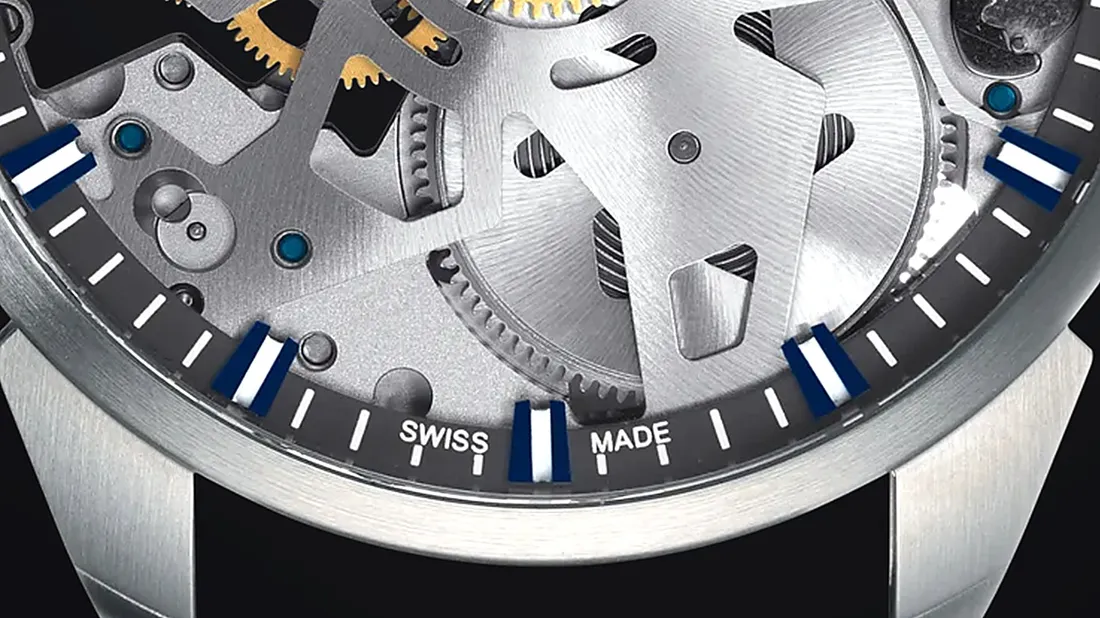
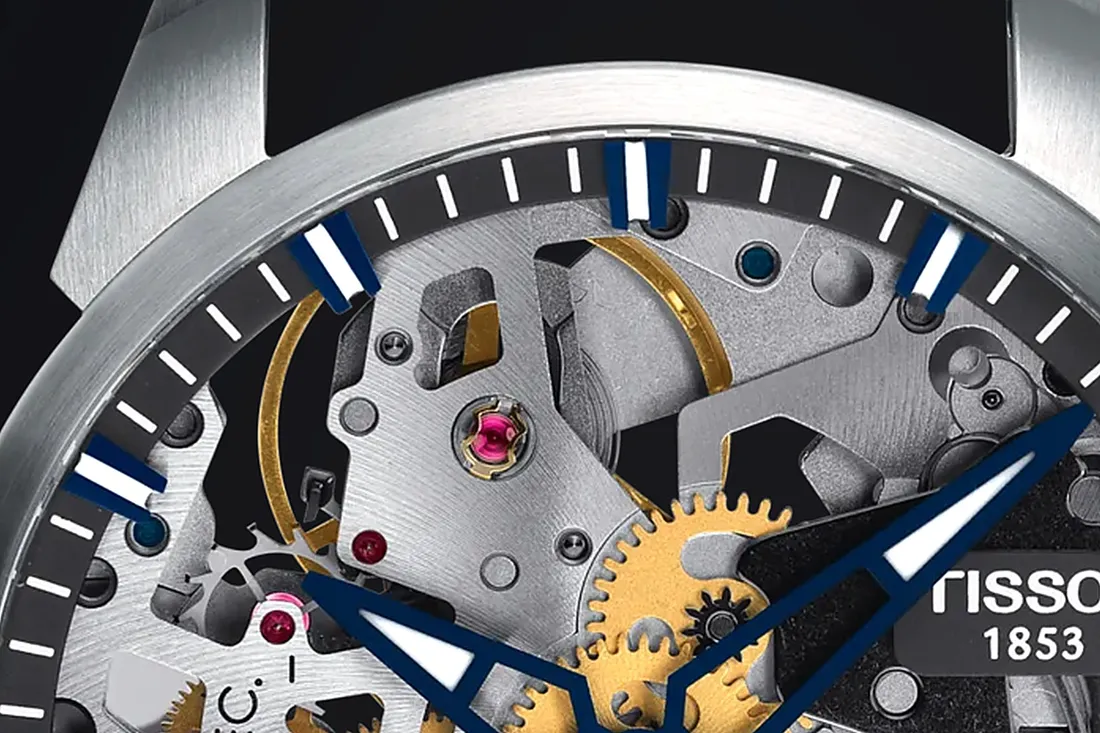
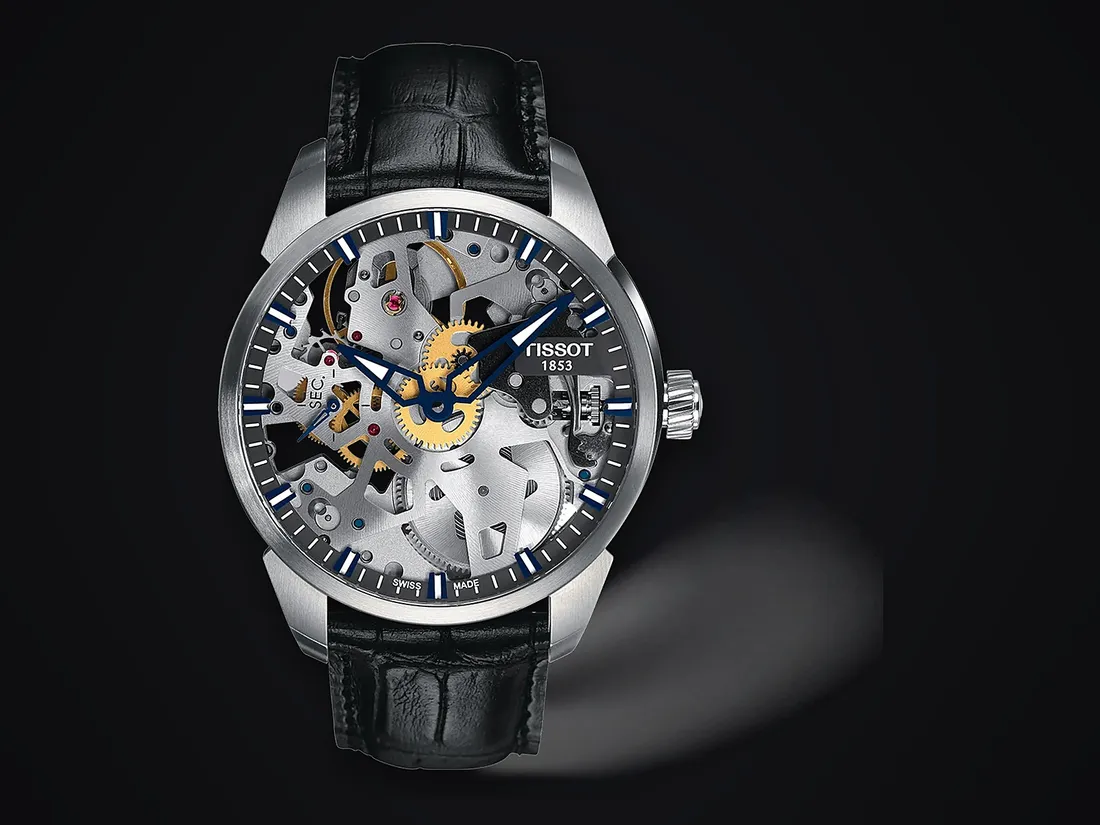
With no dial to flatten it, the watch reads in layers. A dark minute ring lines the inner wall of the case, carrying white markers for precise reading and the words Swiss Made at six. The hour markers sit on top of that ring as applied batons that appear to hang in the air above the movement. They are not single pieces of polished steel: each has two faces, one lacquered deep blue, the other filled with white Super-LumiNova. Blue by day, white by night.
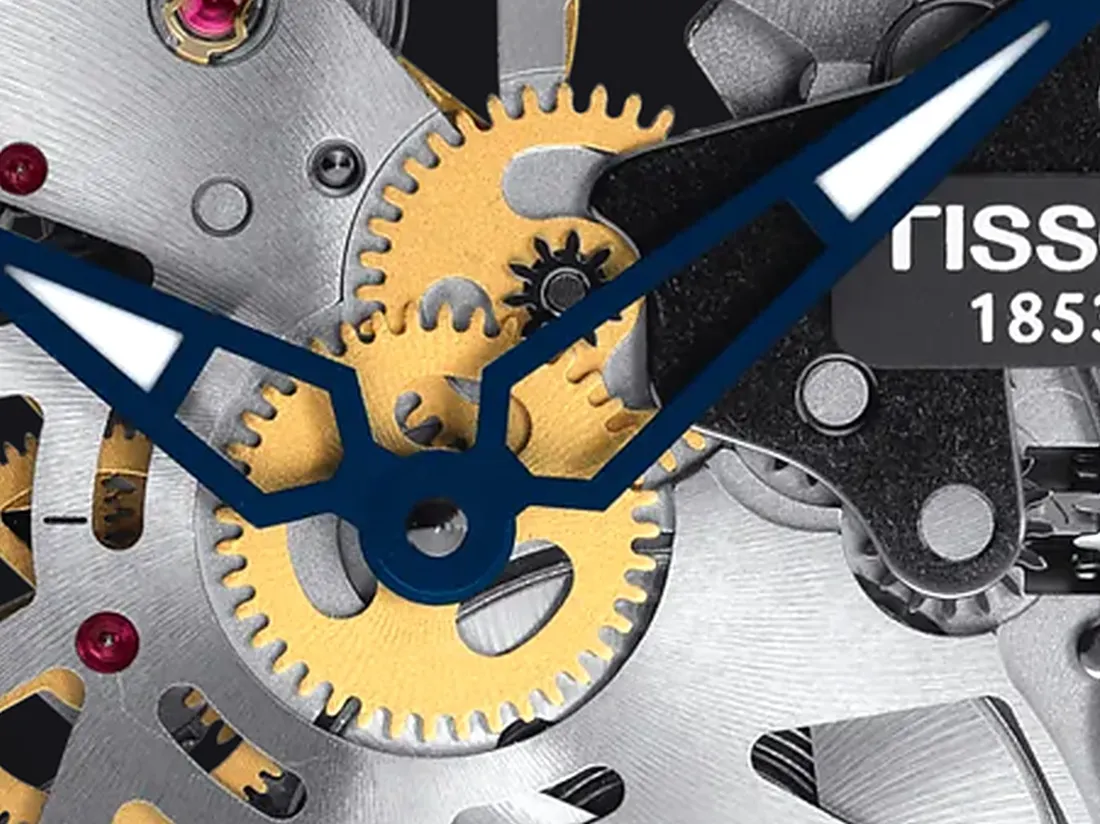
The vertical and horizontal satin brushing across the bridges catches the light in a way that keeps the character industrial rather than decorative, and the sharp anglage along the bridge edges draws a bright line around each structural member from almost any angle.
The hour and minute hands are finished in a deep cobalt blue to set them against the matte silver of the plates. They are openworked down the middle so that nothing behind them is interrupted, and a long stretch of each hand is filled with luminous compound rather than a token dot at the tip.
The small seconds at nine has no sub-dial of its own. There is only the word SEC. engraved straight onto the plate, a few index strokes and a miniature blue hand. The wheel beneath it is left open, so the seconds are not so much indicated as observed directly. That is the generosity of a hand-wound architecture: with no rotor in the way, nothing on this side of the watch has to be covered up.
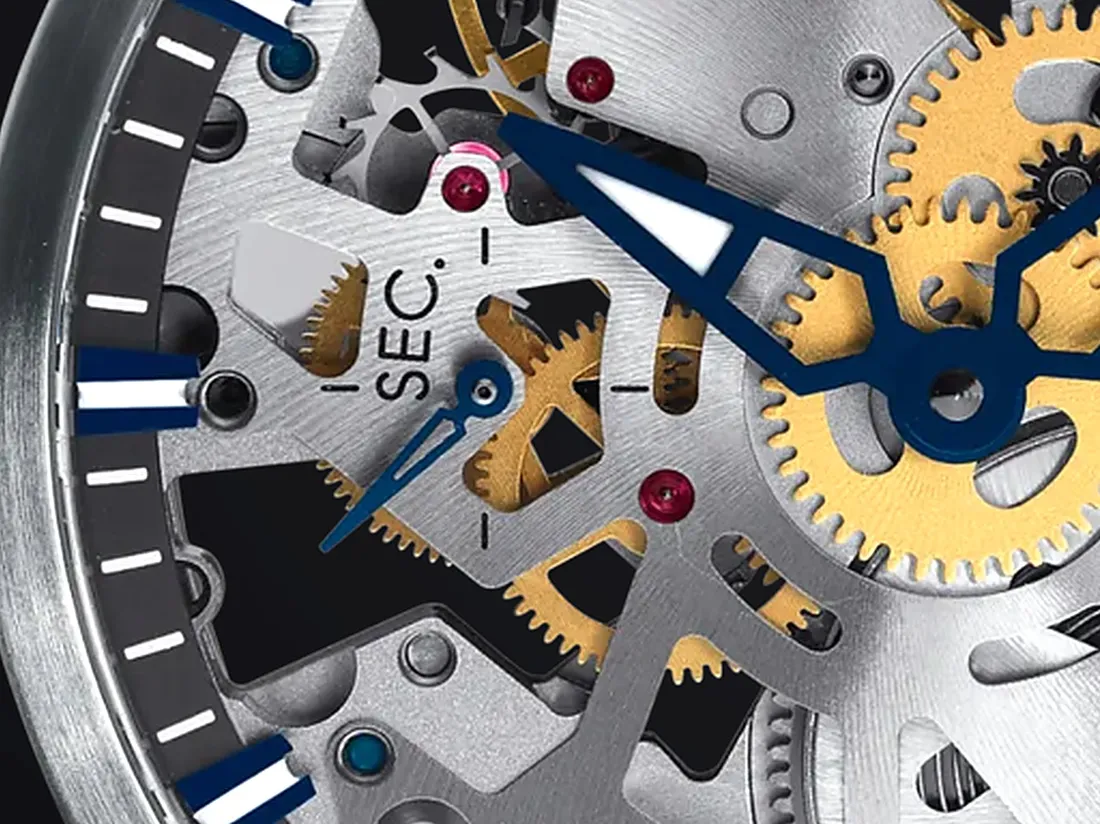
format_quote"The seconds here are not indicated so much as observed. Take the dial away and what is left is not measured time, but the machine that makes it."
Hasan Bekmezci
The Movement: Torque, Scale and Endurance
At the heart of the watch sits an openworked reading of the Unitas-descended 6497 family, one of the most robust and highest-torque hand-wound architectures watchmaking has produced. Its real secret is that it was never designed for a wrist at all: at sixteen and a half lignes, roughly 36.6 millimetres across, this is a pocket-watch calibre, and that is precisely why it fills a 43 mm case corner to corner. A modern wristwatch movement would sit in this case like a small island in a large lake, and the skeletonising would become decoration rather than architecture.
The layout is inherited too. The crown sits at three and the small seconds directly opposite at nine, an arrangement pocket-watch makers called Lépine; the sibling calibre in the same family, with its seconds at six, follows the savonnette plan instead. The symmetry of this dial is therefore not a styling whim but the direct consequence of a two-hundred-year-old logic about where a stem should go.
Between eleven and twelve, the balance and its bridge let you watch the heartbeat itself. The gilt hairspring breathes in the open, close enough to the surface to follow with the naked eye. Tissot quotes roughly 52 hours of running time from a full wind, which in a hand-wound watch means taking it off on Friday evening and still finding it alive on Sunday morning.
Turn the crown and the wheels engaging just below the raised Tissot plaque at three give you the most physical argument there is for mechanical watchmaking: you feel the train take up before you see it move.
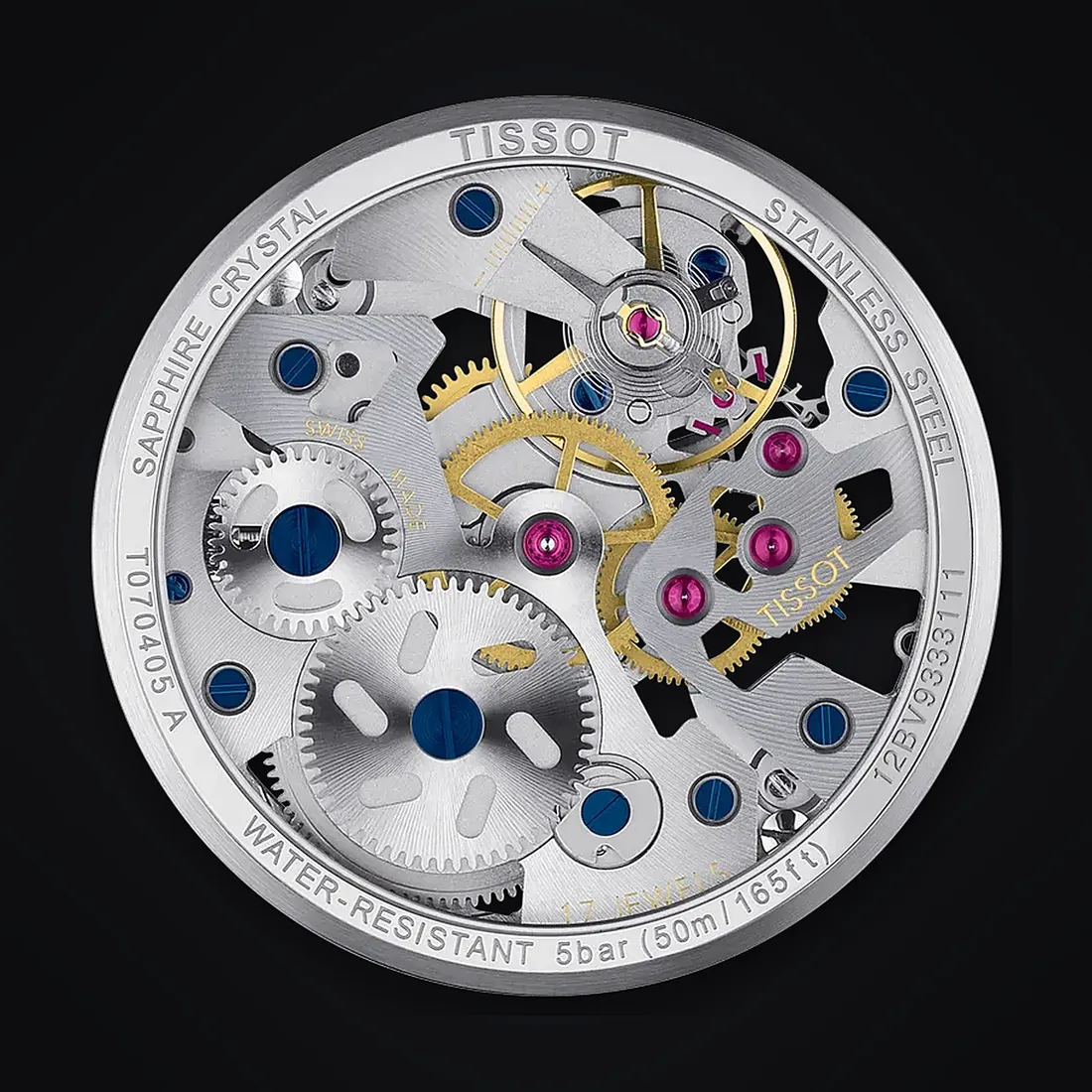
The back keeps the same promise. The identity of the case is engraved around the sapphire: sapphire crystal, stainless steel, five bar of water resistance and the reference number. Inside, blued screws, ruby bearings and the gilt train stand as a mirror image of what the front shows. The 316L steel case measures 43 mm across and 11.99 mm deep; between 22 mm lugs sits a black calfskin strap embossed to imitate alligator, closed by a butterfly clasp with pushers. At around 89 grams, the watch makes you feel its balance rather than its mass.
The architect’s search for less matter and more function, carried down to the wrist, turns here into a piece of kinetic sculpture you can wear.
format_quote"The architect’s search for less matter and more function turns here into a piece of kinetic sculpture you can wear."
Hasan Bekmezci
Craft and Technical Detail
Skeletonising: the maximum removal of metal from mainplate and bridges while every load-bearing point is preserved, which is what buys this degree of mechanical transparency.
Movement architecture: hand-wound, no rotor, built on the pocket-watch-scale 6497 family descended from Unitas; at roughly 36.6 mm in diameter it fills the 43 mm case and leaves an uninterrupted path for light from front to back.
Power reserve: approximately 52 hours from a full wind.
Layout: Lépine, with the crown at three and the small seconds opposite at nine.
Bridges and finishing: vertical and horizontal satin brushing, anglage along the bridge edges, a dark contrasting flange ring and Swiss Made at six.
Hands and markers: openworked cobalt blue hour and minute hands with luminous compound along their length; applied baton markers with one blue face and one that stores light.
Case and crystal: 43 mm across and 11.99 mm deep in 316L stainless steel, anti-reflective sapphire crystal and a transparent sapphire back, water resistant to five bar, that is 50 metres.
Strap: 22 mm between lugs, black calfskin embossed as alligator, butterfly clasp with pushers. Around 89 grams, made in Switzerland.