You do not see the tiger in the forest. You see the forest seeing the tiger.
A troop of monkeys falls silent all at once, then a single alarm call sends the branches shaking. A group of spotted deer stops grazing, turns as one body in the same direction and locks its ears there. You are still looking at nothing. The forest has known for ten minutes.
I spent years running camera-trap counts, and the first thing I learned was that you do not need to see a tiger’s face to know which tiger it is. Every animal’s stripe pattern is unique. No two tigers share one, and the left and right flanks of the same animal do not match each other either. That is why census work compares side profiles rather than faces. The pattern is an identity document.
And that pattern is not only in the fur. Shave a tiger and the stripes remain on the skin. This animal is not wearing a striped coat. It was born striped.
The pattern’s job is not display but disappearance. A body broken into vertical cuts among tall grass and bamboo shadow stops reading as a body at all. Most of the animals a tiger hunts cannot distinguish red the way we do; to them an orange coat is a faded green smudge in dry grass. A tiger’s colour is spectacular to us and invisible to its prey.
Its silence is no accident either. The claws retract, so nothing clicks on the ground. Pads across the underside of the foot spread the load. Not a dry leaf breaks under four hundred kilograms. In the dark, a reflective layer behind the eye passes light through the retina a second time, which is why a tiger sees several times better than we do. The night frames from a camera trap are simply that layer sending the flash back.
And its roar contains more than you can hear. Part of the sound sits below the lower limit of human hearing, so you do not hear it; you feel it in your chest. Everyone who has worked in that forest describes it the same way: the body flinches first, and the ear catches up afterwards.
format_quote"You do not see the tiger in the forest. You see the forest seeing the tiger."
Hasan Bekmezci
One idea explains why protecting a tiger matters so much: umbrella species. A tiger needs a large forest, enough herbivores inside it, healthy vegetation to feed them and a steady water regime beneath all of it. Put one tiger’s range under protection and you have protected thousands of species whose names you do not know. Hold the top link of the chain and the whole chain stays off the ground.
The reverse is equally true. When the tiger withdraws from a region, herbivore numbers explode, young trees are eaten before they establish, the forest stops renewing itself, and years later nobody remembers why.
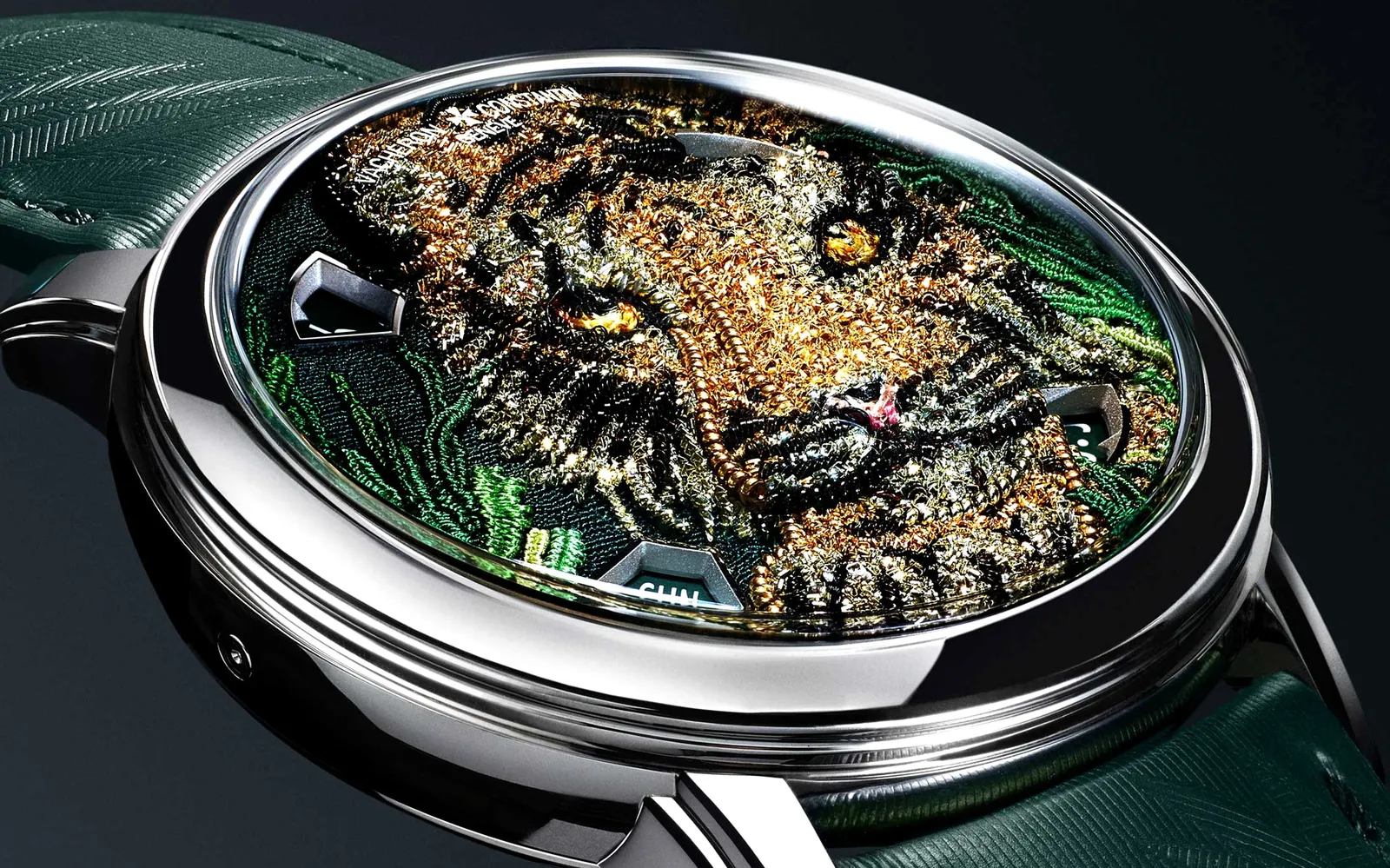
That pattern came down to the point of a needle in Geneva in the summer of 2026. Vacheron Constantin announced a set of six pieces titled Métiers d’Art Tribute to the Animal Kingdom, all of them under the house’s One of Not Many Crafts Programme, which pairs a craftsperson from outside watchmaking with the watchmakers of Geneva and requires their technique to fit inside forty-two millimetres for the first time.
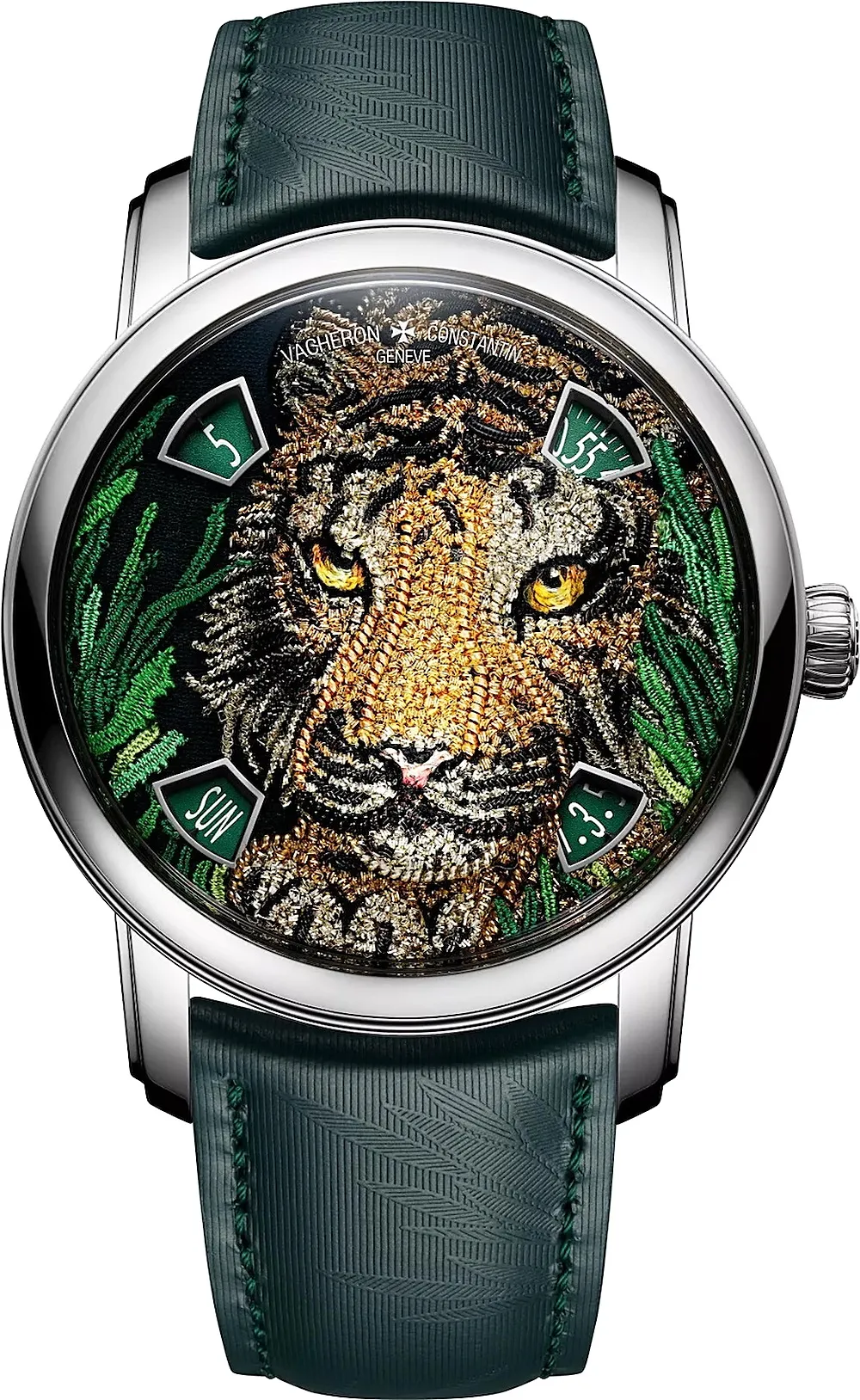
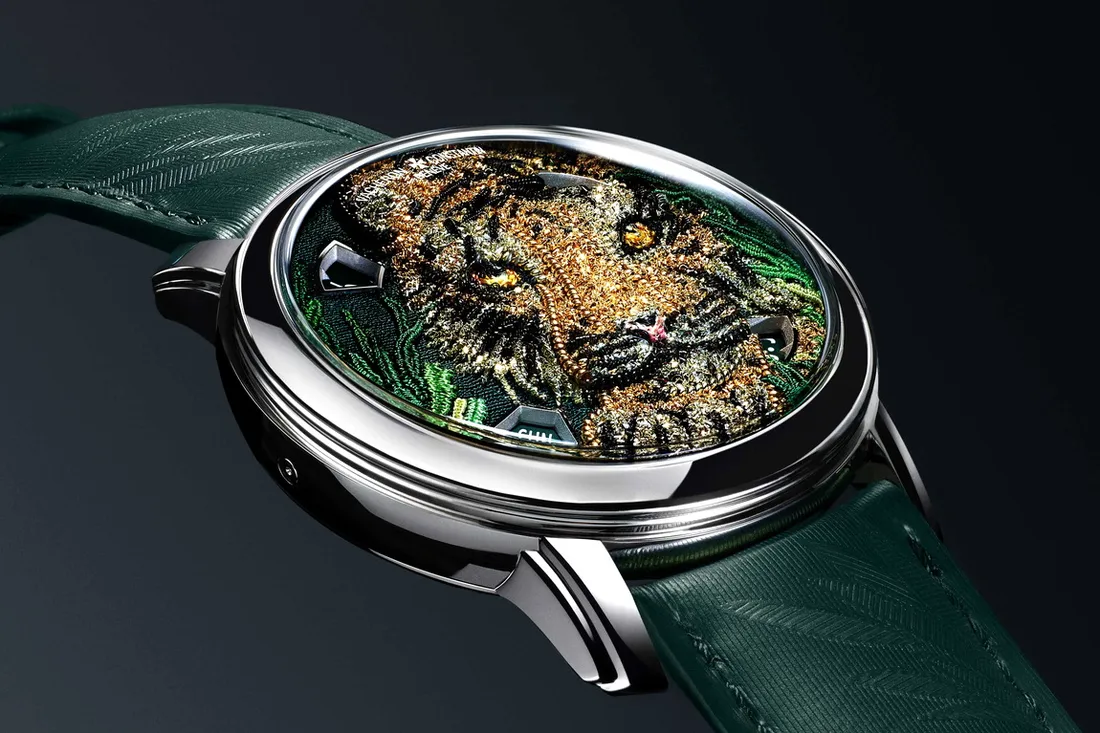
The piece that fell to the tiger is called Tigerbroidery, reference 7630A/000G-H207, and its dial is the work of the embroiderer Laura Baverstock.
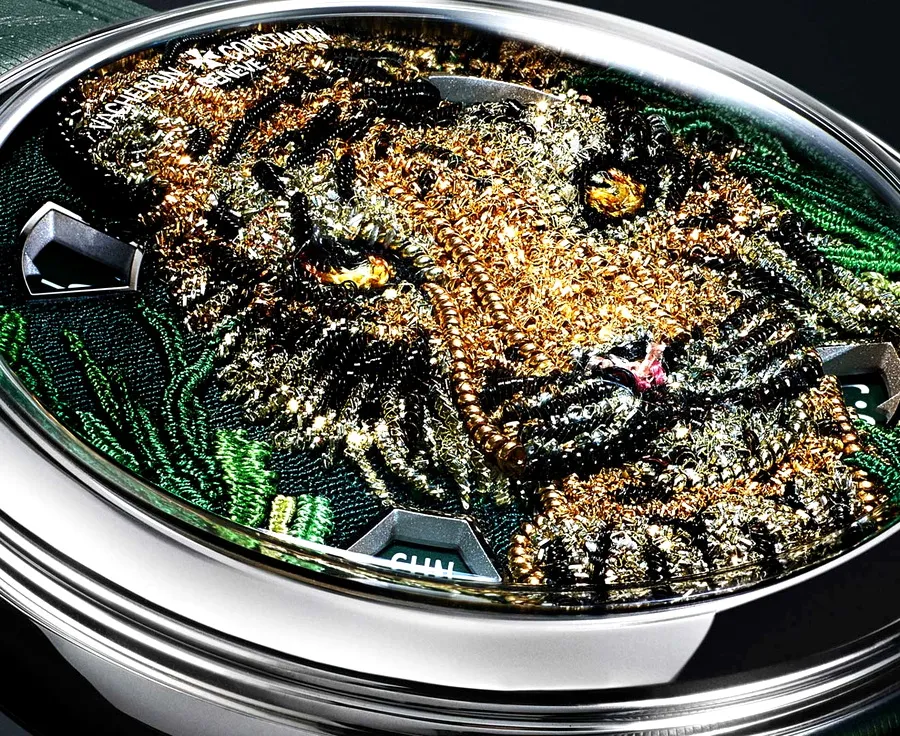
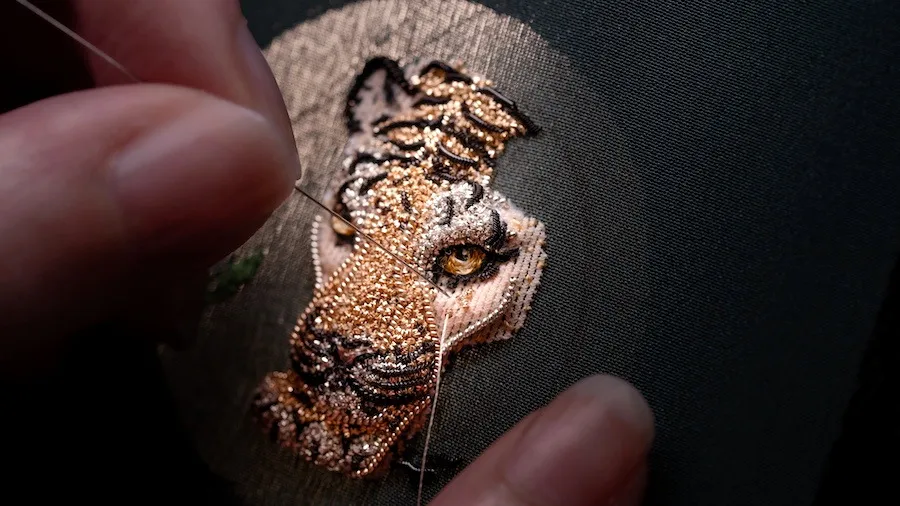
This is the one dial in the series where the material does not sit on the surface but passes through it. In the others, paper, glass, wood and feather are placed onto a ground. In embroidery, thread pierces the ground, comes out at the back and returns to the front. The visible face of this dial and its invisible one are two sides of the same operation.
The base is green silk and cotton. The figure above it is worked in nine-carat gold and silk. Goldwork has a rule of its own: gold thread cannot be passed repeatedly through cloth, because it is both thick and expensive to abrade. It is therefore laid on the surface and held down by a much finer silk stitch crossing over it. Every gold line you see is in fact built from two threads: one that shows, and one that holds it.

format_quote"This is the only dial in the series where the material does not sit on the surface. It passes through it."
Hasan Bekmezci
Scale is where this becomes unforgiving. On an embroidery panel a tiger’s face is drawn at thirty centimetres and every hair is a stitch. On a watch dial the usable area barely reaches thirty millimetres, which means the task is not to shrink the animal tenfold but to keep the stitch count while making the thread ten times finer. The gradations around the eye, the pale patch over the nose and the white flash behind the ear are usually obtained not by changing thread colour but by changing thread direction. A stitch shines according to the angle at which light strikes it; in embroidery, shadow is not painted but rotated.
The cloth itself is a problem too. Held loose, the pattern drifts; held wrongly, the stitches pucker. Once stretched onto the dial plate the whole surface has to stay flat, because there is a movement behind it and every tenth of a millimetre of height is accounted for.
format_quote"In embroidery, shadow is not painted but rotated."
Hasan Bekmezci
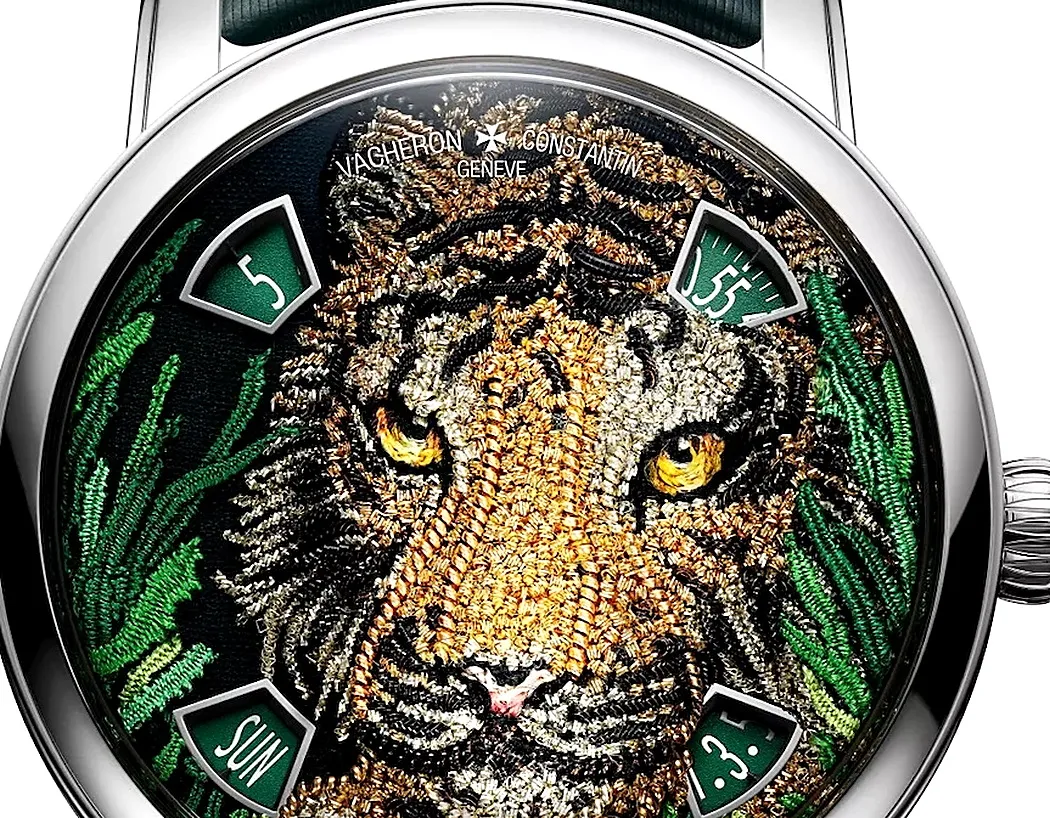
The most radical decision is the same one again: there are no hands. Inside runs Vacheron Constantin’s calibre 2460 G4. Two hundred and thirty-seven parts, self-winding, 28,800 vibrations an hour, forty hours of reserve. The G4 refers to four indications, and all four sit at the rim rather than the centre. Jumping hour at upper left, dragging minute at upper right, jumping day at lower left, dragging date at lower right. A jumping indication waits and then arrives in one movement; a dragging one slides without ever being caught in the act.
A hand crossing this dial would cut the animal’s face in two once a minute and would rub against the stitching as it went. The moment the centre is cleared, the dial stops being an instrument. The 12.9 millimetre height of the forty-two millimetre case serves the same end: roughly four millimetres of air sit between the embroidery and the sapphire, because gold thread touching glass would flatten and lose its light.
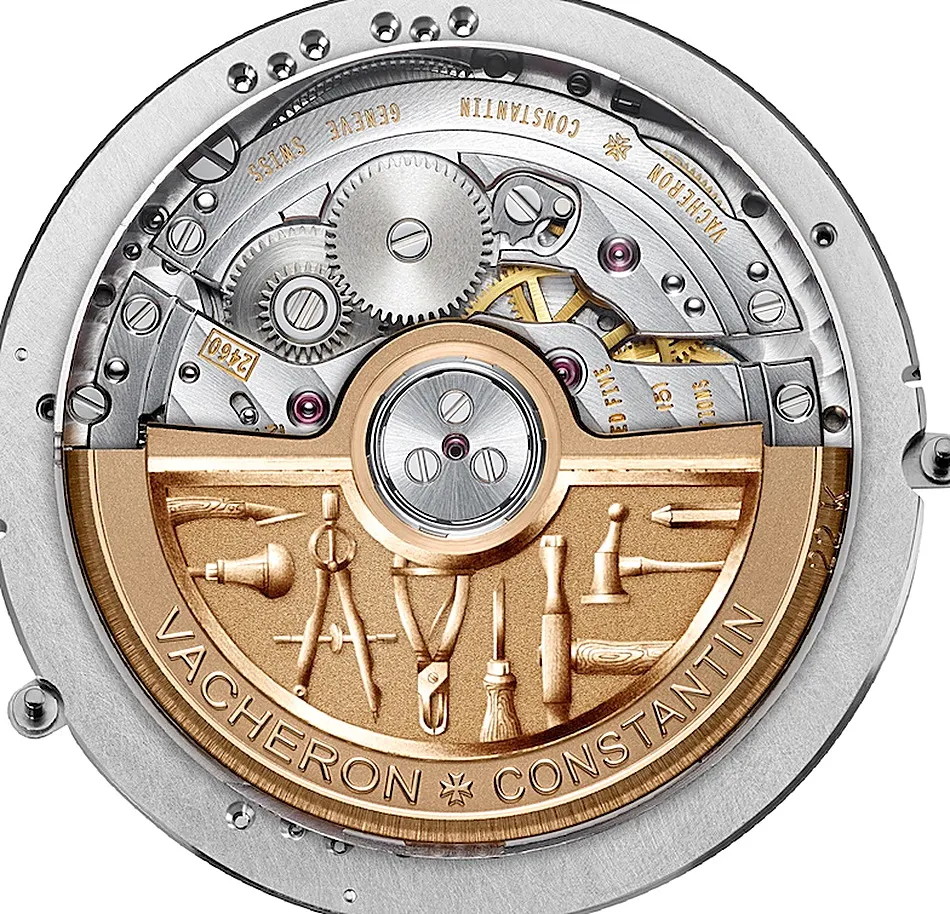
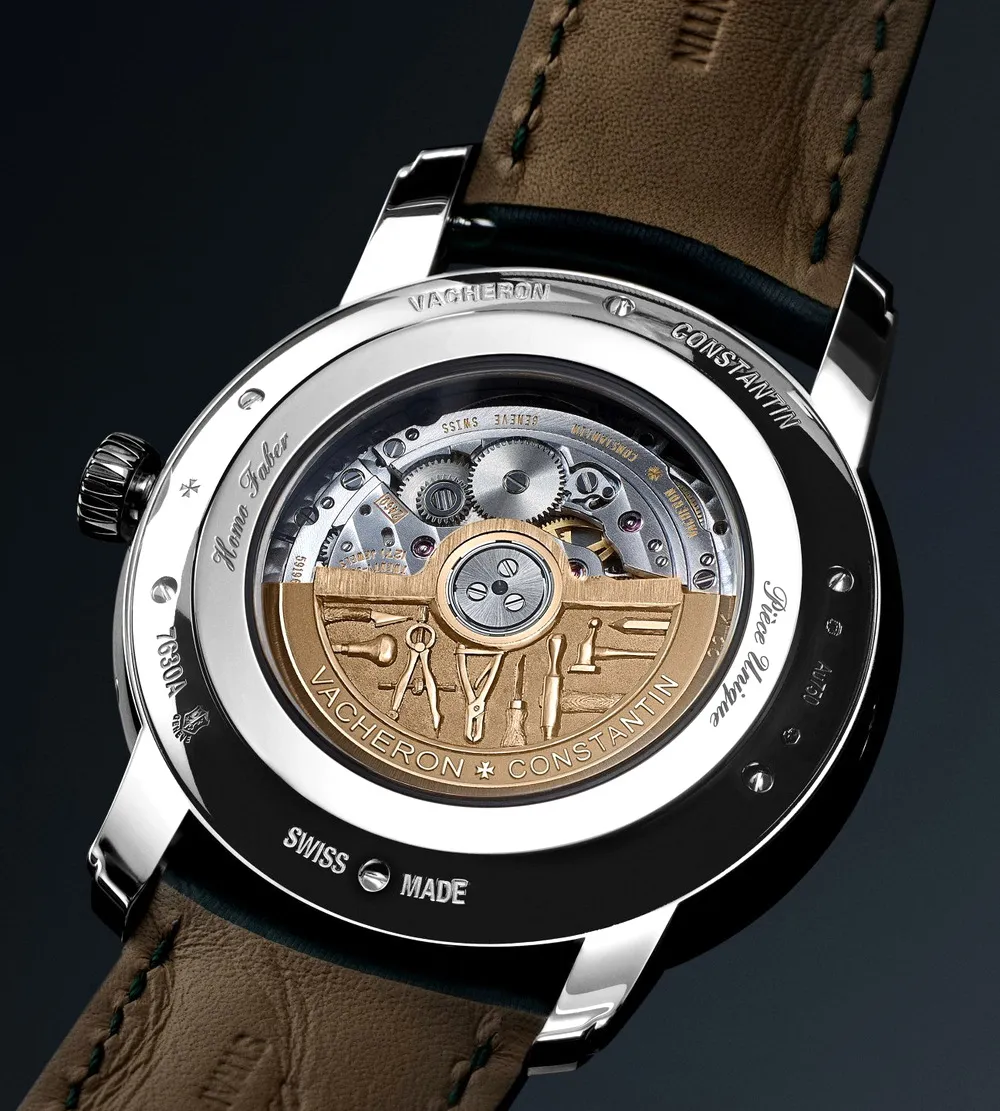
Through the display back, a relief of craftsmen’s tools appears on the rotor, identical across all six pieces. Vacheron put the instruments of the hand behind the movement rather than its own crest.
This is exactly where Tigerbroidery finds the right material. The tiger is already an animal made of lines, carrying a set of them as singular as a fingerprint, and carrying them in the skin rather than the coat. The most honest way to render such an animal is thread, because thread is already a line. Paint covers a surface and engraving subtracts from one; thread makes the line out of the material itself.
In the forest, when the monkeys go quiet and the deer all turn the same way, the tiger still cannot be seen. On this dial it can. But as you come closer the animal dissolves and gives way to thousands of separate stitches. A tiger from a distance and a labour from close up, both on the same surface.