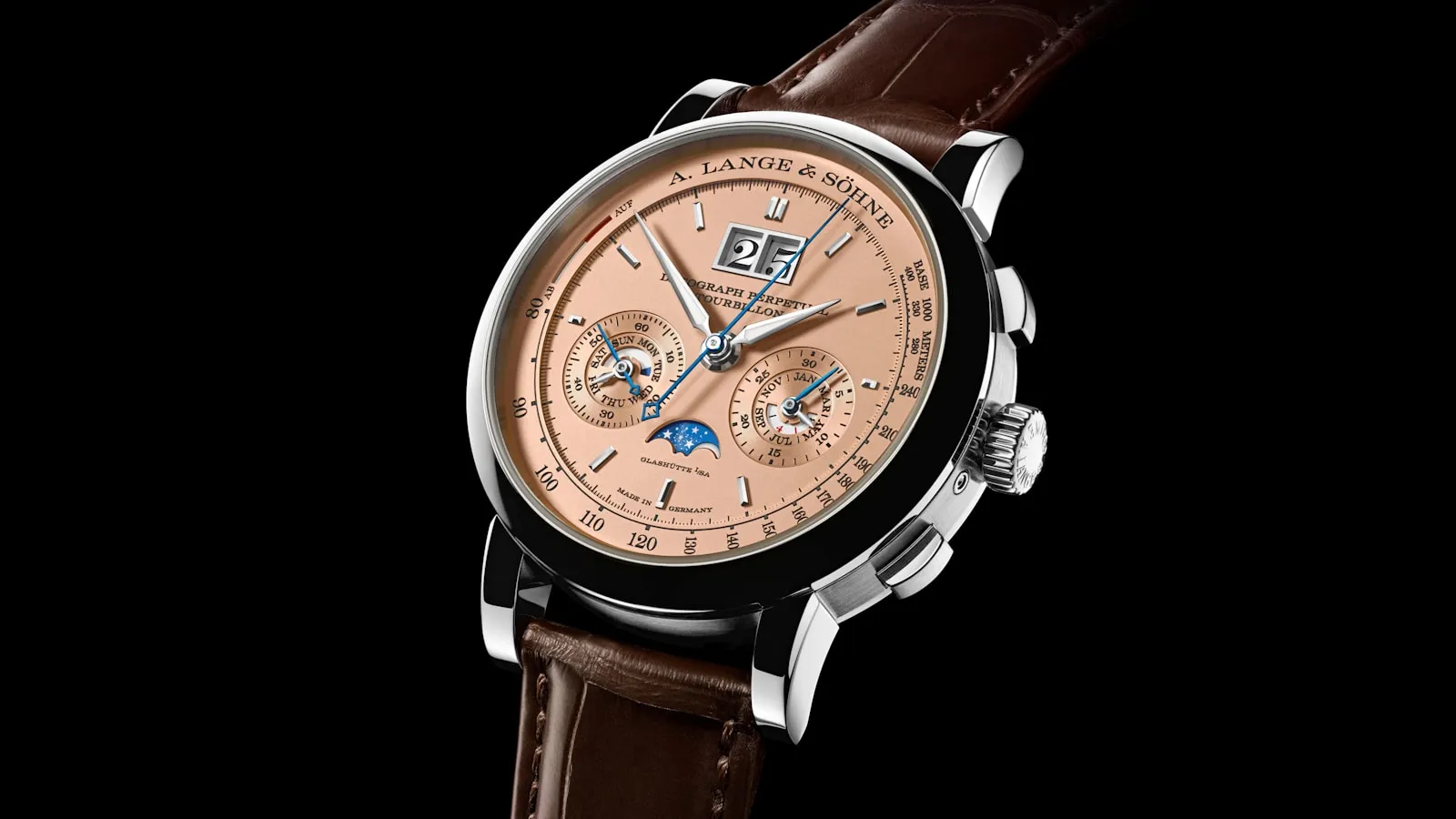
The Back That Silenced a Master
Most watches wear their soul on their face; on the dial, the hands, the numerals. But some watches hide their true story on their backs. And if there is one man in the world who can read that back better than anyone, it is Philippe Dufour. The Swiss master is regarded as the living conscience of watchmaking; a perfectionist who praises almost no one and who finds the smallest flaw under his loupe.
It is said that when this very Dufour once took a German watch in his hand and turned it over, he remarked that 'they do it better than the Swiss.' On our table today is the present-day summit of the mechanical tradition that inspired such admiration: the A. Lange & Söhne Datograph Perpetual Tourbillon, in one of its warmest guises, with a salmon dial. But we shall not merely review it; we shall tell its story.
A Name Reborn from the Ashes: Why 'Datograph'?
A. Lange & Söhne was founded in 1845 by Ferdinand Adolph Lange in the small town of Glashütte, in the Saxony region of Germany, and soon became one of the makers of the finest pocket watches in the world. Then history turned cruel: the factory was bombed in 1945, then nationalised under the communist regime, and the Lange name was buried for forty years. In 1990, just after the reunification of Germany, the family's descendant Walter Lange brought the brand back from its ashes. So behind this watch lies the resurrection of a craft.
But why 'Datograph'? The name is born of two parts: 'Dato' comes from the outsize date (Großdatum) that is Lange's signature; 'graph' from the chronograph. And the origin of that big date is itself poetic: it draws inspiration from the giant digital clock built in 1841 for the Semper Opera House in Dresden, which changed its numerals every five minutes. The young Ferdinand Adolph Lange worked on the making of that very clock. The large date on the Datograph's dial, then, is a heritage brought from the master's homeland.
Three Giants Together
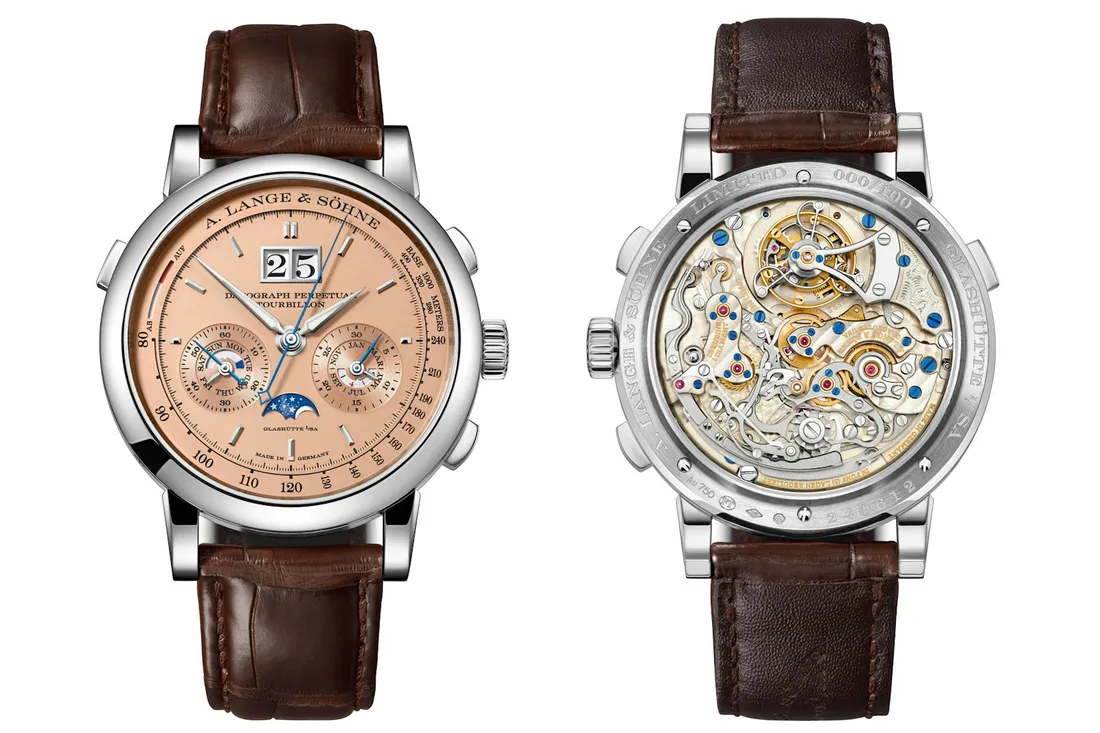
The Datograph Perpetual Tourbillon unites the three most demanding complications of watchmaking in a single white-gold case: a flyback chronograph with the big date, a perpetual calendar, and a tourbillon. The salmon-dial version of this 41.5 mm watch is made in only 100 pieces.
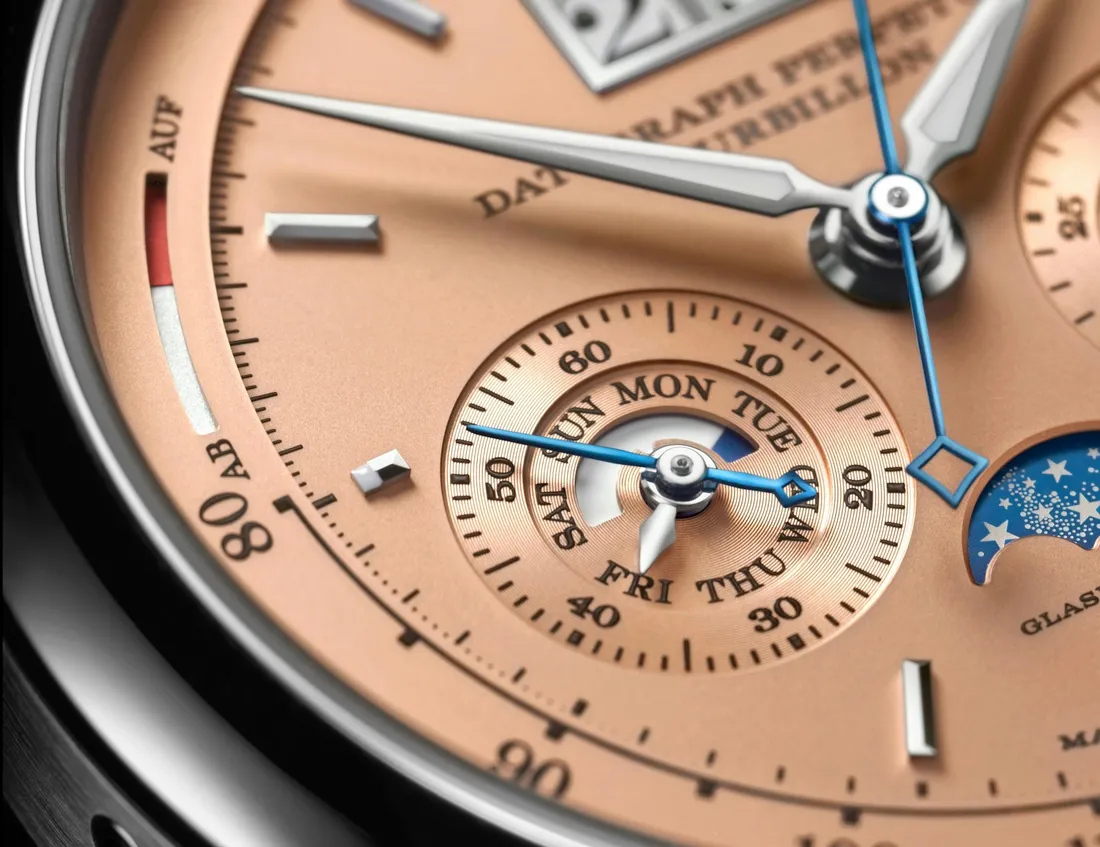
For all its complexity, the dial remains legible. Just below twelve sits the big date; at three, a 30-minute chronograph totaliser that also serves as the month and leap-year display; at six, the moon phase; between eight and nine, both the running seconds and the day and day-night indication; and around the edge, the words AUF (wound) and AB (run down) show the power reserve. The central hands carry the hours, minutes and chronograph seconds. The warm copper tone of the salmon suddenly makes all this technical crowding elegant.
Two Different Stories of Time
The perpetual calendar is, in truth, a mechanical memory. This watch has memorised all the whims of the Gregorian calendar: which months have 30 days, which have 31, February's 28 and the 29th that comes every fourth year. And it will keep them all correct, without a single correction, right up to the year 2100. The machine on your wrist will know the leap year of the coming century long after you are gone; like a quiet promise that outlives its owner.
The tourbillon, meanwhile, is an ingenious answer to gravity. Gravity is a sly thief; when the watch lies still, it pulls the balance wheel differently depending on the position, and steals away precision. The tourbillon says to this thief: let me place the whole escapement on a slowly turning platform, so that gravity can never catch it standing in one place, unprepared. Every error is averaged out and erased by the rotation; just as a spit turning endlessly over a fire lets no side burn. Lange adds a stop-seconds mechanism and, atop it, a diamond endstone, making the work both more precise and more magnificent.
A Mechanical City: The Architectural Depth of the L952.2
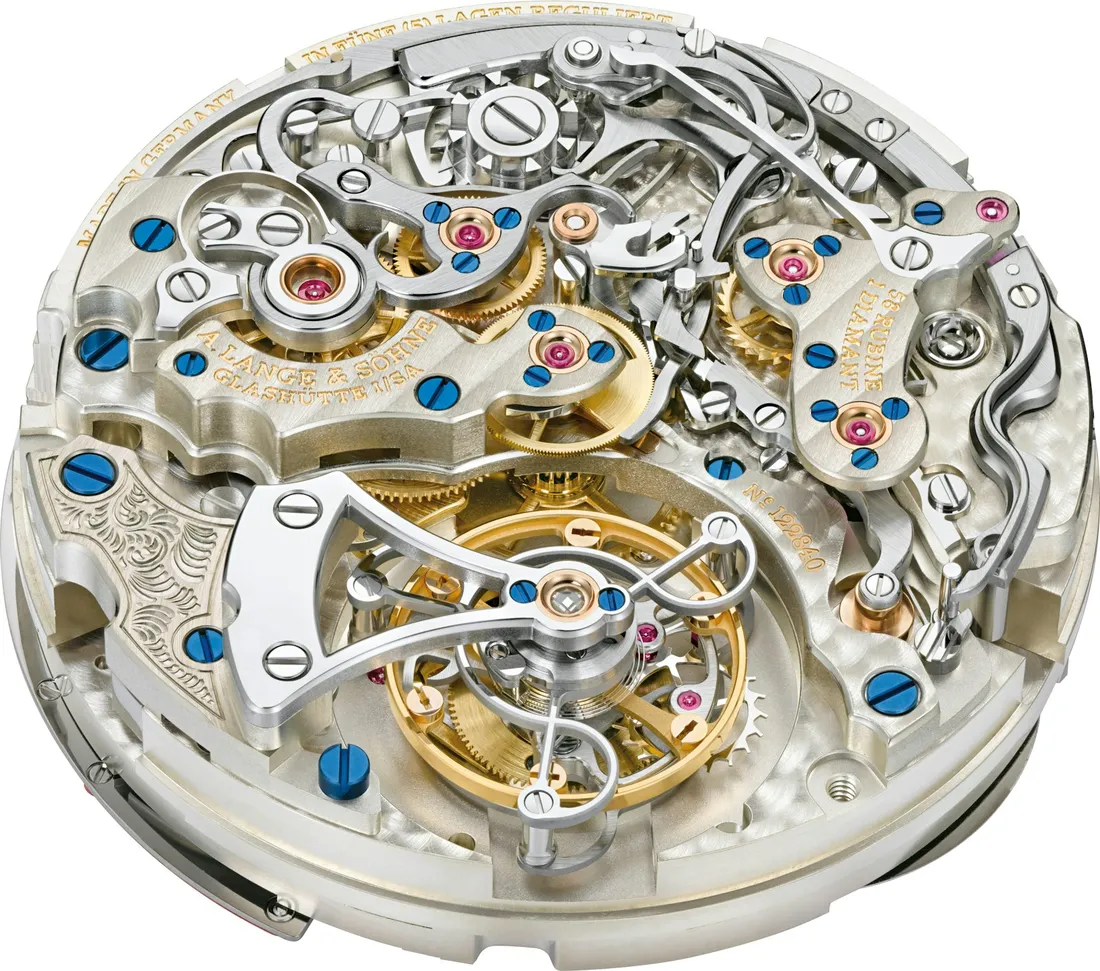
Where ordinary chronograph movements look flat and single-layered, the L952.2 calibre inside this watch is like a three-dimensional city. Turn it over and the sense of depth that greets you is immense: the chronograph levers reach across the top, while the wheels and the barrel appear at the very bottom. This landscape, rising layer upon layer, is an architecture you could watch for hours. Let us look, one by one, at the details that make up that visual feast.
A Signature Cut by Hand: The Balance Cock
The most eye-catching part of the movement is the cock that holds the balance wheel, the heart of the watch. The floral patterns on this cock are not printed; they are engraved entirely by hand, under a microscope and with a chisel, by the engraving masters at Glashütte. And here is the magical part: the angle and style of each master's chisel stroke differ from one another. An expert eye looking at the back can therefore tell which master engraved that cock. Every Lange, in other words, carries on its back a unique signature touched by a human hand.
Just above this hand-engraved cock you will see a curved steel piece resembling the neck of a swan: the swan-neck regulator. This elegant part serves to adjust, with the tiniest of touches, how many seconds a day the watch runs fast or slow. It is at once an engineering instrument and, with its curve, a jewel that enriches the beauty of the back.
A Symphony of Colour: Gold Chatons and Blued Screws
When you look at the L952.2, you see an immense harmony of colour, and that harmony is no accident. The blue screws are not painted; the steel screws are heated by hand to a temperature between 290 and 300 degrees, and at precisely this point the steel changes colour at the molecular level and takes on that deep, parliament-blue tone. A single degree more or less spoils the colour.
The synthetic ruby jewels at the centre of the wheels, which reduce friction, are not set directly into the bridge. First they are placed into small rings of 18-carat gold, the chatons; then this gold ring is fixed to the bridge with blued screws. And so the champagne of the German silver, the deep blue of the screw, the warm gold of the chaton and the red of the ruby form a complete symphony of colour on the back.
The Column Wheel, Glashütte Ribbing and That Famous Finishing
One of the most beautiful details inherited from the first-generation movement is the column wheel at the heart of the chronograph. Look carefully at the back and you will see this wheel, resembling a small castle or a tower gear. When you press the chronograph pusher on the side, steel levers move and push the teeth of this wheel; if you press it while watching the movement, you will see live how those levers and wheels interlock in a flawless mechanical dance. While most modern watches hide this system beneath closed bridges, Lange leaves the whole spectacle fully in the open.
On the German silver bridges run parallel wavy lines, the Glashütte ribbing, the Glashütte interpretation of what the Swiss call Côtes de Genève, and they break the light perfectly. But the real matter lies at the edges: every sharp corner of the hundreds of tiny steel parts is cut at a 45-degree angle by a technique called anglage, and hand-polished until it shines like a mirror. When the light strikes, the edges of those little levers at the back sparkle like diamonds.
So why German silver (Neusilber)? This alloy of copper, nickel and zinc is neither plated nor painted; over time, through the touch of the hand and the air, it acquires a warm, golden patina. It is also difficult to work: it oxidises, cannot be touched with bare hands, and so the master finishes the movement twice, once for assembly and then, after taking it apart, a second time for the final assembly. Lange endures this trouble for the sake of warmth and honesty. These bridges hold 58 rubies and, atop the tourbillon, a single diamond; the movement is adjusted in five positions. This is exactly what Philippe Dufour meant: while many great brands polish only the visible surfaces, Lange works even the most hidden corners, where you could not find a flaw with a loupe, with the very same rigour.
The Face That Tells the Time, the Back That Tells the Art
In the end, two separate masterpieces stand before us: on the front, a dial that whispers the time, the date and the moon over a warm salmon ground; on the back, the L952.2, which alone tells you why watchmaking is an art. This white-gold watch, which only 100 people can own, is a mechanical city you carry on your wrist. Some watches you admire from the front; this one you fall in love with from behind. Just like Philippe Dufour.