Night in a tropical forest is the reverse of the day. The instant the light goes, the sound begins, and the forest brings to the surface everything it kept hidden. When I turned the beam of my torch onto a branch I saw it: a snake coiled twice around itself, its head resting on its own body. It was not moving. But it had noticed me long before I noticed it.
As a herpetologist you know this from certain details. A snake has no eyelids. Over the eye sits a transparent scale that is renewed each time the skin is shed. It never blinks, and it never looks as if it is asleep. That it had seen me I understood from the tongue. That forked tongue is not a weapon; it is a nose. It collects molecules from the air and carries them to an organ in the roof of the mouth, and from the tiny difference between the two tips it works out which direction the scent came from. A snake does not smell an odour. It sees the odour in three dimensions.
In some species there are small pits between the eye and the nostril. Each pit is lined with a membrane that registers temperature differences of less than a degree. In total darkness it maps the warm body in front of it. We are talking about an animal that sees light with one organ and heat with another, and assembles both into a single image.
Then there is the famous business of the jaw. A snake’s lower jaw is not a single piece; its two halves are joined at the front by an elastic ligament, and it is attached to the upper jaw not rigidly but through a mobile bone. That is how it swallows prey several times the width of its head. Nothing is ever dislocated; there is no joint there to dislocate.
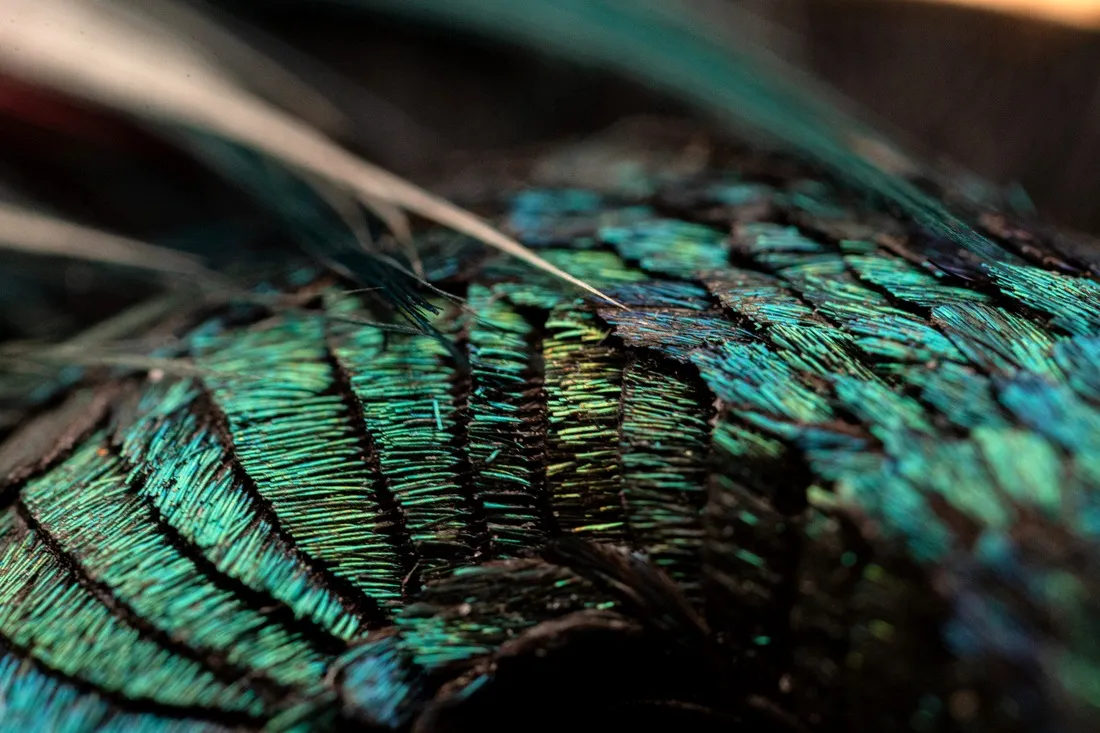
But what stopped me that night was the scales. In the torchlight the snake’s back had a metallic green cast, as though a thin film of oil had been poured over it. Snake skin is in fact dry and hard. That gloss does not come from pigment but from structure: microscopic layers on the surface of each scale refract light and send certain wavelengths back. The colour is not a dye. It is geometry.
And this is where I had to repeat, once more, the sentence I have been repeating for years. The scale of a snake and the feather of a bird are made of the same substance. Both are keratin. Our fingernails, our hair, the horn of a rhinoceros, the shell of a tortoise, the wing of an eagle and the back of this snake are different architectures built from one family of protein. So much form written into a single material.
For a zoologist that is an ordinary line in a lecture. For a craftsman it is a door.
format_quote"The scale of a snake and the feather of a bird are the same substance. So much form written into one material cannot be explained away as accident."
Hasan Bekmezci
That door was walked through in Geneva in the summer of 2026. Vacheron Constantin announced a set of six pieces titled Métiers d’Art Tribute to the Animal Kingdom, all of them under the house’s One of Not Many Crafts Programme, which pairs a craftsperson from outside watchmaking with the watchmakers of Geneva and asks that their technique be brought into forty-two millimetres for the first time.
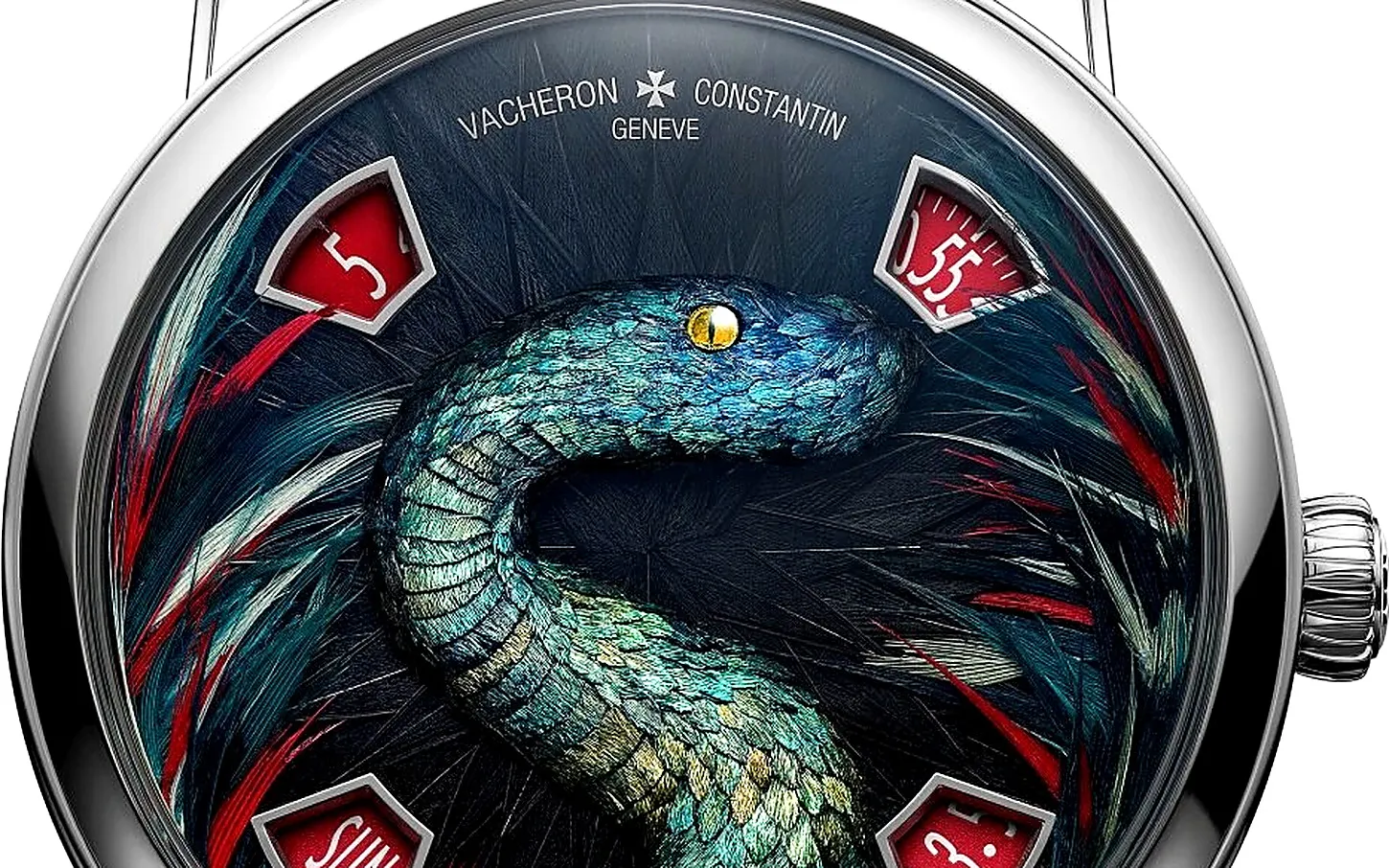
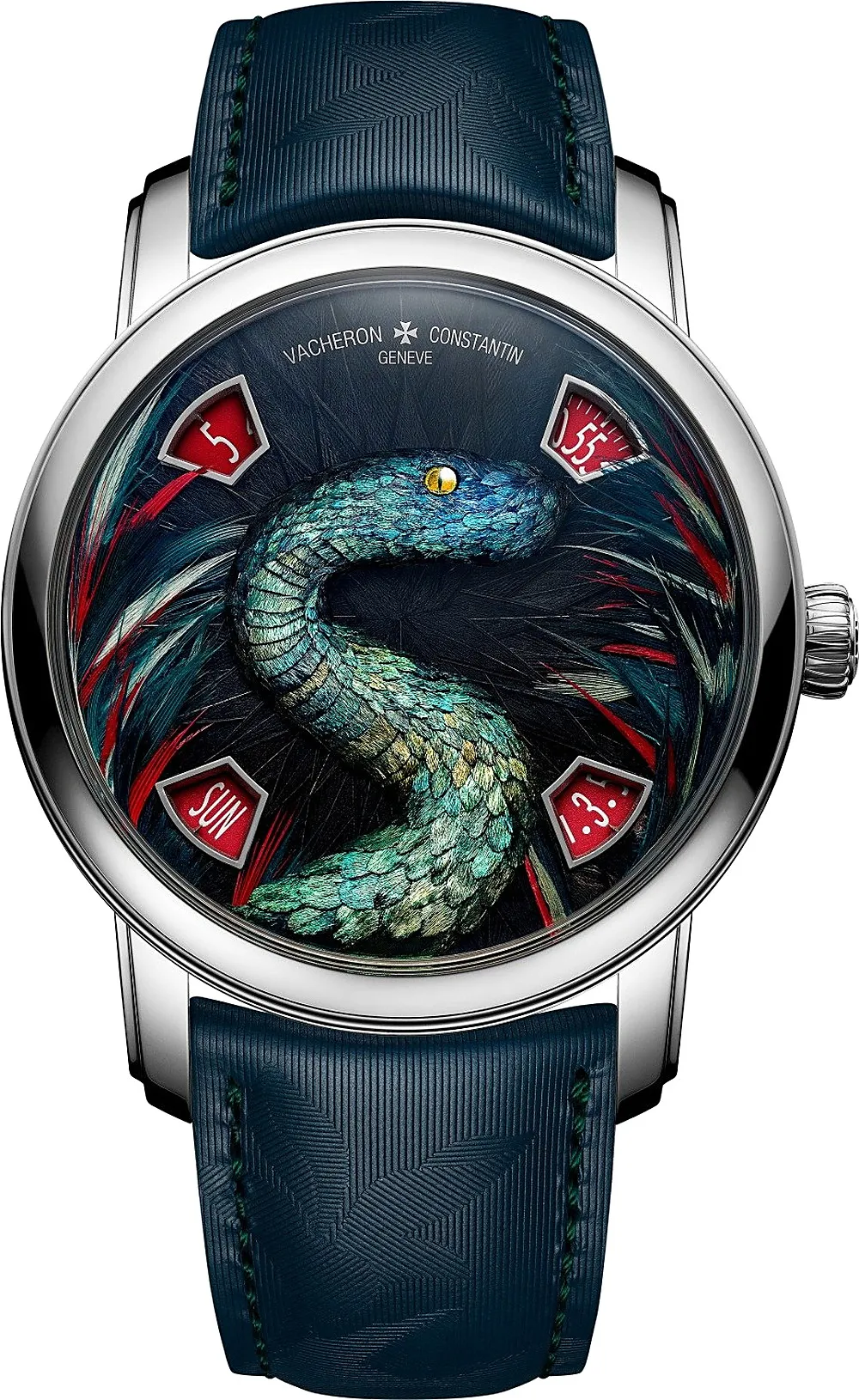
The piece that fell to the snake is called Feathersnake, reference 7630A/000G-H206, and its dial is the work of the French plumassier Julien Vermeulen.
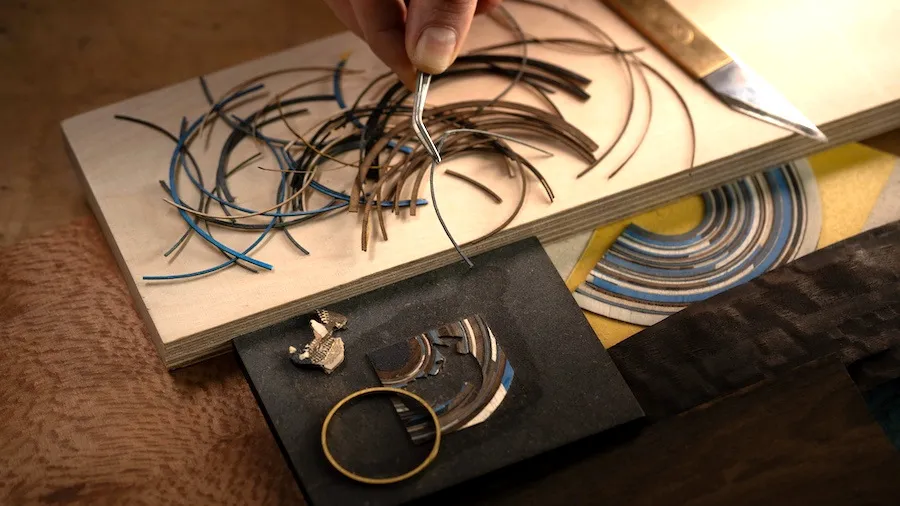
Plumasserie, the art of featherwork, is among the oldest and most delicate of the Parisian crafts. A feather is not cut so much as pared; it is not soaked but steamed; it is not glued down but laid. Every feather has a direction, and working against it destroys the barbs. For this dial Vermeulen used lophophore and goose. The lophophore is a pheasant of the high Himalayan slopes whose neck and back carry that metallic green and blue shimmer. Goose does the opposite job: flat and durable, it takes cutting and shaping well.
The work itself is this. Every scale on the snake’s body is a small piece cut from a single feather. The pieces are laid in overlapping rows, from the bottom upward, exactly as they would sit on a real reptile. The result is a surface that carries the softness of a feather while building the geometry of a scale. Vermeulen did not make feathers out of feathers. He made scales out of them.
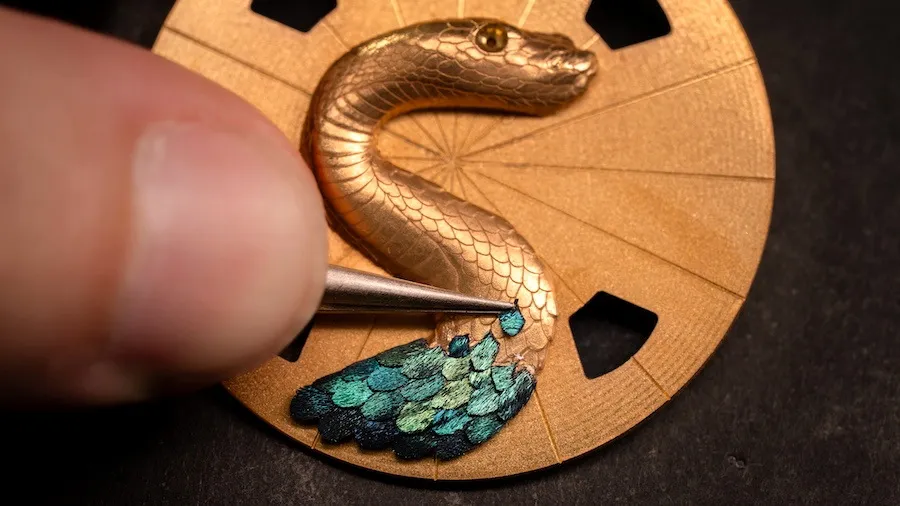
format_quote"Vermeulen did not make feathers out of feathers. He made scales out of them. The leap of a craft begins exactly there."
Hasan Bekmezci
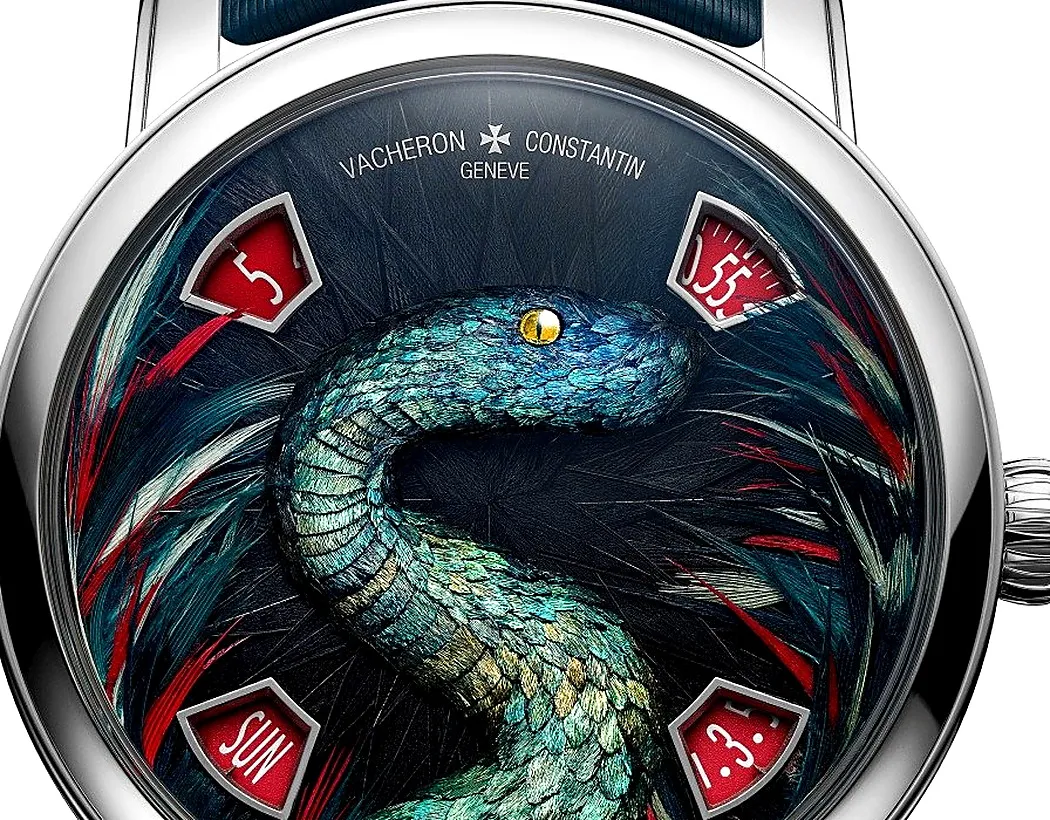
One further decision holds this dial together: colour. The body runs in cold greens and turquoises, and around it are scattered bursts of red feather. The red is not decorative but functional. A warm colour pushes a cold body forward. Your eye finds the red first and then falls to the green at the centre. What a painter does on canvas, Vermeulen does with feathers.
The most radical decision is the absence of hands. Inside runs Vacheron Constantin’s calibre 2460 G4: two hundred and thirty-seven parts, self-winding, 28,800 vibrations an hour, forty hours of reserve. The G4 refers to four indications, and all four have been pushed to the rim rather than the centre. Jumping hour at upper left, dragging minute at upper right, jumping day at lower left, dragging date at lower right.
The reason is plain enough. A steel hand crossing this dial would comb the feathers once a minute, damaging both the image and the material. The moment the centre is cleared, the dial stops being an instrument. The 12.9 millimetre height of the forty-two millimetre white gold case exists for the same reason: roughly four millimetres of air have been left between the feathers and the sapphire. Nothing touches the glass, because anything that did would lie flat and lose its shimmer.
format_quote"Carving a snake in gold is a preference. Building one out of feathers is an argument."
Hasan Bekmezci
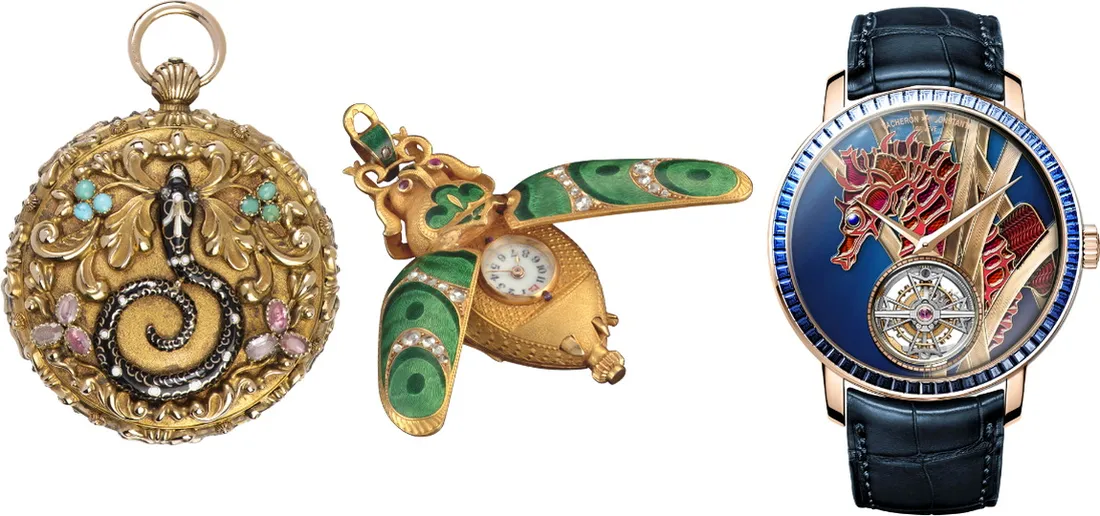
Finding a snake in a watch house’s archive is not difficult. The animal figure is one of the oldest decorative languages in watchmaking, moving through engraved pocket watches, enamelled covers and jewelled watches for centuries. What lifts Feathersnake out of that tradition is not the figure but the way the material was chosen.
Because here the material is not arbitrary. Carving a snake in gold is a preference. Building one out of feathers is an argument. The feather is the one surface a snake can never have in life, and at the same time it is made of the same protein. Vermeulen is not demonstrating an impossibility. He is demonstrating a kinship.
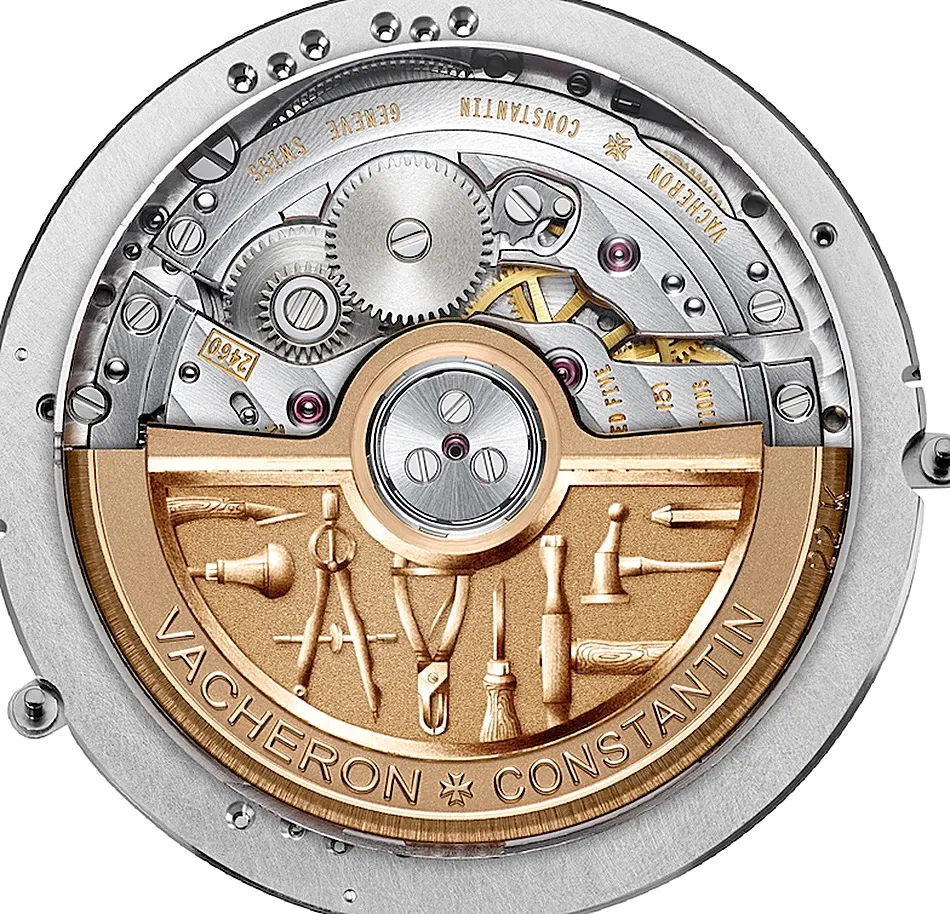
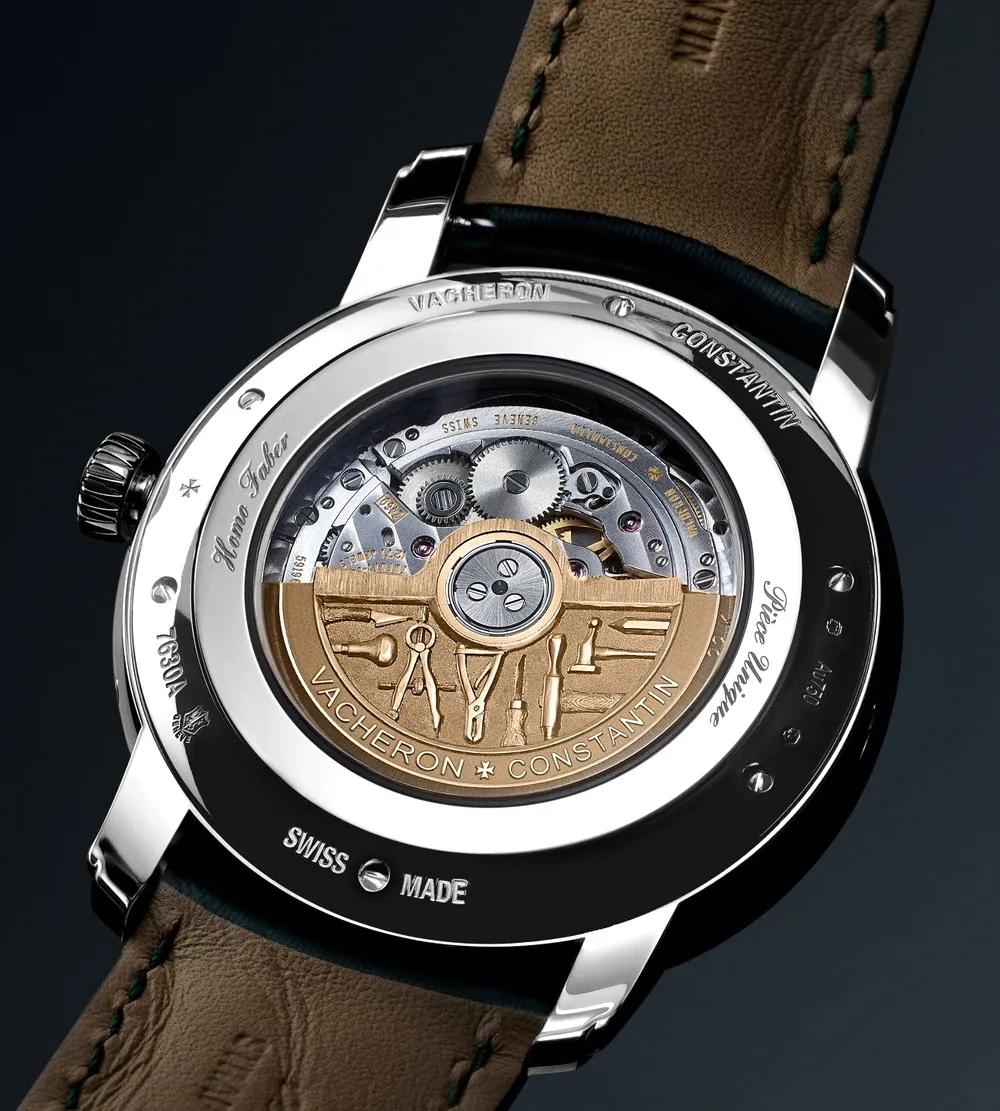
Through the display back, a relief of craftsmen’s tools appears on the rotor, identical across all six pieces in the series. Vacheron put the instruments of the hand behind the movement rather than its own crest.
When I switched off my torch in the forest that night, the snake was still on the branch. It had not left; it had no reason to. A reptile that has found the stone that warms it does not move on.
The dial of Feathersnake sits in the same way. It is going nowhere and it is indicating nothing. It has handed the hours over to four small windows and kept the middle for itself. It says one thing to whoever looks at it: the wing of a bird and the back of a snake are made of the same substance, and for you to see that, somebody had to cut a thousand feathers one at a time.