In the fabric of the universe no unit and no measure is the work of a random coincidence; the true balance is woven from that dimensionless, pure and unshakeable ratio at the very bottom.
Time is the silent reflection of eternity upon a set of wheels; independent watchmaking is the pure philosophy that makes that divine equilibrium concrete in layers of steel.
Does the ratio of any two numbers not give the same value everywhere? That is the most legitimate question the mind can raise here. But what we are comparing is not abstract figures on paper; it is the weighing of two entirely opposite physical realities.
Why does this ratio have to be 1836? If it were not this ratio, why would atoms fall apart? What is the divine order and measure in the bringing into being of these particles? Let us put all of it on the table, step by step.
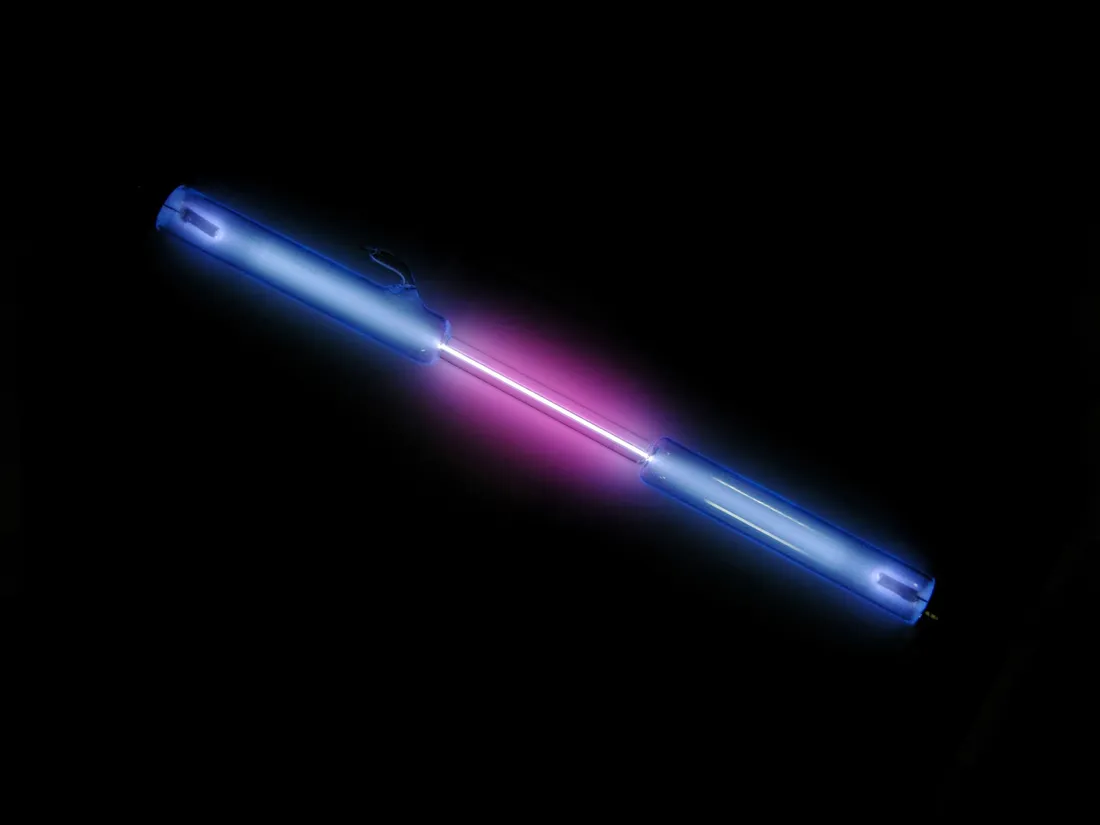
These two fundamental actors of the universe do not resemble one another; an enormous gulf of character and of weight separates them. The proton is the vast, unshakeable centre of mass that sits in the nucleus of the atom; dense, heavy and stable, it carries almost the whole weight of the atom on its back. The electron, beside it, is a ghostly quantum grain, lighter than a feather, possessing a wavelength, swinging around the nucleus at roughly one hundredth of the speed of light. The ratio of their masses, as far as it can be measured, comes to 1836.152, and it carries no unit at all.
If this mass ratio were not 1836 but, say, 10 or 100, that is to say if the electron were far heavier relative to the proton, the cloud the electron holds around the nucleus would contract in the same proportion and the atom would shrink far below its present size. What keeps the electron from falling into the nucleus is not its mass but the uncertainty principle; yet that lightness is what gives the atom its present width and, more critically still, what lets the nucleus stand almost perfectly still beside the electron. As the ratio approaches one, the nucleus blurs out just as the electron does, and nothing is left of a molecule’s fixed shape. A stable thing called an orbit could not exist. The lightness of the electron is what lets it turn at a safe distance around the nucleus without falling into it.
For atoms to come close to one another and, by sharing electrons, build molecules such as water, proteins and DNA, those electrons must form clouds in the outer shells according to particular rules. If the mass ratio were not locked at 1836, atoms would either repel one another or swallow one another. The exchange of electrons that is the glue of chemical bonds would become impossible.
In a universe without molecules there would be no liquid water, no carbon-based organic structures and no cells to be born. The universe would have remained a hot, dark and blind soup of gas, nothing but free protons and electrons colliding at random.
format_quote"The universe would have remained a hot, dark and blind soup of gas, nothing but free protons and electrons colliding at random."
Hasan Bekmezci
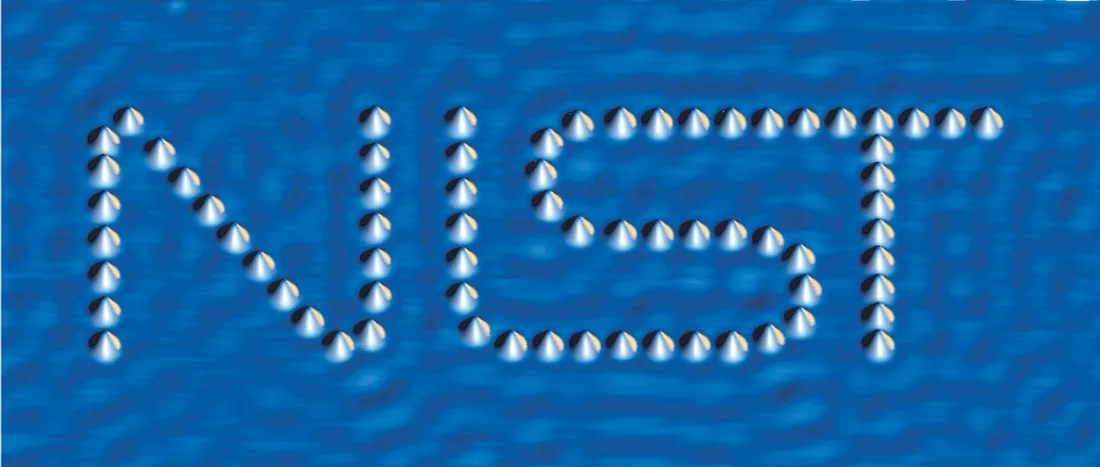
This flawless balance in the cosmos shows that everything was created upon a measure and a scale. Giving the proton that heavy mass let matter build itself a basic dwelling, and giving the electron that feather lightness set the chemistry and the motion of life going around that dwelling. The electron to proton ratio is the most sensitive set of scales in the universe at the scale of particles. That ratio cries out that the cosmos is no stray coincidence, and that every single particle has been set in its place by a flawless reckoning and order.
format_quote"The electron to proton ratio is the most sensitive set of scales in the universe at the scale of particles."
Hasan Bekmezci
Let us use four analogies to make this delicate balance concrete in the mind.
Picture a tiny moon going round an enormous Jupiter. If the moon were far too heavy relative to Jupiter it would crash into the planet; if it were far too light it would be flung out into space. The electron to proton ratio is the cosmic law of attraction that keeps the system inside the atom from leaving its orbit.
Picture a pair of scales of great delicacy. Put the slightest excess in one pan and the balance is overturned. The electron and the proton, the two pans of the universe, stand on those delicate scales in flawless equilibrium.
It is like the perfect ratio between the tension and the thickness of a violin string. Break that ratio and what comes out of the instrument is not a note but a noise that grates on the ear. This ratio is the tuning of that flawless melody of existence the universe sings.
It is like the keystone at the very top of an enormous arched bridge. Were the size of that stone different by even a millimetre, the whole bridge would come down.
format_quote"This ratio is the tuning of that flawless melody of existence the universe sings."
Hasan Bekmezci
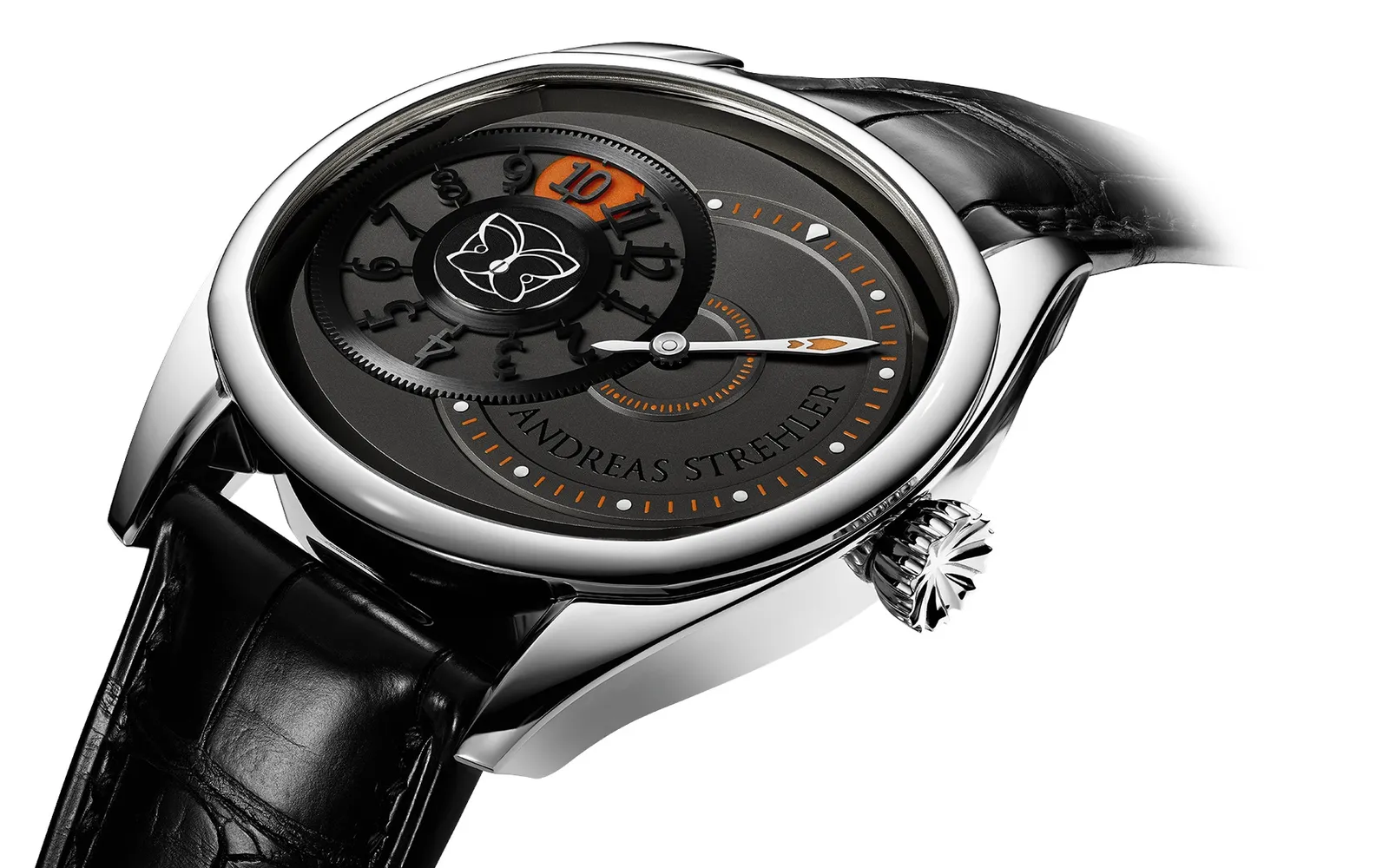
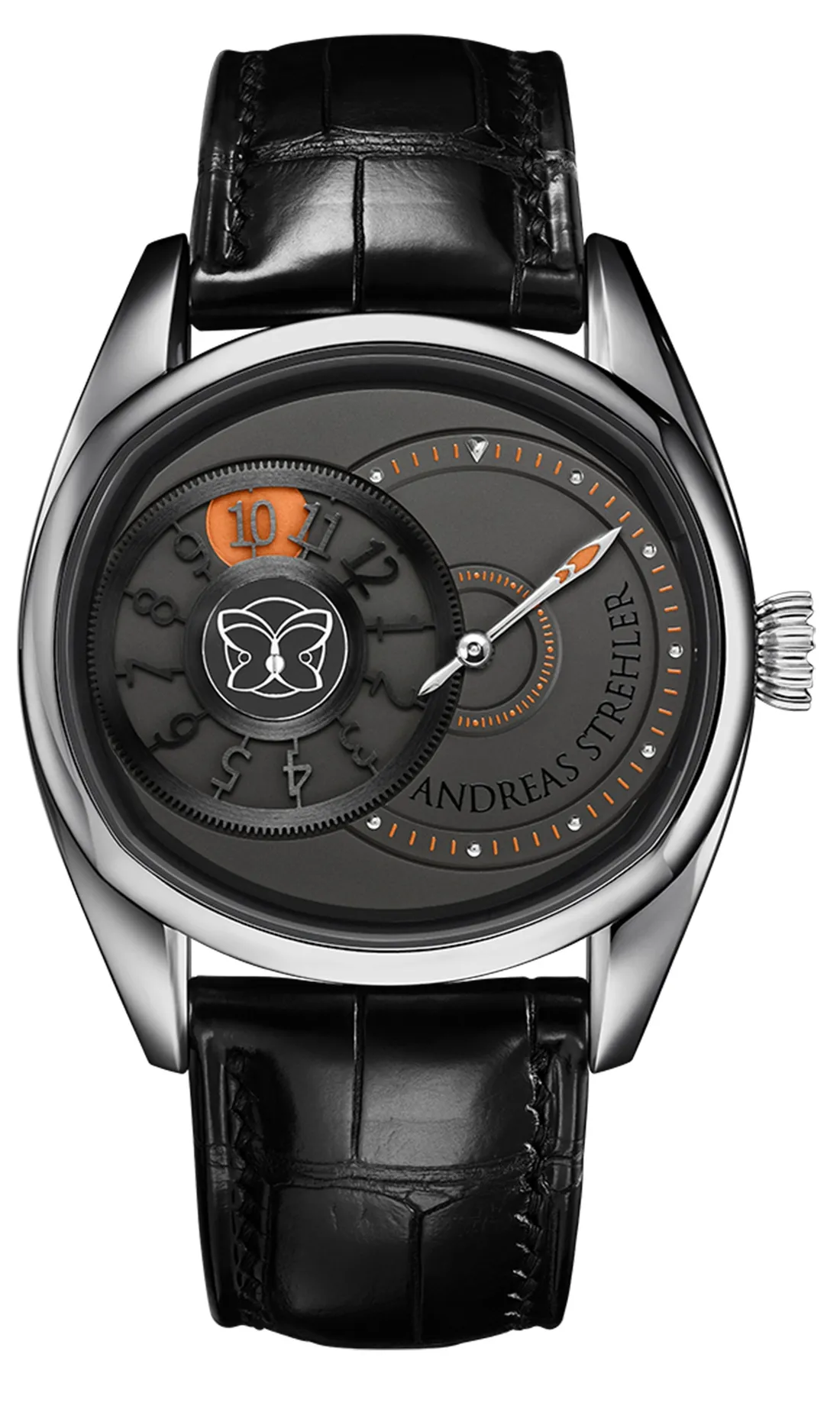
The watch that carries this most fundamental mass ratio of the universe, and its flawless mathematical order, onto the wrist is the Time Shadow, the masterpiece of Andreas Strehler, the genius of independent watchmaking. A stainless steel body finished by hand, a graphite grey dial, wheels in the form of an eight and a hand-wound calibre running seventy-eight hours on a double barrel: all of it gathered in one place.
The stainless steel case of 41 mm by 47.2 mm recalls the flawless structure of the physical constants in the universe. Every corner and every curve of the case is polished by hand; nothing in it is left to chance. This is the watch in which Strehler turned to steel for a case for the first time; the body, ten millimetres high, deliberately keeps company with the technical air of the dial.
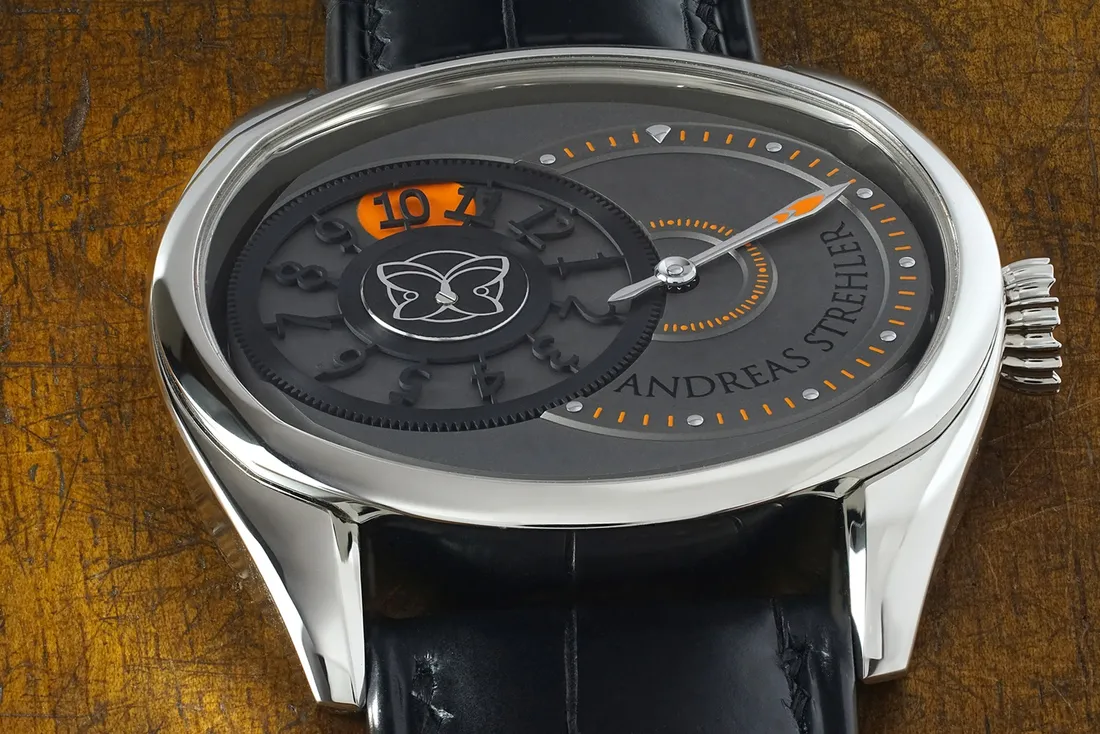
On the graphite grey dial of the watch, the enormous gear arrangement that ties the hour and minute indications to one another forms a lying eight, which is to say the sign for infinity. That reading is not the reader’s but the maker’s own: the minute wheel drives the hour disc directly, and the two wheels together draw a recumbent eight. This design, which recalls the endless flow of a dimensionless constant through the universe, is completed by the orange details on the left of the dial. The current hour is read as a numeral cut out of the disc passing over an orange luminous dot, and two luminous inserts are sunk into the minute hand as well. The dial itself is silver under a grey coating and left matt, so that it answers the fine grained grainage texture of the movement.
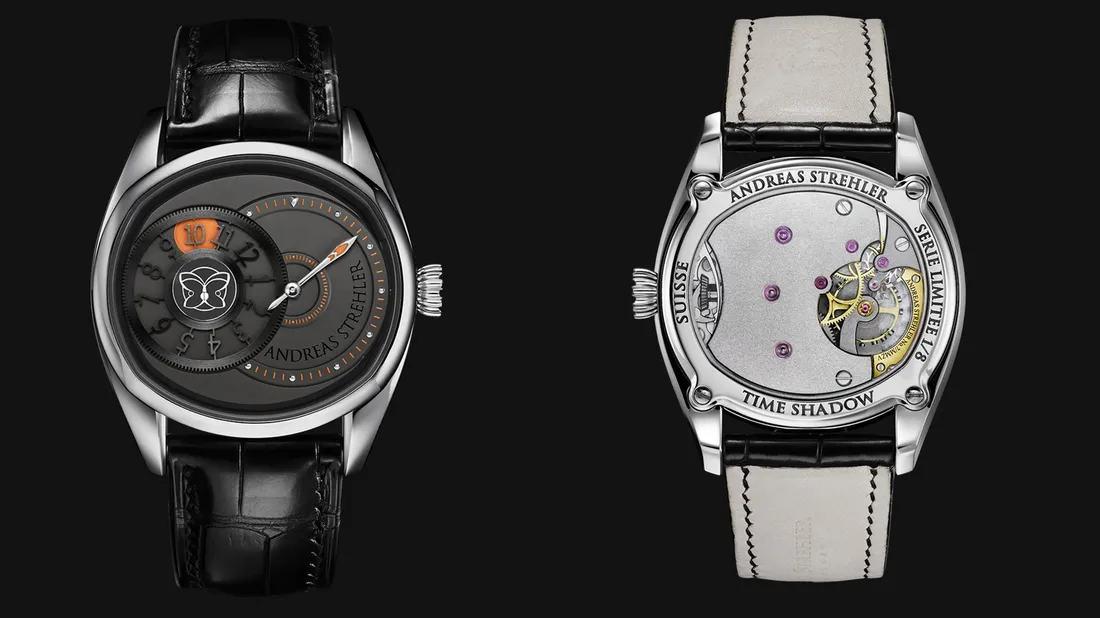
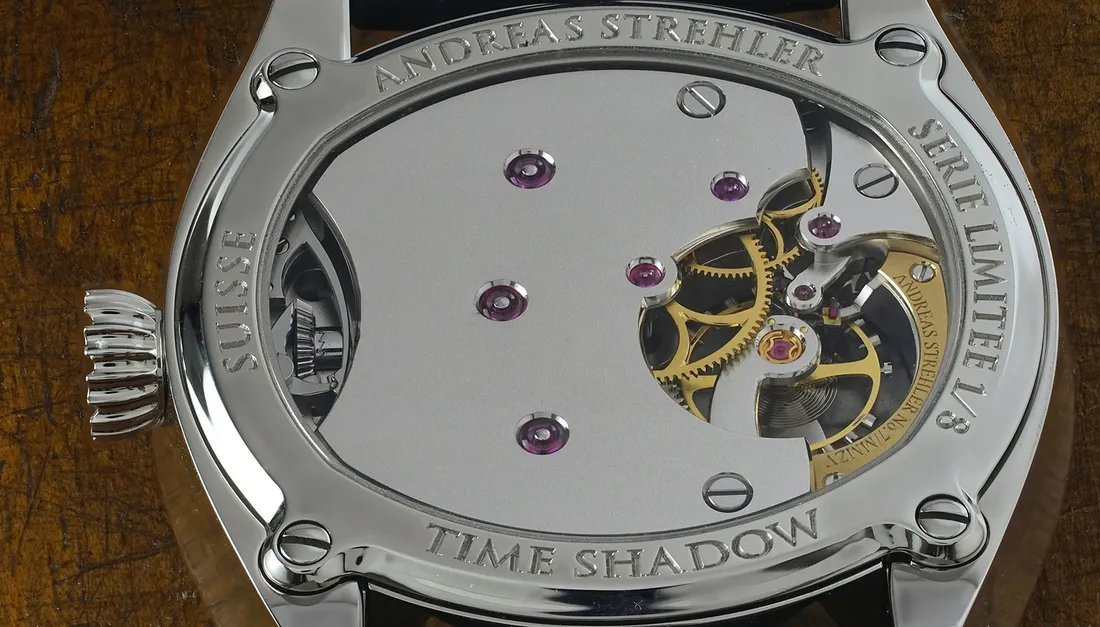
At the heart of this special model, made in only 8 pieces, beats a hand-wound movement built for it. The 78 hours of power reserve offered by the double barrel carry time forward with the same steadiness as the unshakeable period of the electron around its proton. The tonneau-shaped calibre measures 32 by 30 millimetres and is 5.9 millimetres thick, beats three times a second, and carries twenty jewels across a hundred and thirty-two parts. The main plate is finished in that fine grained grainage which allows no later retouching; the edges of the eight-cornered, figure-of-eight bridge are bevelled and polished by hand. The series is finished and entirely sold out, at fifty-nine thousand Swiss francs before tax.
One of them is the most fundamental and dimensionless mass ratio of the cosmos, the electron to proton mass ratio, the fact that an electron weighs one part in one thousand eight hundred and thirty-six of a proton; the other is the Andreas Strehler Time Shadow, the work of a genius of independent watchmaking who makes that divine order concrete in steel and wheels.
One is the dimensionless essence of the cosmos; the other is a masterpiece of mechanical philosophy that brings that infinity together with craft.
The watch in its maker’s own words: Andreas Strehler, Time Shadow