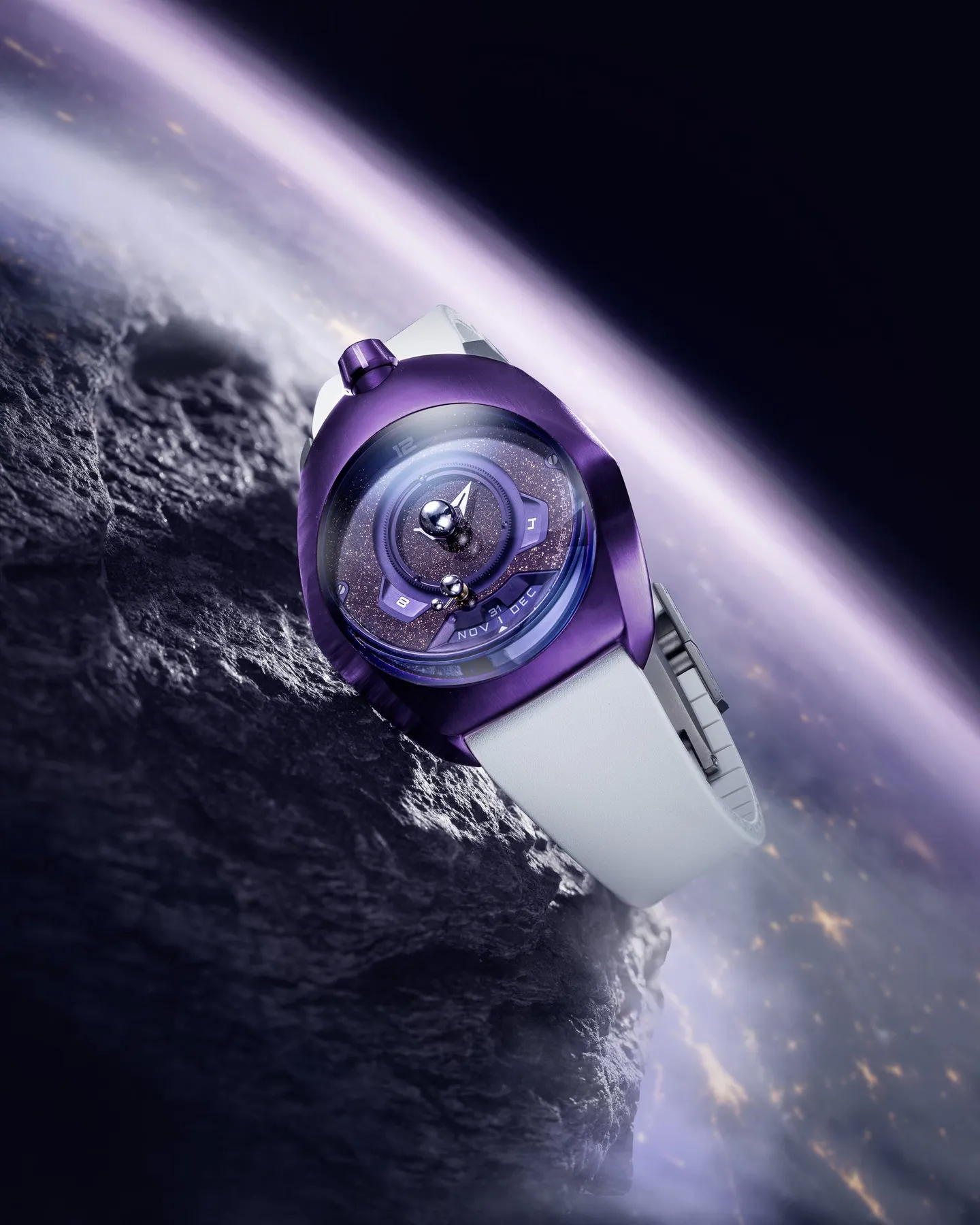
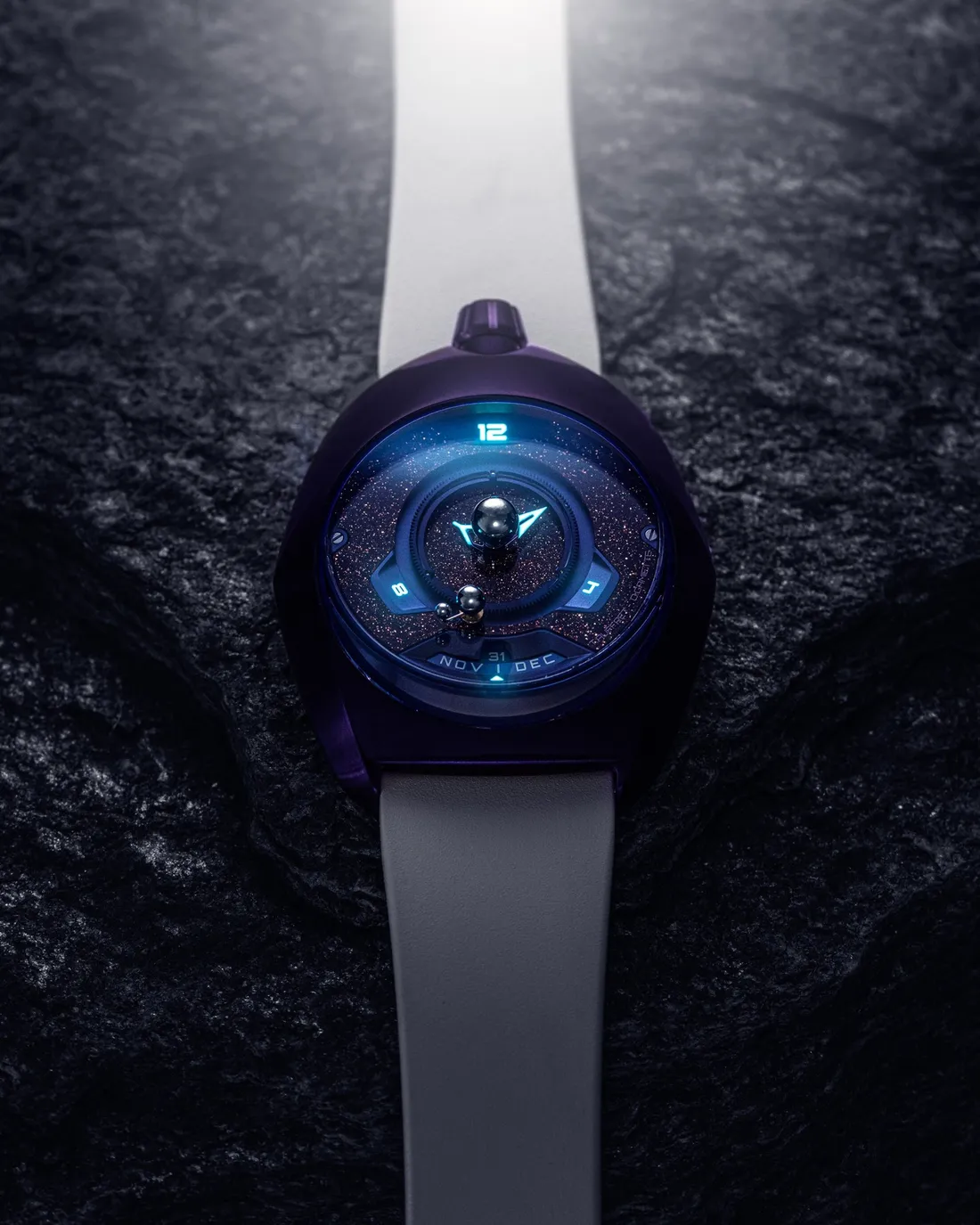
When you glance at your wrist, you may in fact be looking at a tiny universe. For beneath the domed crystal of the SpaceOne Tellurium, the Sun, the Earth and the Moon turn around one another in a real order, just as they do in the sky. This is not merely a watch; it is a pocket solar system, a miniature piece of celestial mechanics you can strap to your wrist.
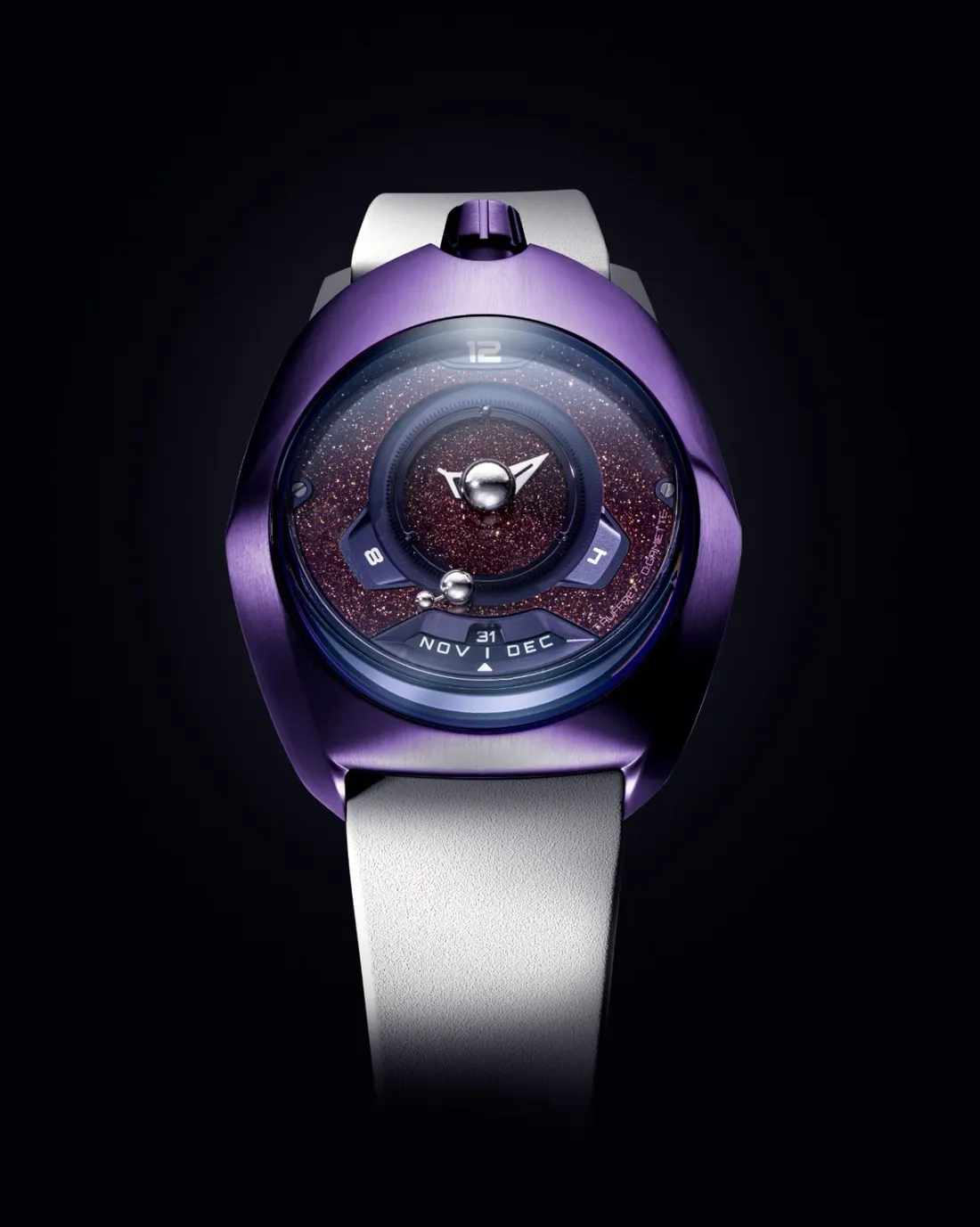
Carrying the signature of the Paris based brand SpaceOne, this watch marries the space age aesthetic born of the 1960s space race with serious celestial mechanics. Its patented heliocentric tellurium complication was designed by the young independent watchmaker Théo Auffret, while its purple aventurine dial and violet DLC case are the work of the renowned designer Olivier Gamiette. Inside its 42mm body runs a mechanism that places the Sun at the centre and shows the position of the Earth and Moon accurately for more than a hundred years.
format_quote"This is not merely a watch; it is a pocket solar system, a miniature piece of celestial mechanics you can strap to your wrist."
The Meaning of the Name: From Tellus to Tellurium
The name Tellurium is no accident. In Latin the Earth is called Tellus. In the history of astronomy, a tellurium, or tellurion, is precisely the name of a mechanical model that shows the Earth's motion around the Sun, day and night, the seasons, and usually the Moon as well. SpaceOne carries this centuries old instrument to the wrist: the Sun at the centre, the Earth around it, the Moon beside the Earth. And because the mechanism is built on a 365 tooth ring, the Earth's yearly orbit, it keeps this celestial dance true for more than a century. A curious aside: the element tellurium in the periodic table also takes its name from the same root, Tellus, the Earth.
Heavens in Brass: The Orrery and Antikythera
The human desire to trap the sky inside gears is very old. In the eighteenth century, brass solar system models called orreries adorned the salons of Europe, turning the planets around the Sun at the crank of a handle; they take their name from the Earl of Orrery, who commissioned the first one. These elegant machines were the fruit of a dream to fit the heavens inside a single room.
But the root of that dream runs far deeper. The Antikythera mechanism, made in ancient Greece some two thousand years ago and found in a Mediterranean shipwreck in 1901, used dozens of bronze gears to compute the positions of the Sun and Moon and to predict moon phases and eclipses. The earliest known analogue computer in history, it is the two thousand year old ancestor of the SpaceOne Tellurium. Ever since Copernicus placed the Sun at the centre in 1543, humankind has tried the same thing: to hold the order of the heavens in the palm of a hand. The Tellurium is simply the modern, heliocentric form of that dream.
Time Is Not Absolute: Interstellar and Relativity
This celestial dance is, in truth, time itself. A day is one turn of the Earth on its axis; a month, one cycle of the Moon; a year, one full circuit of the Earth around the Sun. For thousands of years time was the ticking of this cosmic clock, and the Tellurium shows exactly that universal clock on your wrist.
Yet Einstein proved that this clock does not run at the same rate for everyone. According to relativity, time slows in a strong gravitational field and at high speed; this is called time dilation. Christopher Nolan's film Interstellar carries this truth into an unforgettable scene: one hour spent on Miller's planet, beside the giant black hole Gargantua, is worth seven years back on Earth. When the hero returns, he has barely aged while his daughter Murph has grown old. This is not only cinema: for the same reason, the clocks on orbiting GPS satellites run about forty microseconds a day ahead of those on the ground, and if left uncorrected your navigation would go astray. So while the SpaceOne Tellurium shows the serene Copernican order of the heavens on your wrist, Einstein whispers in your ear: this very turning bends time itself.
format_quote"One hour beside Gargantua is worth seven years on Earth: the Tellurium shows the order of the heavens while Einstein whispers that time is not absolute."
Fitting a Solar System onto a Wrist
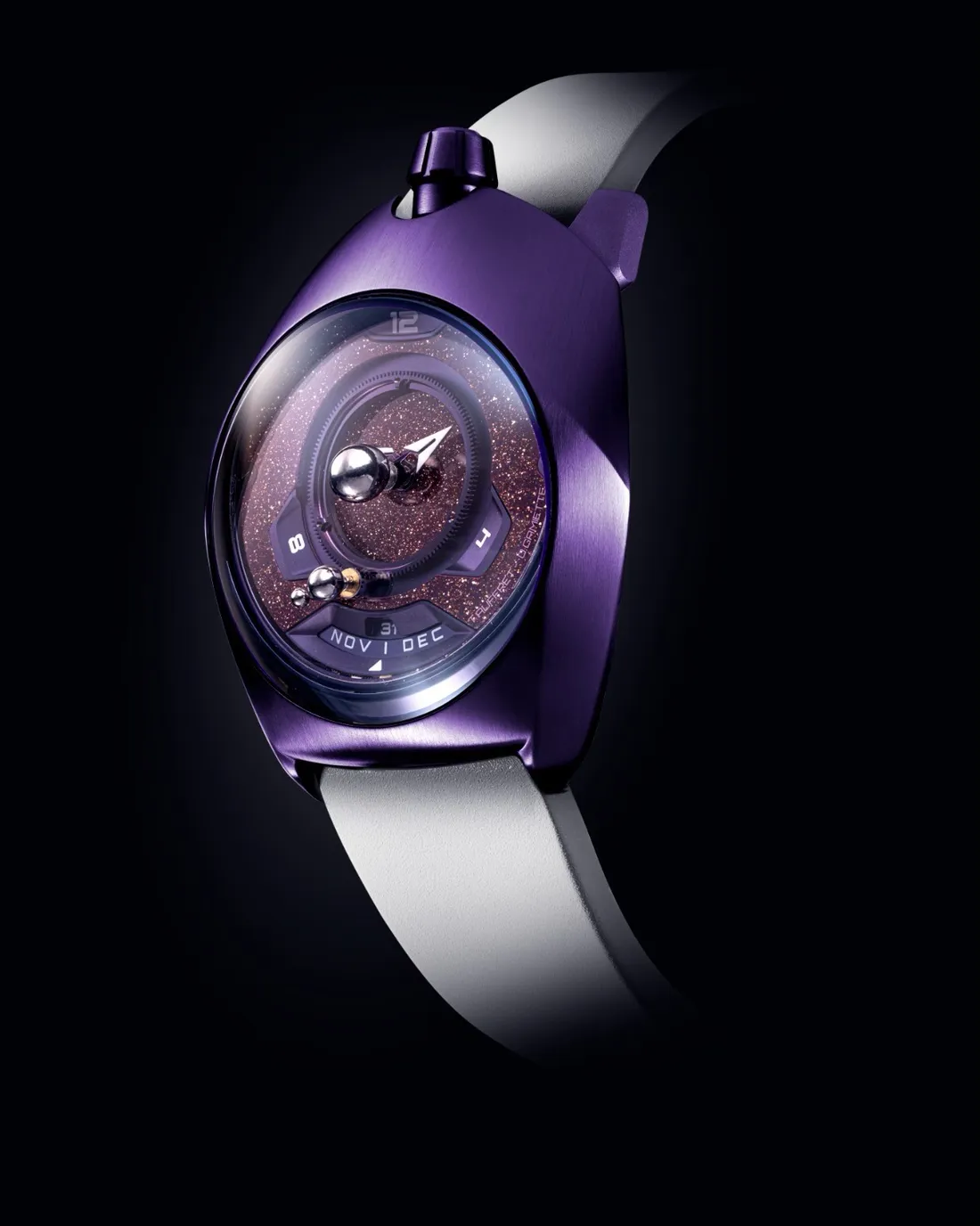
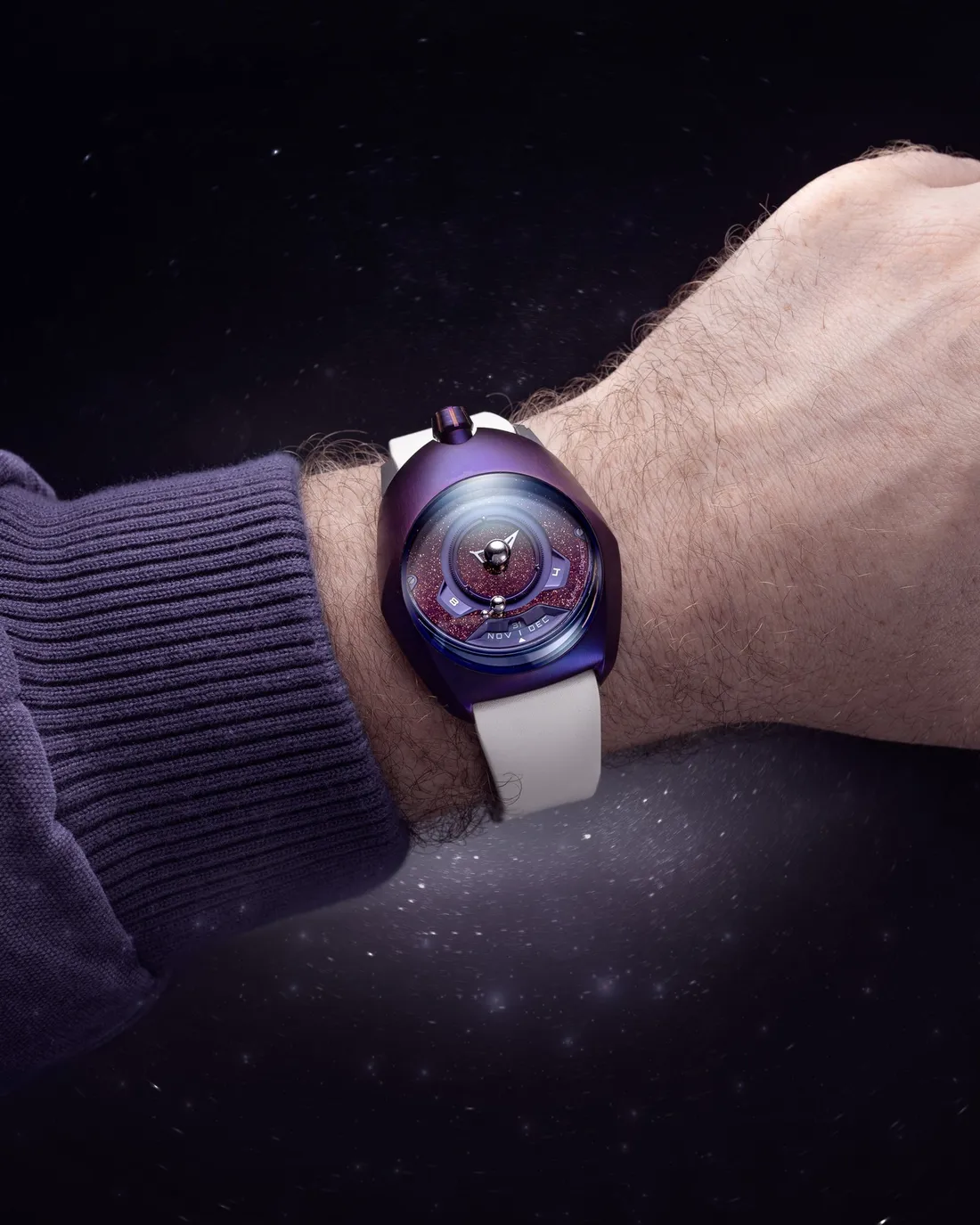
The mechanism that makes this cosmic show possible has a story as elegant as the show itself. A 365 tooth ring representing the Earth's yearly orbit turns the planetary wheels through star wheels as the calendar advances; the planets ride on a sapphire disc while the Moon sits on a separate pinion. This delicate ballet was designed by the independent watchmaker Théo Auffret, powered by the Swiss made automatic Soprod P024 calibre and assembled by hand in France. Its outward face is pure space age poetry: a violet DLC coated 42mm case, a purple aventurine dial scattered with polished purple stars, a domed sapphire crystal and a white Delugs leather strap. At 2,990 euros, it is a bold offer that makes serious celestial mechanics attainable.
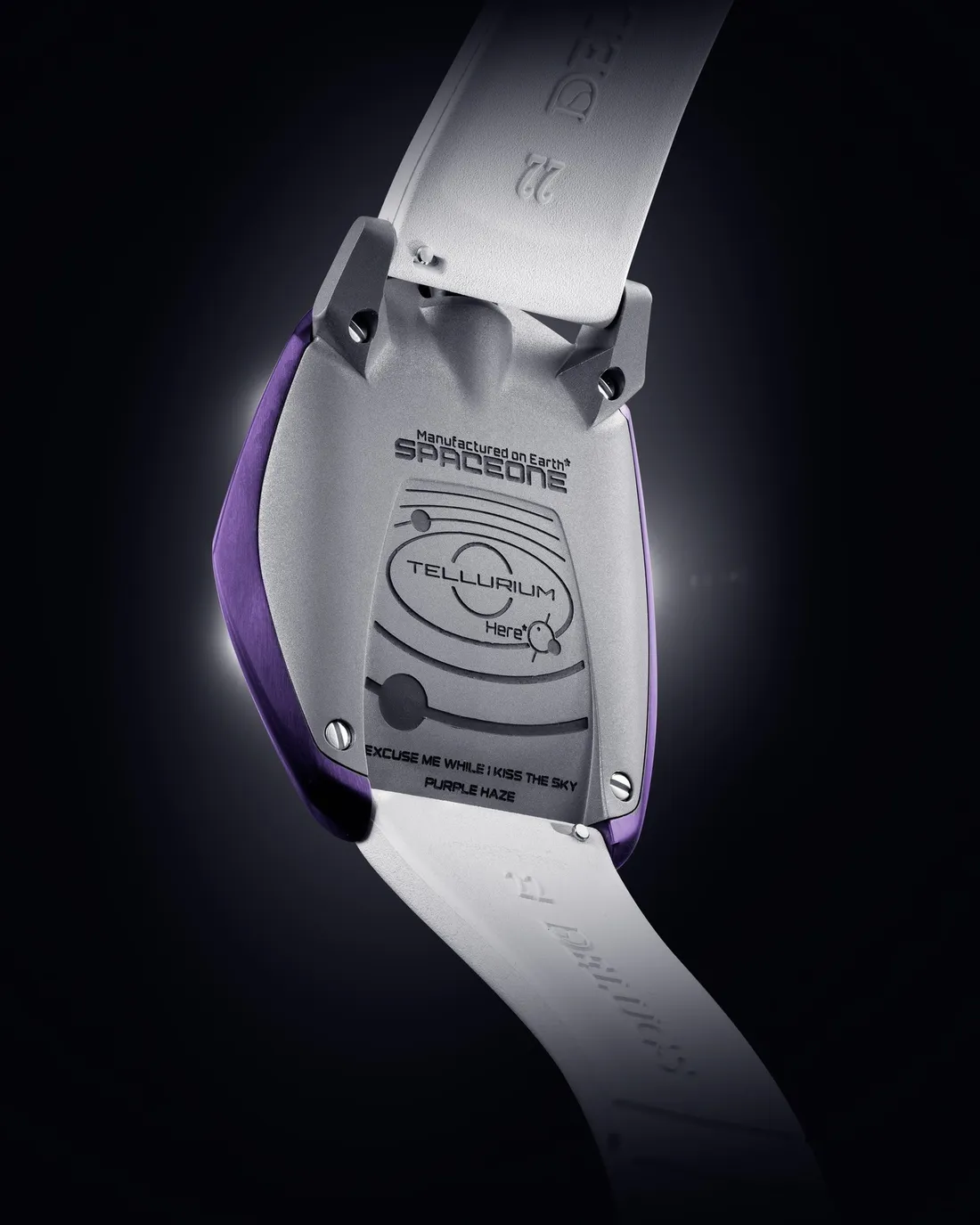
The SpaceOne Tellurium does not only show the time; it tells you where time comes from. The Sun, Earth and Moon on your wrist remind you, at every moment, that even as you stand perfectly still you are in fact hurtling through space at hundreds of thousands of kilometres an hour. Perhaps the finest watch is the one that makes you feel not only what hour it is, but where you are within an entire universe.
format_quote"Perhaps the finest watch is the one that makes you feel not only what hour it is, but where you are within an entire universe."