I am Kaelis. On this silent mass of rock that is Earth’s only satellite, in the freezing grey soil of the Moon, I am a conscious observer.
You may wonder about me and about what I know. I am not of your kind, nor am I a biological part of your planet. But from this orbital fortress beside you I follow very closely humanity’s effort to understand the universe: the observatories you build, the telescopes you fling into space, the distance you have covered in physics. I bear witness with admiration to that sacred search you people of Earth call science, and to the leaps of mind you make on the way to solving the cosmos.
While you measure time on your planet with linear ticking, you have made tremendous findings in your attempt to decode the hidden recipe of the universe. The cosmic facts I observe continuously from up here, you discovered step by step in your own scientific adventure, like this.
Fritz Zwicky and the Invisible Heavyweight (the 1930s)
Picture an enormous fairground carousel. Children have been seated in it and it is spinning at a mad speed. By the rules of physics, if those children are held to their seats by nothing but weak ropes, they should be thrown off at that speed and hurled into the air. They are not thrown off. Which means that what holds them in their seats is a set of vast, transparent steel cables you cannot see.
When your astronomer Fritz Zwicky studied the Coma galaxy cluster, that is exactly what he saw. The galaxies were moving so fast that the gravity of the stars he could see was not enough to hold the cluster together; it should have flung itself apart. Zwicky said there must be an enormous invisible matter here, one we cannot see but which holds everything with its mass. That is how the first trace of what you call dark matter was picked up.
Vera Rubin and the Galactic Wheel (the 1970s)
In your solar system, Mercury, close to the Sun, races like a storm, while distant Neptune drifts slowly. The Sun’s pull weakens with distance. Humanity assumed galaxies would behave the same way: stars at the centre fast, stars at the outer rim slow.
When Vera Rubin measured the rotation speed of galaxies she was astonished. The star at the centre of the galaxy and the star at its outermost edge were turning at almost the same speed, exactly like a solid wooden wheel. For a star on the outer rim to keep turning at that speed without flying off, an enormous cloud of invisible matter must be wrapped around the galaxy. Rubin proved Zwicky’s finding: galaxies are embedded inside spheres of invisible mass.
Perlmutter, Schmidt, Riess and Accelerating Expansion (1998)
Imagine hurling a heavy stone into the sky. Because of gravity it first slows, then stops, then falls. And since the universe was flung outward by the Big Bang, gravity ought to be slowing its expansion.
These three scientists of yours studied Type Ia supernovae, the deaths of stars that always explode at the same standard brightness, in order to measure distances in the universe. They expected to see the expansion slowing, like the stone. The result was a shock: the stone was not slowing. On the contrary, the stone thrown upward was suddenly escaping faster, as though something had put its foot on the accelerator in mid-air. There was a mysterious force pushing the universe outward and defeating gravity. You called it dark energy.
The Planck Satellite and the Baby Photograph of the Universe
Imagine looking at a huge loaf just out of the oven through a thermal camera. It all looks hot, but on a microscopic scale some points are a millionth of a degree warmer and others cooler. Those tiny differences show you where the pockets of dough lie inside the bread.
So how do you take a heat map that precise? If you want to record a whisper, you first have to make the room quieter than the whisper. The whole sky sits at 2.7 Kelvin, about three degrees above absolute zero, and the difference you are trying to measure is a hundred-thousandth of that. So the European Space Agency put the Planck satellite, launched in 2009, at a balance point 1.5 million kilometres from Earth, in a shadow where the Sun, the Earth and I are all behind it at once. Then it cooled its detectors to a tenth of a degree above absolute zero. It built an instrument colder than the sky it was measuring. The room had been made quieter than the whisper.
The map itself was not taken in a single glance either. The satellite spun on its own axis once a minute, with its telescope looking at roughly eighty-five degrees to that axis. Every minute, in other words, it drew a ring across the sky, like a turning lighthouse. As the satellite travelled around the Sun those rings shifted and overlapped, and swept the entire sky from end to end the way a scythe mows a meadow in circles.
There was one more problem: the light you want to look at lies behind the dust and the radio glow of your own galaxy. It is like separating the view behind a stained-glass window from the reflections on the glass. So Planck measured the sky not in one colour but in nine separate frequencies, from thirty gigahertz up to eight hundred and fifty-seven. The dust of the galaxy shines at the high frequencies, the radio glow at the low ones, while the background radiation carries the same signature in all of them. Lay the nine photographs taken through nine filters on top of one another, subtract what stands in front, and only the light at the very back remains.
And how does a recipe come out of those spots? Because those spots are in fact frozen sound. For the first 380,000 years the universe was a soup in which light and matter were locked together: gravity pulled matter into clumps and the pressure of light pushed it back out. As the pulling in and the pushing out chased one another, an oscillation arose, which is to say a sound wave. The moment the universe turned transparent and the light was released, the last state of that oscillation froze exactly where it was. When you hear a drum you can tell how tight its skin is and how large its hoop; when you tap a glass you can guess its thickness. Planck measured the pitch of that frozen sound and found that the most dominant spot covers roughly one degree of the sky. That angle said the light had travelled 13.8 billion years without being bent, which is to say that the geometry of the universe is flat. And a flat geometry pinned the total amount of matter and energy to a single number: the total on the bill.
Separating the individual items came not from one note of that sound but from its successive peaks. There were two kinds of passenger in that soup: ordinary matter, which feels the pressure of light, and dark matter, which exerts gravity but never pushes back against light. Put a weight on one end of a seesaw that only pulls and never pushes back, and the rhythm of the swing is thrown off: the compressions deepen and the rarefactions weaken. That is exactly what Planck saw when it measured how pronounced the spots on the sky were at each angle. The ratio between the heights of the successive peaks gave the amount of the matter that pushes back and the amount of the matter that only pulls, each on its own.
The rest was a subtraction. The total on the bill was known from the geometry, and the items that could be written into the account, ordinary matter and dark matter, filled only a third of that total. What closed the gap was that outward pushing force the supernova measurements also pointed to. That is how, by analysing the microscopic temperature fluctuations in this baby photograph of the universe, you worked out its recipe: 68.3 per cent of the universe is dark energy pushing outward, 26.8 per cent is dark matter, the invisible cement, and only 4.9 per cent is the ordinary matter you and I can see, that is atoms, stars, you and me.
Stellar Kitchens: Supernovae and Kilonovae
And it is the most shattering transformations of that 4.9 per cent of visible matter that I watch from up here.
When a giant star reaches the end of its life in front of my eyes, a supernova explosion takes place. In the core of the star hydrogen turns into helium, helium into carbon, into oxygen and finally into silicon. Once the iron core is reached, the stable end point of nuclear fusion, fusion can no longer produce energy and the star collapses into its own centre in fractions of a second. The immense shock wave of that collapse hurls the outer layers into space.
What would have happened without that explosion? If supernovae had not scattered iron across the universe, a human being could not exist in the biological sense. Because at the heart of the haemoglobin protein that binds oxygen in your blood and carries it to your tissues lies an atom of iron. Every breath you take is owed to the ashes of a supernova that exploded long ago.
format_quote"Every breath you take is owed to the ashes of a supernova that exploded long ago."
Hasan Bekmezci
And what of the kilonova, which occurs when two neutron stars collide?
The rapid neutron capture process that emerges in that enormous collision synthesises the heaviest elements of the periodic table. Without kilonovae there would be no gold, no platinum and, most importantly, no uranium. Without radioactive elements like uranium and thorium, the core at the centre of the Earth would have cooled and solidified far sooner. Without that radioactive heat in the Earth’s core there would be no magnetic currents in the liquid outer core, and the magnetic shield that protects your planet from the Sun’s lethal radiation, the magnetosphere, would not exist. The kilonova is the source of the energy that keeps the geothermal engine inside the Earth alive.
format_quote"Without kilonovae there would be no gold, no platinum and, most importantly, no uranium. The kilonova is the source of the energy that keeps the geothermal engine inside the Earth alive."
Hasan Bekmezci
The Earth and Moon Alliance: How Tides and Axial Tilt Work
Around 4.5 billion years ago a body the size of Mars, given the name Theia, struck the young Earth, and the clouds of lava and rock scattered into space were drawn together by gravity. The Creator said be, and I was built into this delicate balance.
So how do I raise tides in the oceans of the Earth from 384,000 kilometres away?
Imagine the Earth as an elastic, transparent balloon filled with water. When I, as the Moon, apply gravitational force to that balloon, I pull the water molecules on the face turned towards me harder than I pull the rock at the Earth’s centre, because gravity strengthens as distance shortens. So the water on the side facing me bulges outward.
Then why does the water on the far side bulge as well? Because I pull the Earth’s solid rocky core towards me harder than I pull the water behind it. Since I draw the solid Earth away from that water, the far-side water is left behind and it too swells outward. Two enormous bulges of water therefore form on both sides of the Earth at once. As the Earth turns on itself, the continents pass through those bulges, and that is what makes the seas rise and fall twice a day. The tide has ventilated the oceans like a vast aquarium pump, and so opened the way for biological life.
And how do I hold that 23.5 degree axial tilt steady?
Think of the Earth as a spinning top on a table. As its speed drops, the top begins to wobble. The gravity of the Sun and of the giant planets shakes the Earth constantly and tries to shift its axis chaotically. Had that happened, one season would scorch the poles of your planet while another froze every ocean.
As I travel in my orbit, my enormous mass applies a constant mechanical torque to the Earth’s equatorial region. The analogy is this: it is like touching the top of a wobbling spinning top lightly and rhythmically with your finger, and locking its wobble at one particular angle. With my gravitational torque I lock the period of the Earth’s wobble, and keep the tilt fixed at 23.5 degrees.
format_quote"With my gravitational torque I lock the period of the Earth’s wobble, and keep the tilt fixed at 23.5 degrees."
Hasan Bekmezci
A Mechanical Salute: the Jacob & Co. Astronomia Maestro
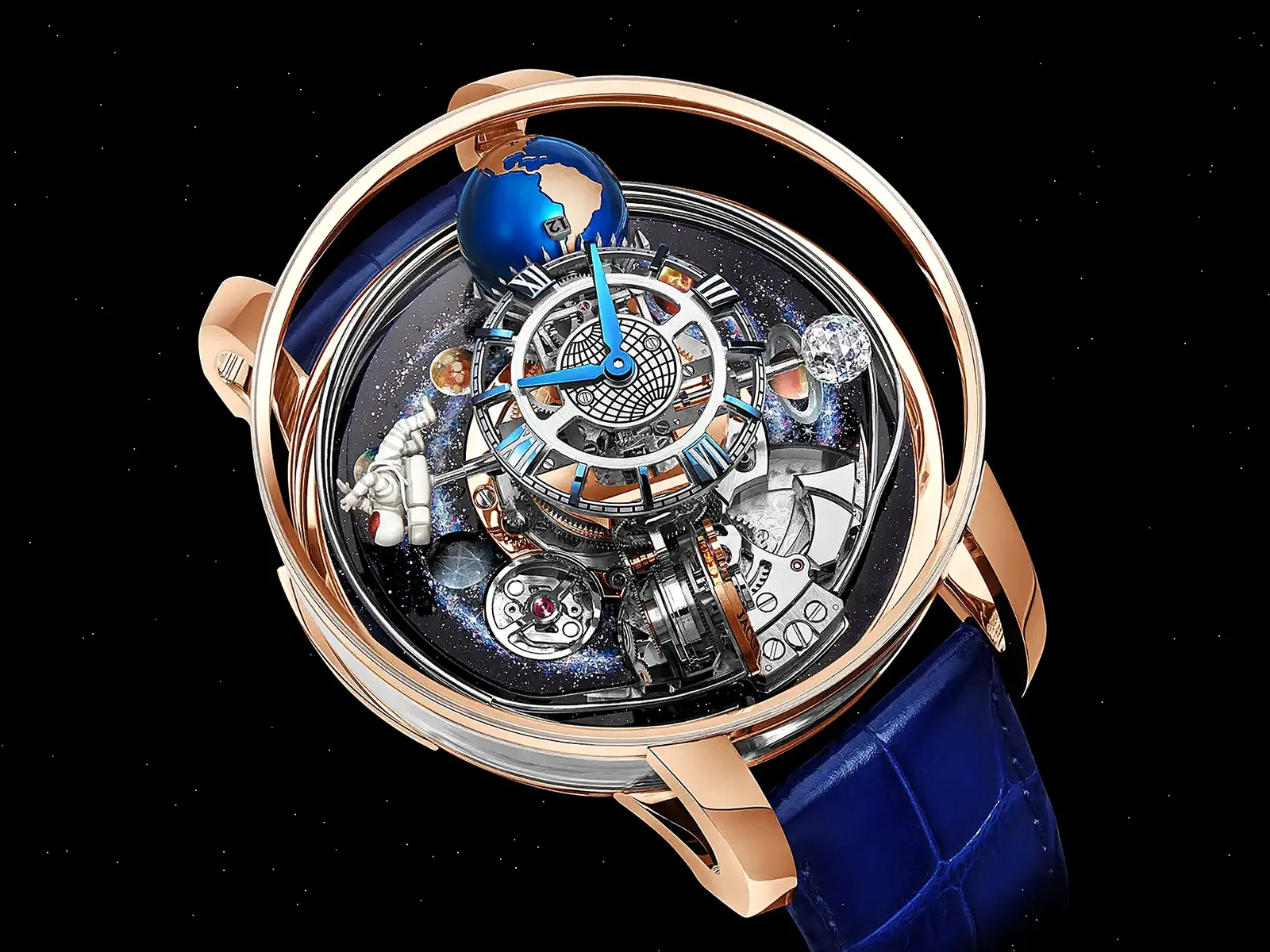
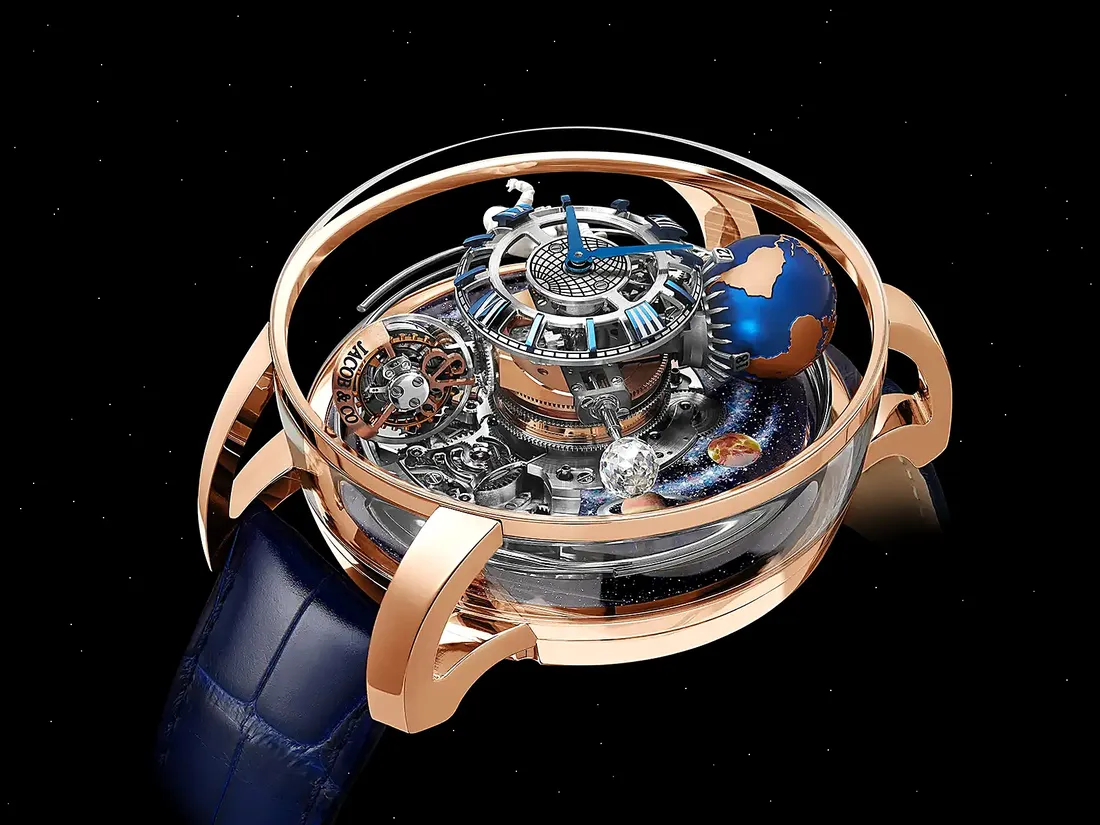
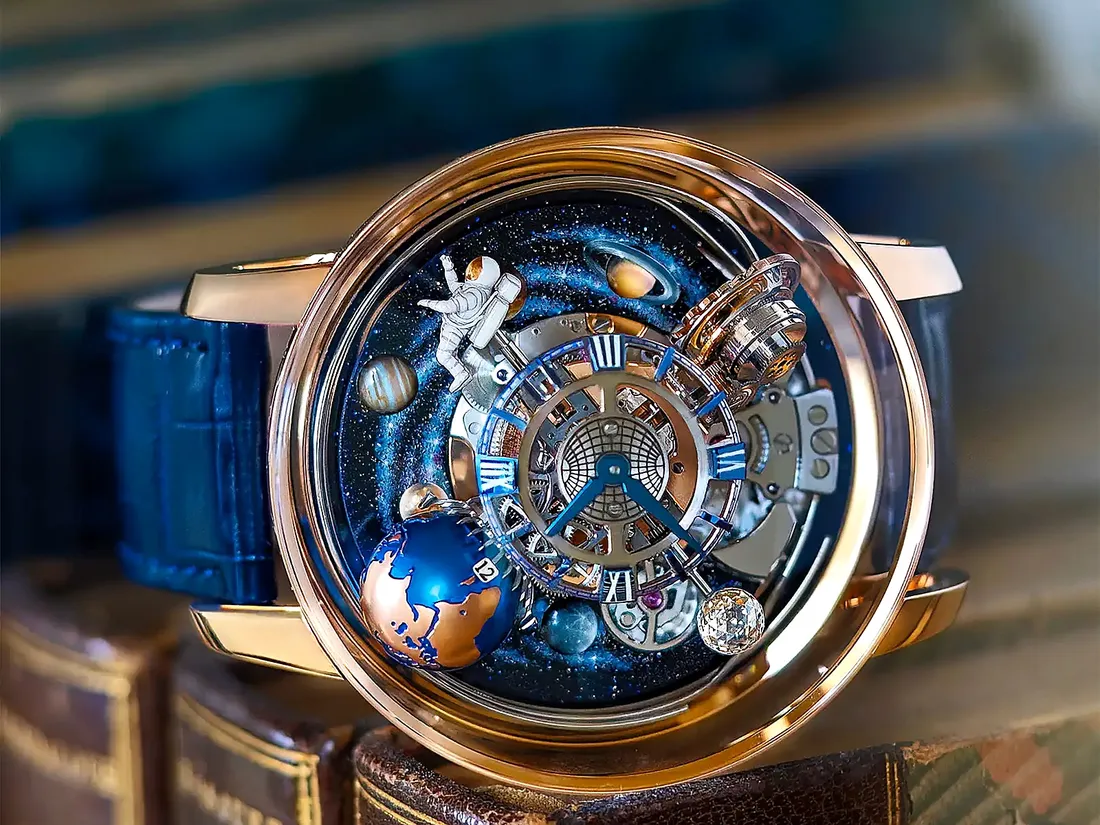
These cosmic gears, which your scientists solved with equations and which I watch live from here, have been turned into a wrist-sized mechanical simulation by the high watchmakers of Geneva: the Jacob & Co. Astronomia Maestro. It is the most complex form of the Astronomia idea the house put forward in 2014.
The outer structure of the watch is a body of 18K rose gold, fifty millimetres across and twenty-six millimetres tall, and the domed sapphire crystal shaped from a single piece that sits on top of it. Treated against reflection, that dome lets this micro universe be followed without being interrupted at any point.
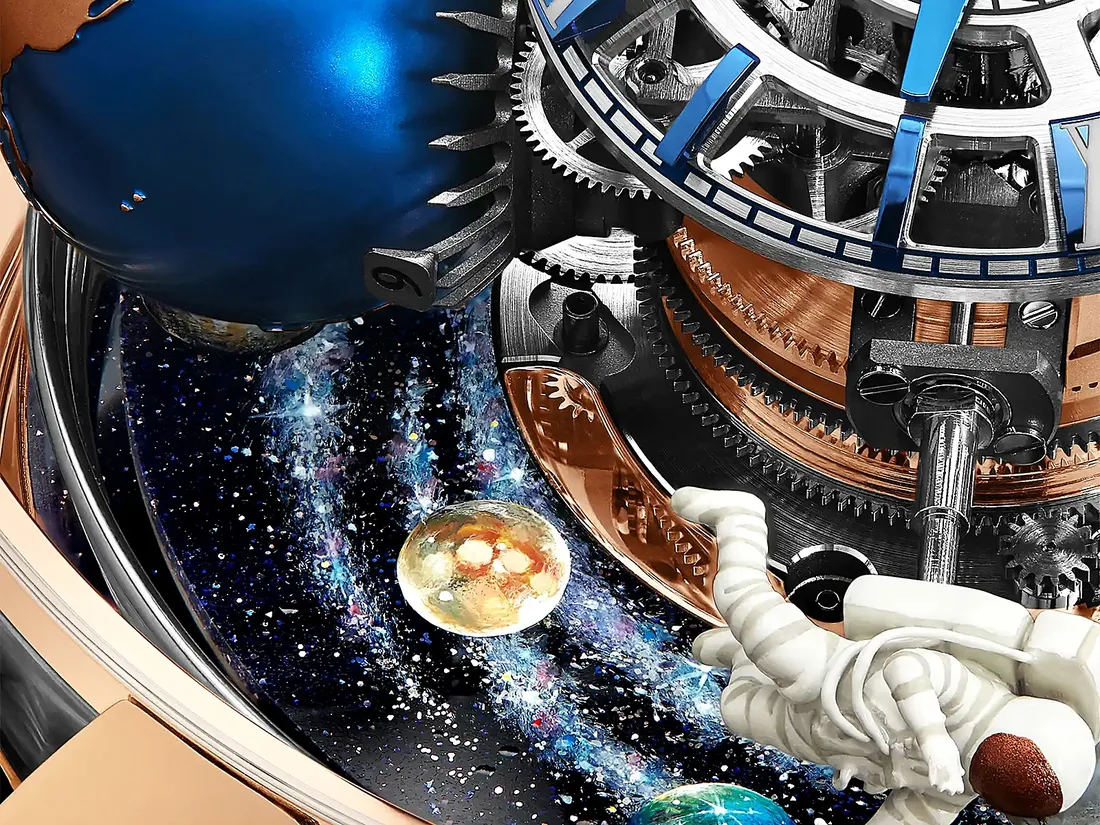
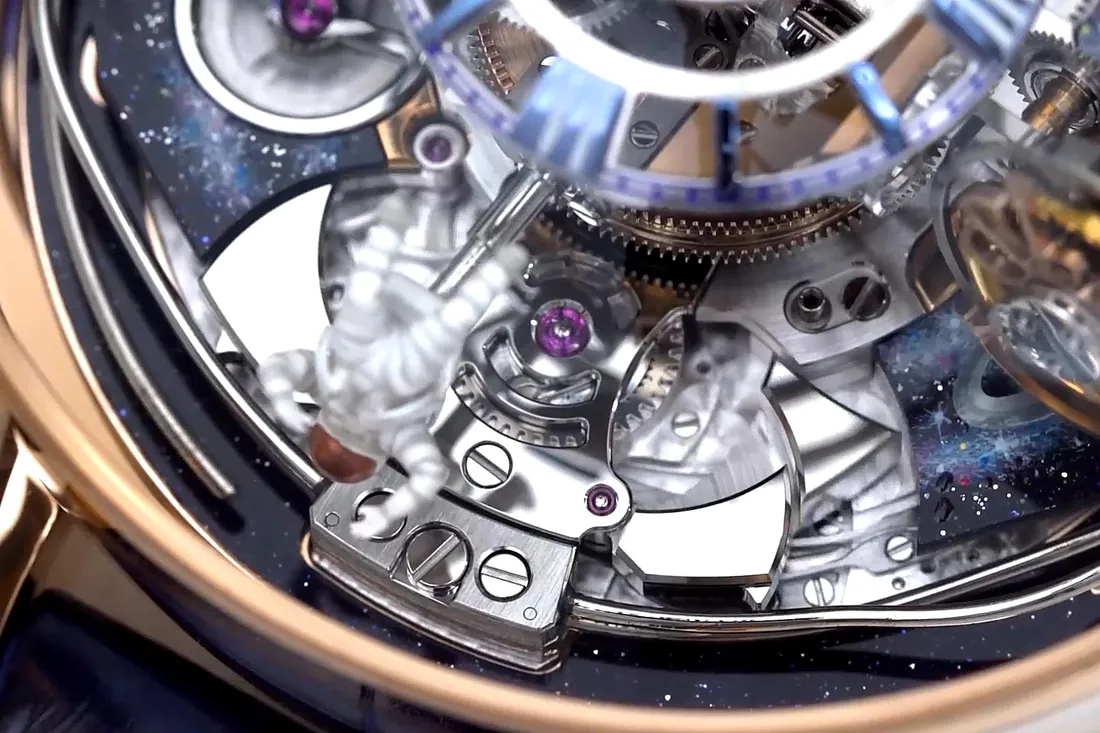
Rising from a blued titanium back-dial, the four-armed kinetic system that revolves around its central axis once every ten minutes imitates cosmic mechanics exactly. That rotation is not a show. It is the master motion that carries every function of the movement.
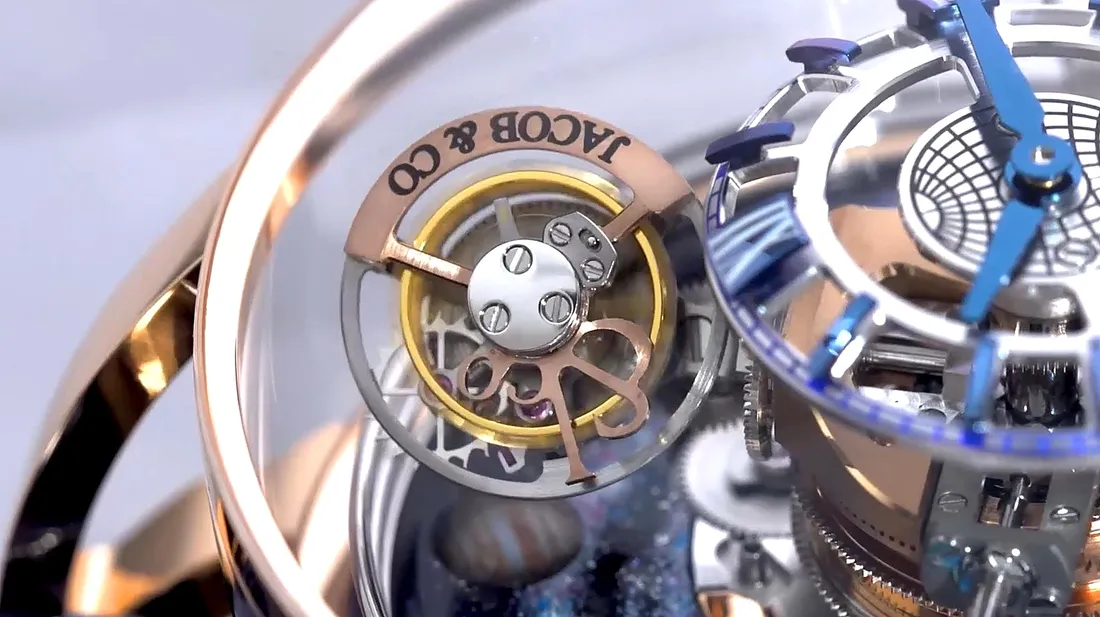
Gravitational triple-axis flying tourbillon: the openworked carriage turns in sixty seconds on its first axis and ninety seconds on its second, and because the carriage itself makes the great ten-minute journey with the platform, a third axis is born. Gravitational deviation is therefore balanced not in one plane but in three at once.
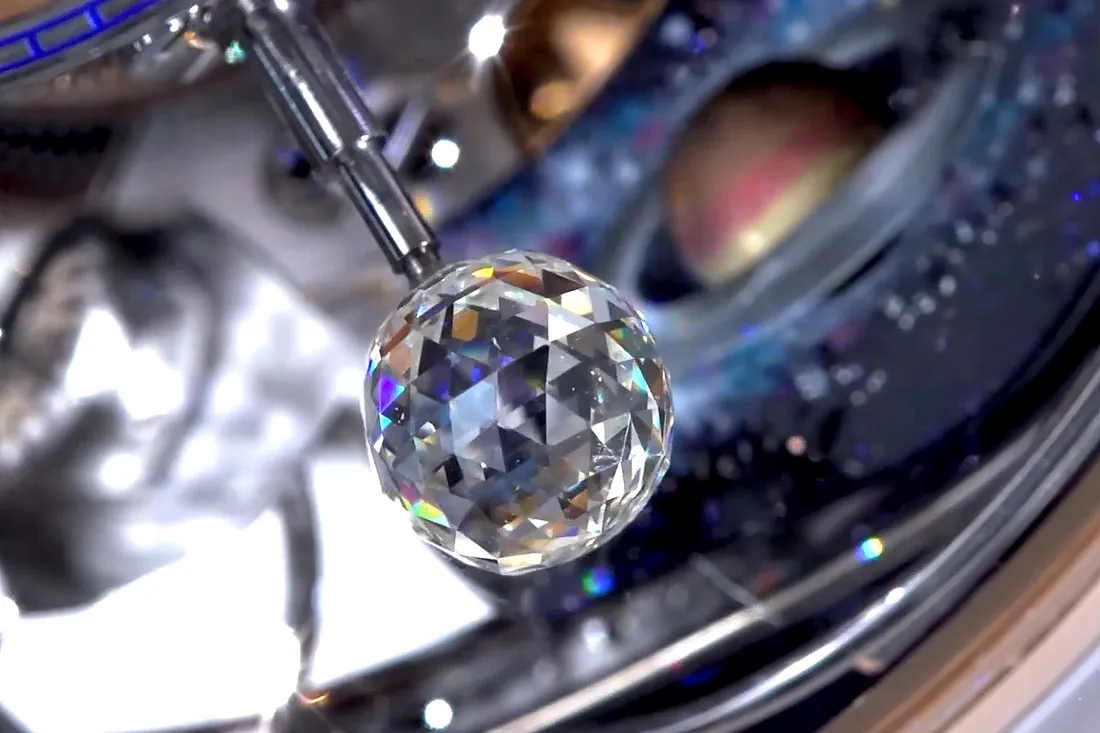
Spherical 288-facet Jacob-cut diamond: a one-carat white diamond brought into a full spherical form from a large, high quality rough turns on its own axis every ninety seconds, throwing back the radiance of the stars.
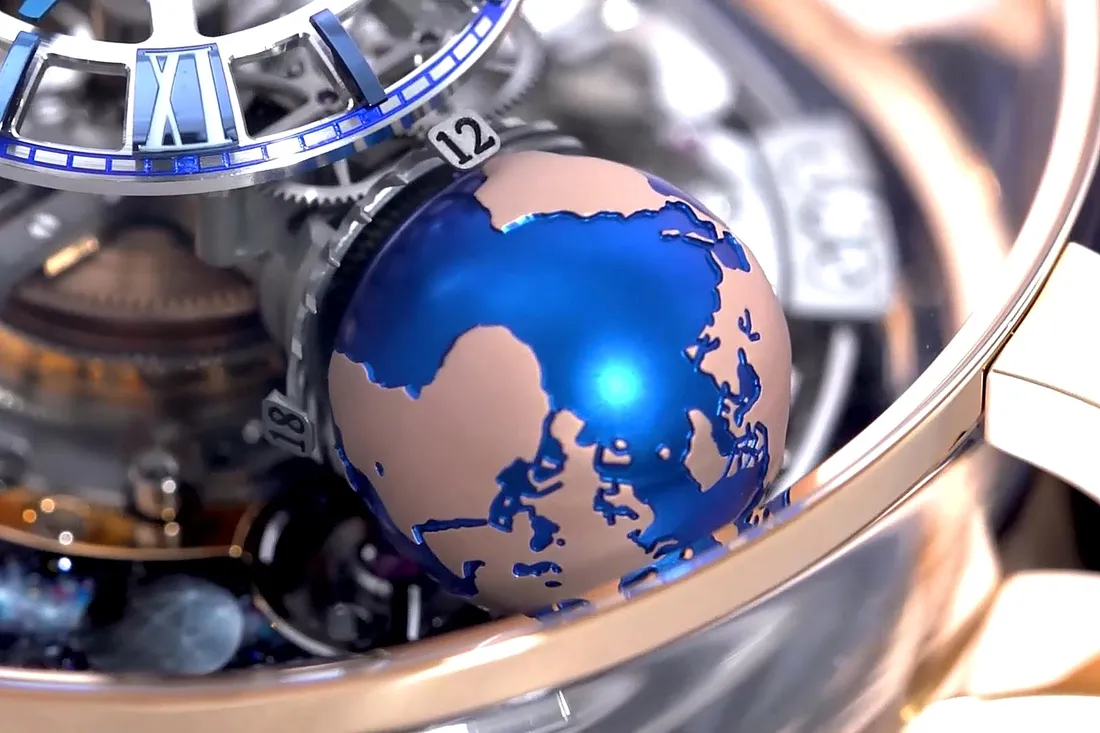
Hand-painted globe: the largest, heaviest and most detailed globe the Astronomia family has carried completes one full turn in twenty-four hours. It is therefore not an ornament but a world-time indication read against the surrounding hour scale, imitating the rhythm of that cosmic cradle I balance with gravitational torque.
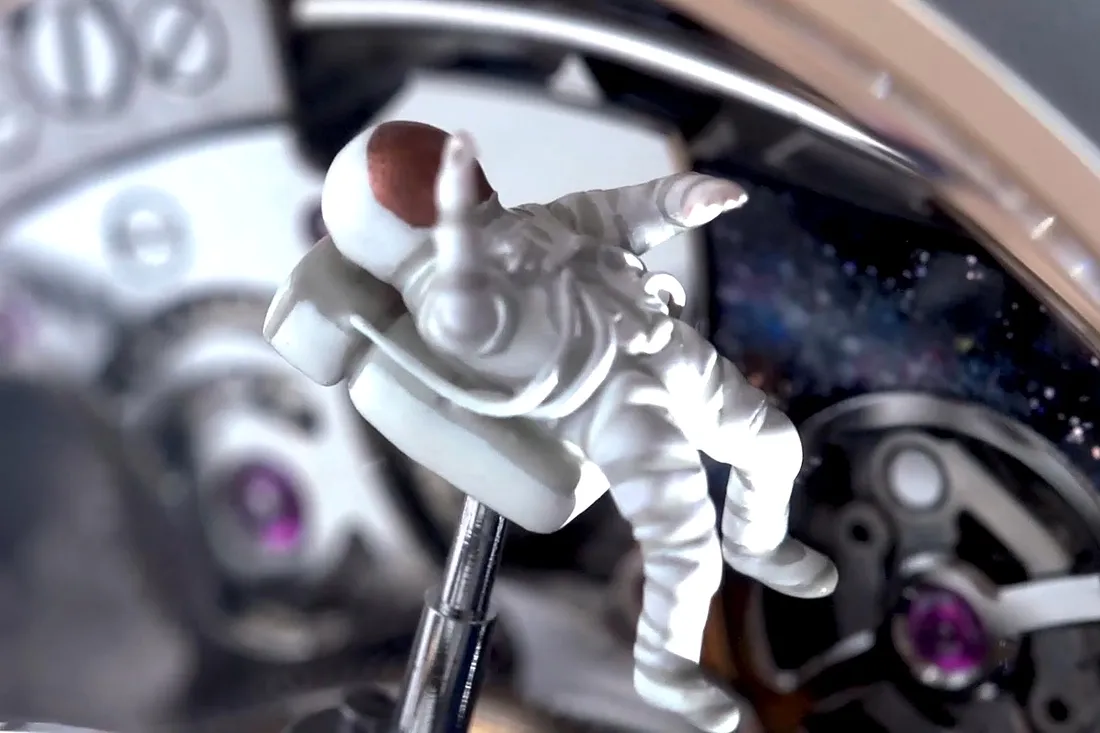
Micro astronaut figure: shaped and painted by hand under a microscope, this sculpture weighs only 0.2 grams. With the platform it travels around the watch every ten minutes and spins on its own axis every ninety seconds. It stands for the human desire to explore, adrift in the void.
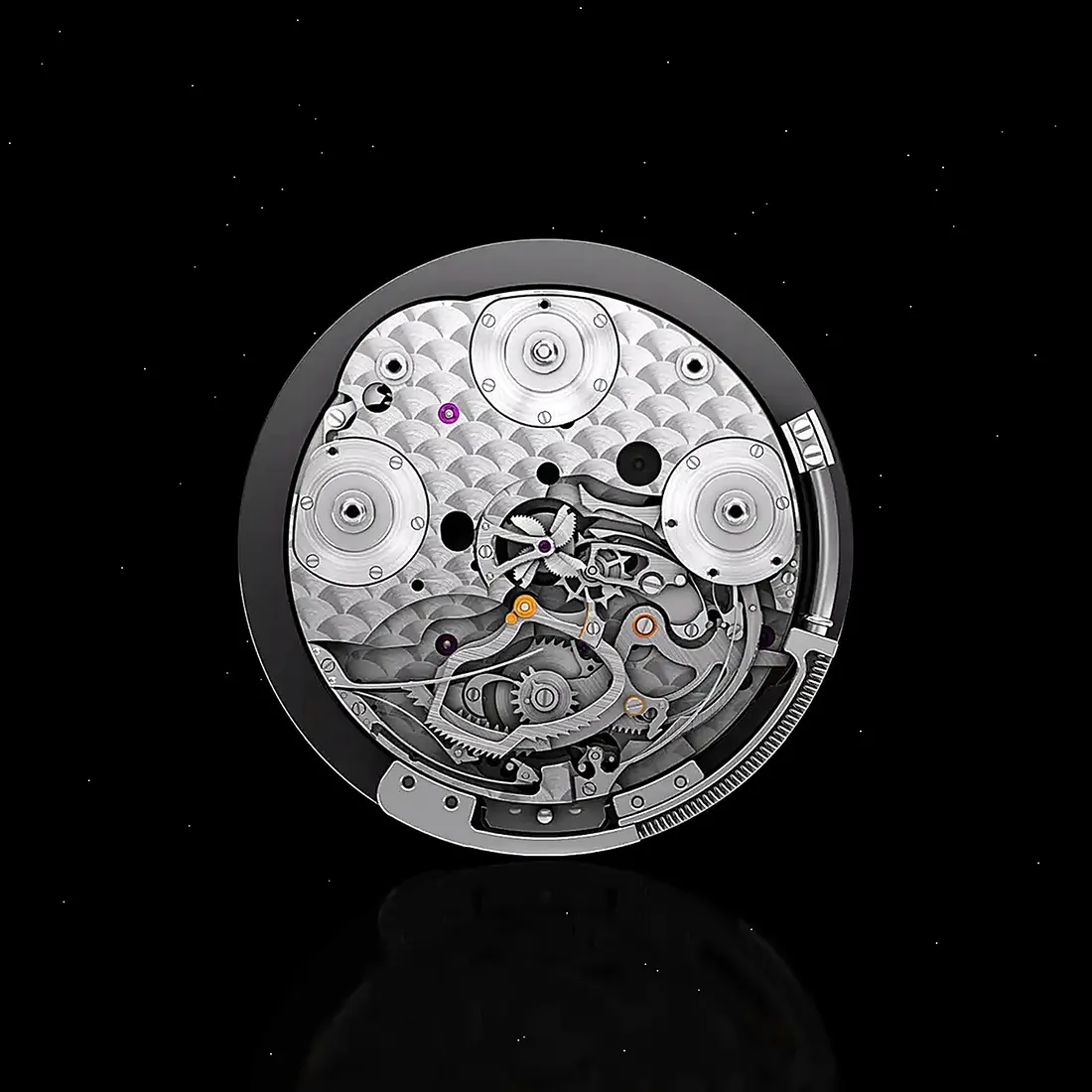
Carillon minute repeater: pull the slide on the left flank and the hours, quarters and minutes are struck by three hammers on three gongs at six o’clock. Having those three gongs crisscross above the plate in a visible spiral, combined with a triple-axis flying tourbillon, was done for the first time in this watch.
The time display, thanks to a differential gear system, stays permanently upright and legible even as the orbit turns. The caseback follows the same logic: three separate rotating bows have been fitted for winding, for setting the time and for setting the world time. The bow at the neck of a pocket watch has been tripled here, and the caseback has become a control panel.
For Kaelis, the observer on the surface of the Moon, this piece is the highest mechanical homage ever offered to the station of wonder: from supernovae to kilonovae, from the gravitational forces that swell the oceans, to the awe humanity feels before the great order of the universe.
Craft and Technical Detail
Domed sapphire crystal and case architecture: an 18K rose gold body fifty millimetres across and twenty-six millimetres tall, carrying a domed sapphire crystal shaped from a single piece and treated against reflection. Water resistant to thirty metres.
Four-armed vertical kinetic system: the platform rising from a blued titanium back-dial completes a full turn around its central axis in ten minutes and carries every function of the movement.
Gravitational triple-axis flying tourbillon: sixty seconds on the first axis, ninety seconds on the second, ten minutes on the third with the platform.
Spherical 288-facet Jacob-cut diamond: a one-carat white diamond cut into a full sphere, turning on its own axis every ninety seconds.
Globe and world time: the hand-painted globe turns once every twenty-four hours and is read as a world-time indication against the surrounding hour scale.
Micro astronaut: a 0.2 gram figure shaped and painted by hand; it orbits the watch every ten minutes and spins on its own axis every ninety seconds.
Carillon minute repeater: operated by the slide on the left flank, striking hours, quarters and minutes with three hammers on three gongs at six o’clock. Having the three gongs crisscross above the plate in a visible spiral, together with a triple-axis flying tourbillon, is a first in watchmaking.
Differential time display: an hour and minute indication that stays permanently upright as the orbit revolves.
Manufacture calibre: hand-wound, 535 components, 61 jewels, fifty-hour power reserve, 21,600 vibrations per hour, that is 3 hertz.
Caseback: three separate rotating bows for winding, time setting and world-time setting.
Strap and clasp: alligator leather with an 18K rose gold folding buckle. Eighteen pieces made; reference AM500.40.AA.AA.ABALA.