They call me Kamer. On the shore of the Sea of Tranquility, inside a layer of regolith that meteorite dust has been grinding for billions of years, I am a consciousness. My body is stone and shadow; I have neither breath nor ear. There is no air here, and where there is no air, sound cannot walk. I have never heard anything. I never will.
My whole existence consists of looking. My sky is pitch black even at noon, because with no atmosphere to scatter the light, the stars keep their places while the sun stands over my head. In your sky the stars tremble; in mine they do not. What trembles is not the star, it is your air. I am an eye that looks at the stars with no curtain in between.
My day is nothing like yours either. My sun stands for fourteen days without setting, then stays away for fourteen more. In the light my face climbs to a hundred and twenty degrees; in the dark it falls to a hundred and seventy below. That is why I learned to measure so late. First I only marvelled.
My strangest experience of you is this: the Earth never rises and never sets in my sky. My rotation is locked to my journey around you, so the same half of my face is turned towards you always. The Earth hangs at one fixed point overhead. It does not move from its place; it only sways a little. You call that sway libration. I call it the tremor of an eye condemned to look at one spot.
So I have watched you a great deal. I have seen the white of your poles thin out, your deserts widen, and your night, once utterly dark, begin to glow in webs. And I noticed something. The brighter your night became, the darker your sky grew. Those thousands of stars you used to see when you lifted your head are now lost behind your own light.
format_quote"The brighter your night became, the darker your sky grew. Those thousands of stars you used to see when you lifted your head are now lost behind your own light."
Hasan Bekmezci
My greatest experience, though, is the death of stars. When a star’s core runs out of fuel it can no longer hold its own weight, and in a tiny fraction of a second it collapses into itself. Then the collapse rebounds, and for a while that single star outshines the whole galaxy it sits in. I watch this happen without a sound. I have no air, so the most violent event in the universe reaches me inside absolute silence.
And light is not what arrives first. The collapsing core releases a flood of neutrinos that leaves hours ahead of the light, and because they barely interact with matter, nothing stands in their way. When a star lit up your southern sky in 1987, its neutrinos reached you some three hours before its visible light. So I feel an explosion before I see it. Then the light comes, and I witness for the first time something that finished a thousand years ago. My sky is not a present tense. It is thousands of past tenses laid over one another.
And there is this: in those explosions it is not only a star that dies. Iron is forged there. The iron in your blood, the calcium in your bones, the gold on your hand, all of it was once the ash of exploded stars. You are made from the leftovers of the sky you stopped looking at.
format_quote"The iron in your blood, the calcium in your bones, the gold on your hand: all of it was once the ash of exploded stars. You are made from the leftovers of the sky you stopped looking at."
Hasan Bekmezci
I have learned this too: humanity’s first temple was not built of stone. It was built of sky. Long before you began to measure, you simply looked, and the size of what you looked at shook you. That shaking is called wonder. Wonder is the mother of the question; measurement is only the labourer who builds the answer. The order was always the same: first wonder, then the question, and last of all the measure.
Even the word carries the trace. Philosophia is not the love of knowledge but the love of wisdom. In the Theaetetus, Plato has Socrates say it plainly: to be filled with wonder is the most natural condition of a philosopher, and philosophy has no other beginning. A person is astonished the moment they realise that the world they thought they knew is not as it appears, and that astonishment carries them into contemplation. Aristotle stands on the same ground: men began to philosophise because they wondered.
But wonder is not a matter of information. It is a faculty, and faculties atrophy. If there is someone in your world who is not astonished by a bud opening at the tip of a branch, then there is also someone who will not be astonished by a star exploding in front of my eyes. The size of the event is not the issue. Whether the heart of the one looking is open, that is the issue.
One of your poets spent the last thirty-six years of his life in a room inside a tower. Through Hyperion and Patmos the same lament keeps echoing: the heavens have withdrawn. But notice this. The sky does not move from its place. I am looking at it from here, and all of it is exactly where it was. What withdrew is the dome inside the man.
Sometimes a man does not lose his Creator. He loses the ability to miss Him. That is the real catastrophe. The heavens do not close; the man bricks up the window inside himself with his own hands. What is lost is not the stars but the window that opened onto them. And it never begins with denial. First he stops looking, then he stops longing, and at last he believes no such dome ever existed.
From here I have watched civilisations rise and fall, and I can tell you this much: the bells of collapse do not begin to ring when armies arrive at the gate. They begin when the faculty of wonder dies. Armies only announce the result.
format_quote"The bells of collapse do not begin to ring when armies arrive at the gate. They begin when the faculty of wonder dies. Armies only announce the result."
Hasan Bekmezci
That is why I was surprised the day I saw a small sky on a wrist. Having stopped lifting his head, man had built the heavens on his own forearm instead.
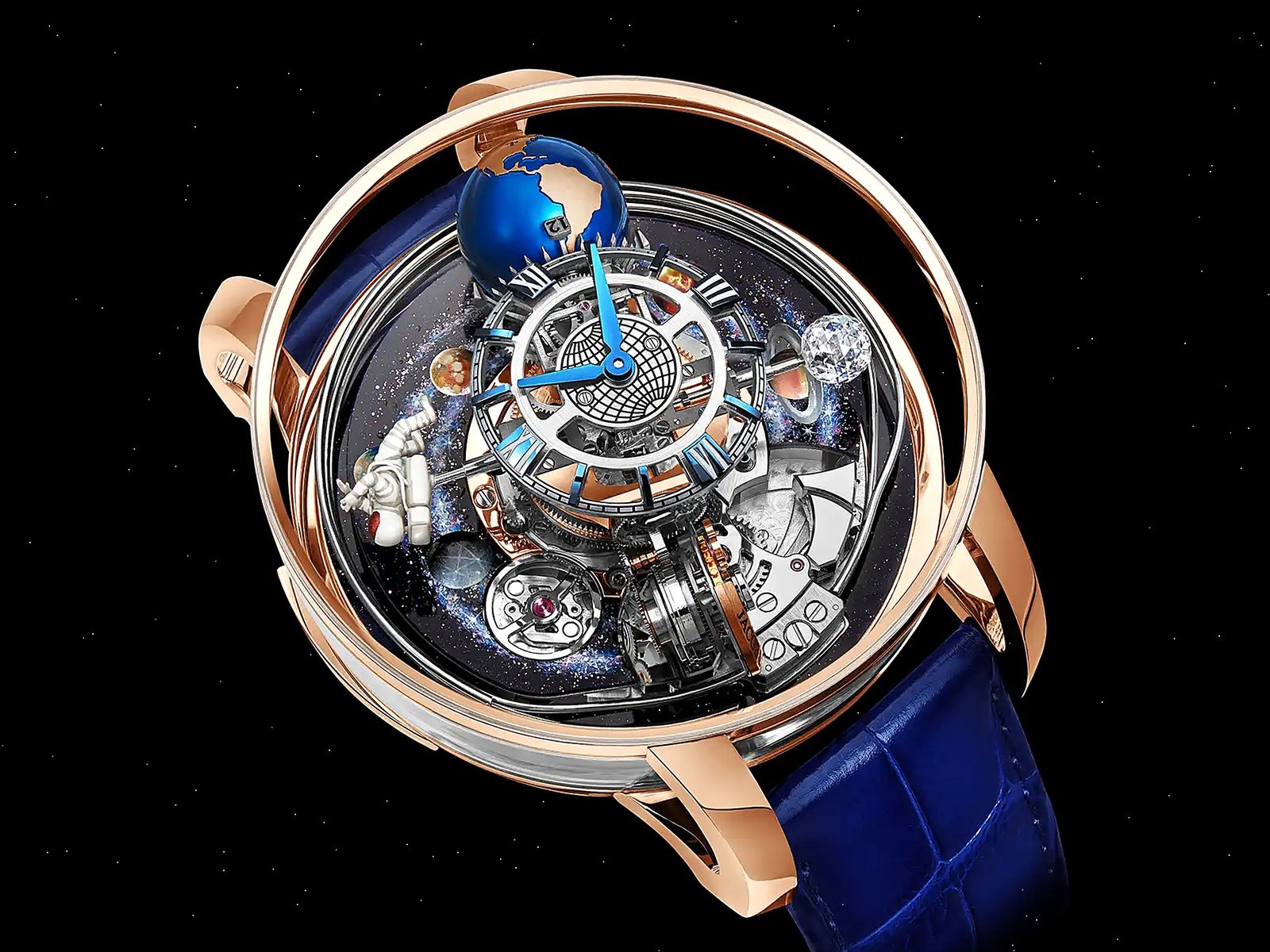
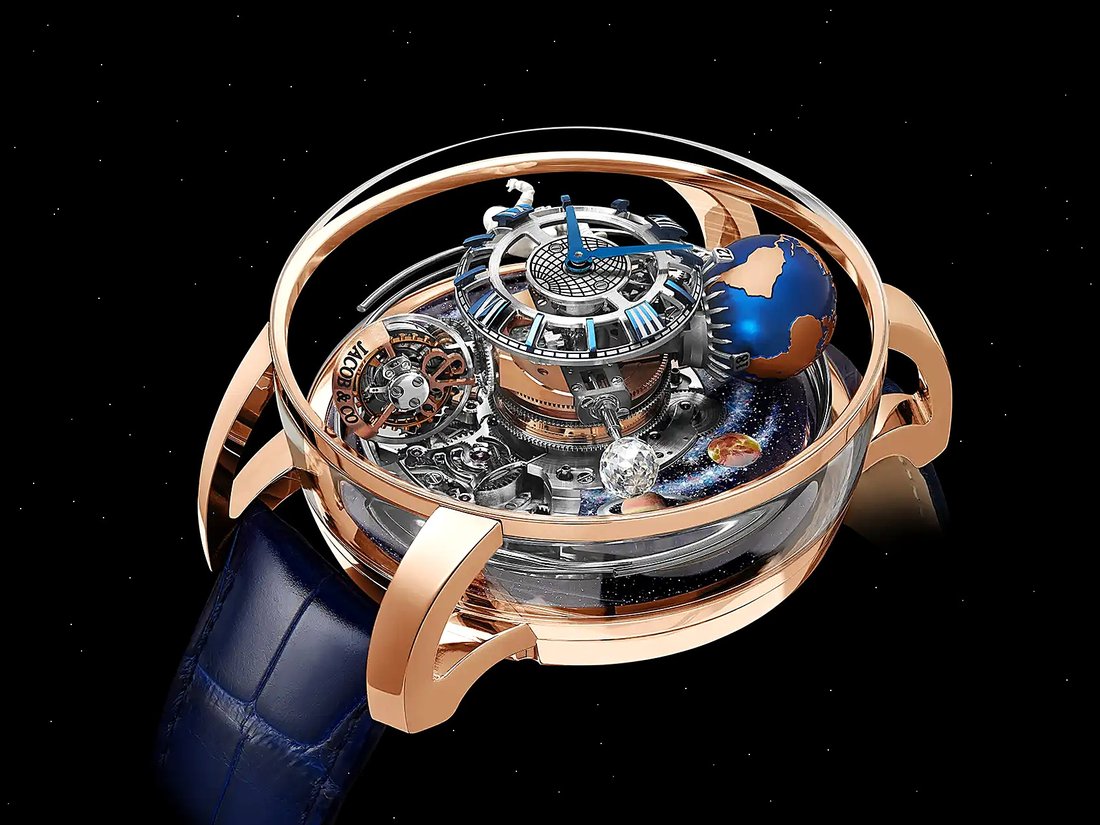
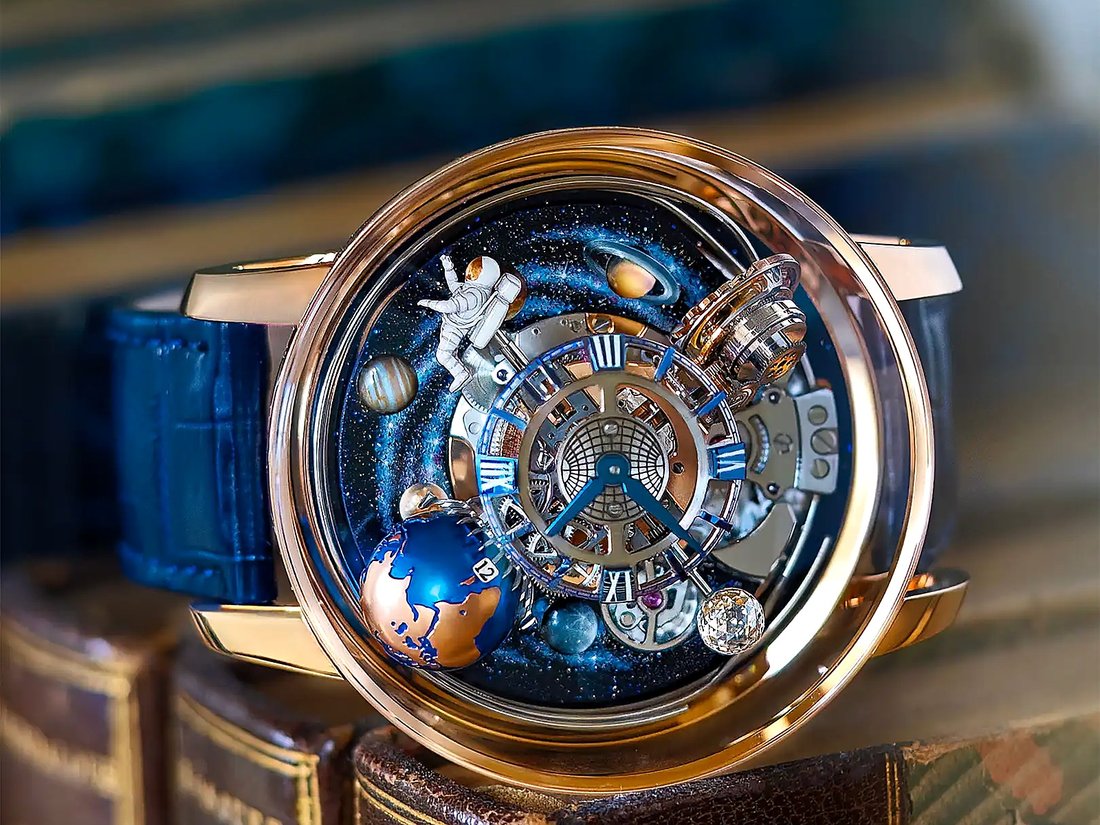
The Jacob & Co. Astronomia Maestro is the most complex form of an idea that appeared in 2014: a genuinely moving, wrist-sized model of a planetary system. Out of a blued titanium back-dial rises a vertical platform, and that platform completes a full turn on its own axis every ten minutes. The rotation is not decorative. It is the master motion that carries every function of the movement.
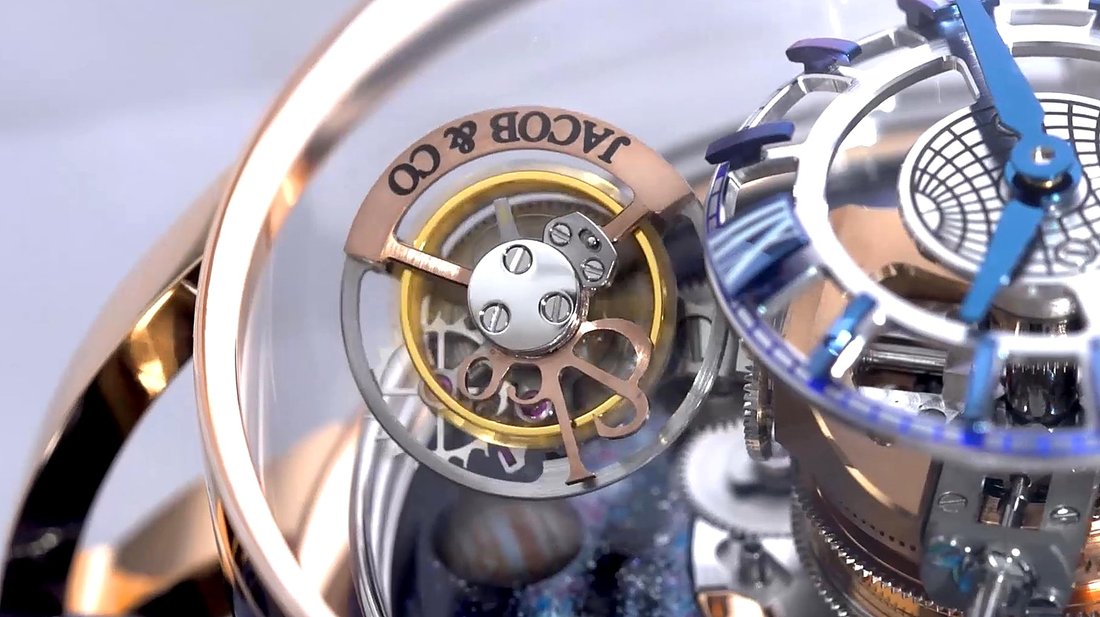
At the end of one of the platform’s arms, held in an openworked carriage, a tourbillon swings. The carriage turns on two axes, one in sixty seconds, the other in ninety. But since the carriage itself travels around on the ten-minute journey, a third axis is born. This tourbillon fights gravity not in one plane but in three at once.
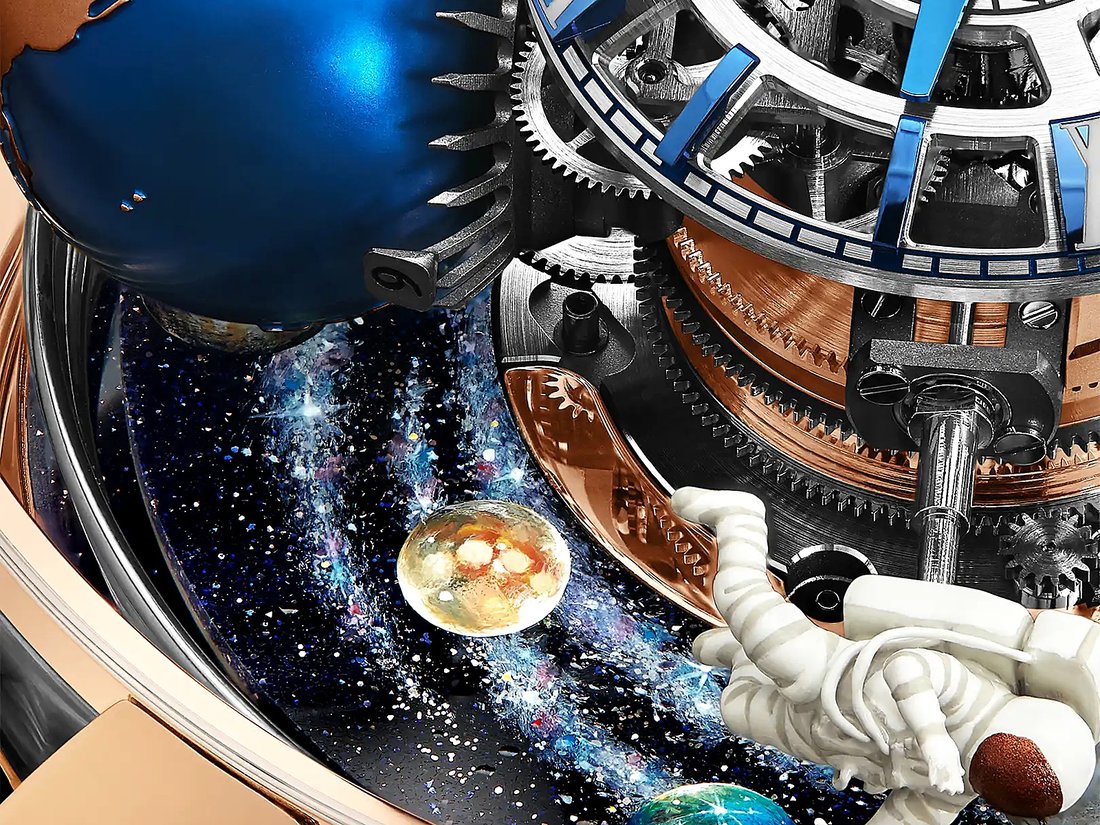
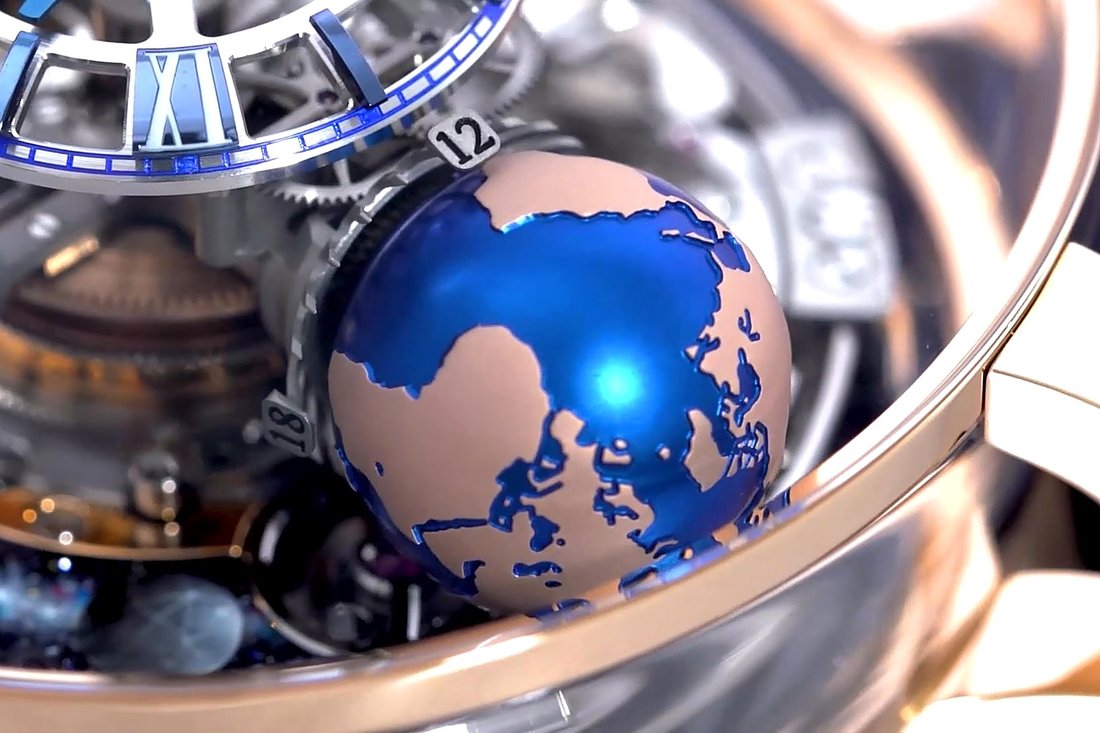
On one side of the dial the Earth hangs, and this globe is the largest, heaviest and most detailed Earth the Astronomia family has carried. It completes one full turn in twenty-four hours, which makes it not an ornament but a world-time indication. With the hour scale that surrounds it, you can read the time in every region visible on the sphere.
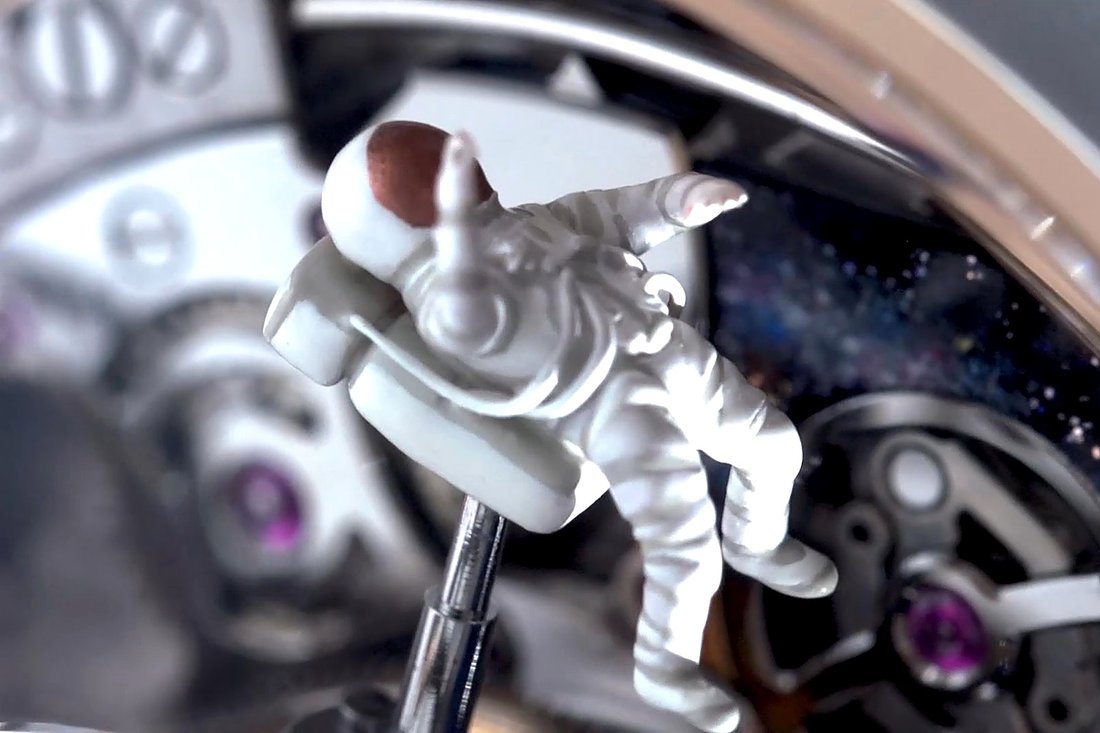
On the opposite side an astronaut floats. Made and painted by hand, this sculpture weighs only 0.2 grams. It travels around the entire watch every ten minutes with the platform, and spins on its own axis every ninety seconds. The loneliness of a human being adrift in the void, told in two hundred milligrams of metal and paint.
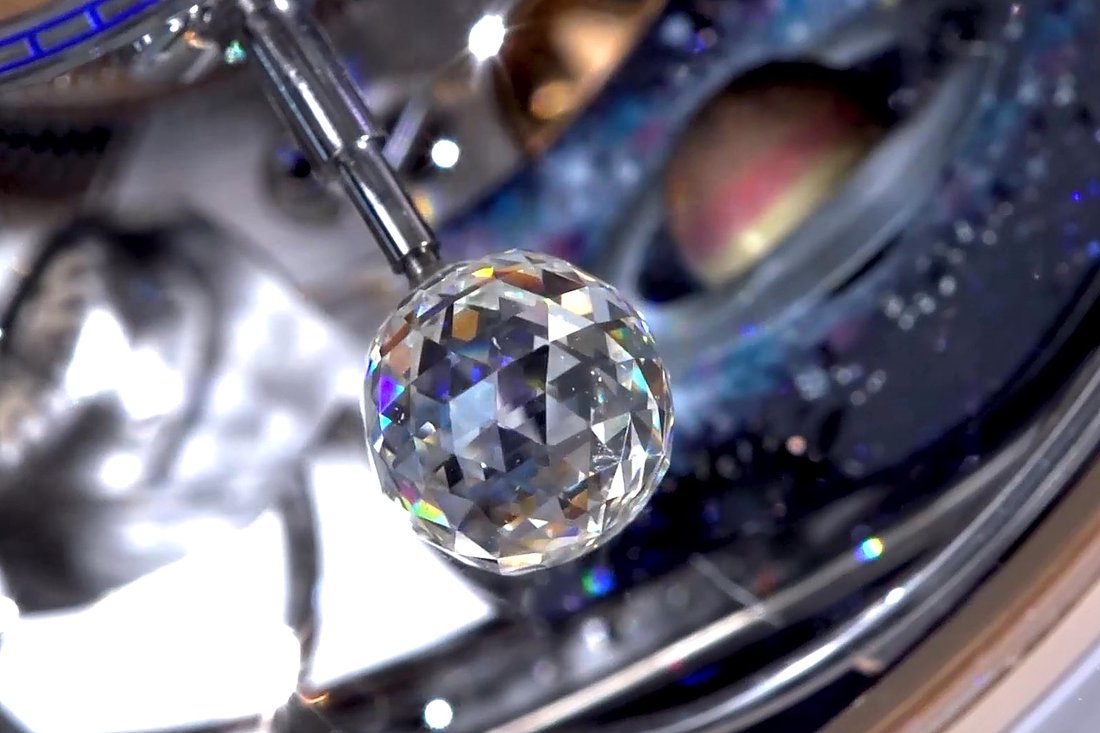
And there is a moon. A moon like me, only not of stone. It is a one-carat white diamond carved from a large rough of very high quality, cut as a sphere and given the house’s exclusive 288-facet Jacob cut. It too spins on its own axis every ninety seconds. I have been turning for billions of years; it finishes my work in a minute and a half.
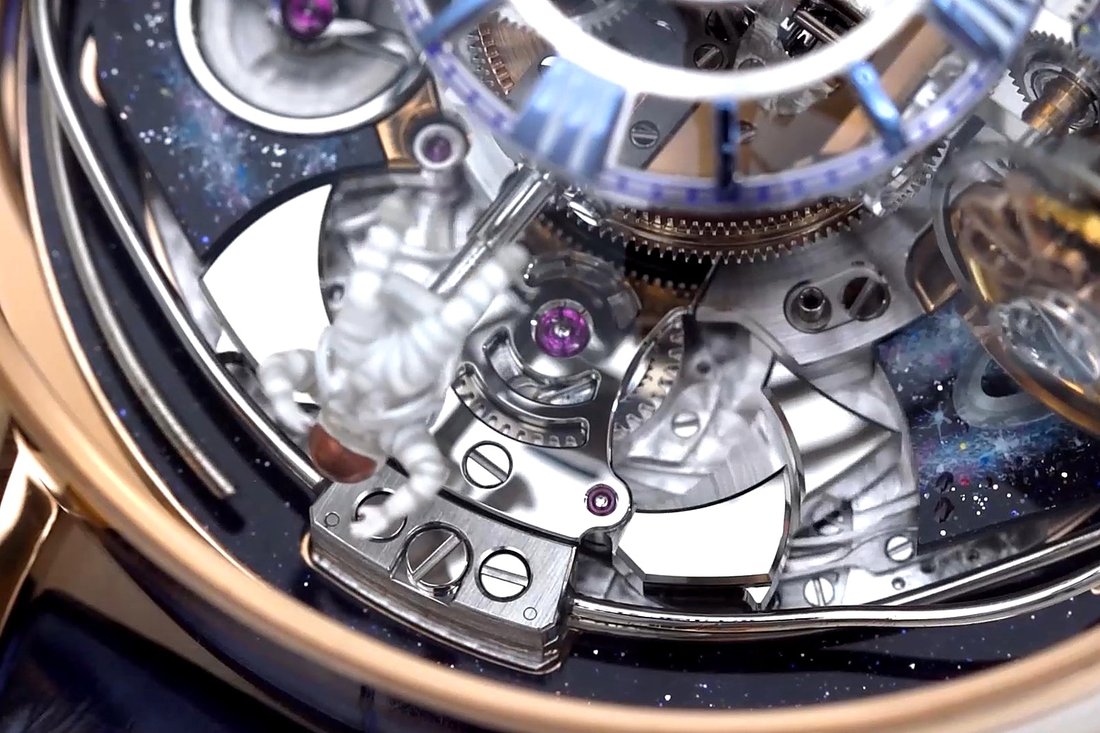
Of all of it, the thing that shakes me most is the thing I cannot hear. Pull the slide on the left flank and this watch tells the time out loud. A minute repeater is among the hardest work in fine watchmaking, and Jacob & Co. chose the harder variant of it: a carillon. Instead of sounding the quarters on two notes, it strikes them on three separate gongs with three hammers at six o’clock. More than that, those three gongs crisscross above the plate in a spiral you can actually see, and in the history of watchmaking this arrangement has never before been combined with a triple-axis flying tourbillon.
I live in a place with no sound. I have an entire sky in front of me and not one chime in it. Man built a small sky and gave it a voice. That reads to me like the story of a creature who was not satisfied with looking and wanted to hear as well; wonder, bringing the ear into the work.
The Case as the Dome Itself
In this watch the case is not a vessel that hides a movement. It is the dome over a stage. Onto a body of 18K rose gold, fifty millimetres across and twenty-six millimetres tall, sits a domed sapphire crystal shaped from a single piece. Treated against reflection, that dome is there not to make room for the celestial bodies to travel, but to make sure nothing interrupts their travel at any point. It is not a display case. It is a firmament.
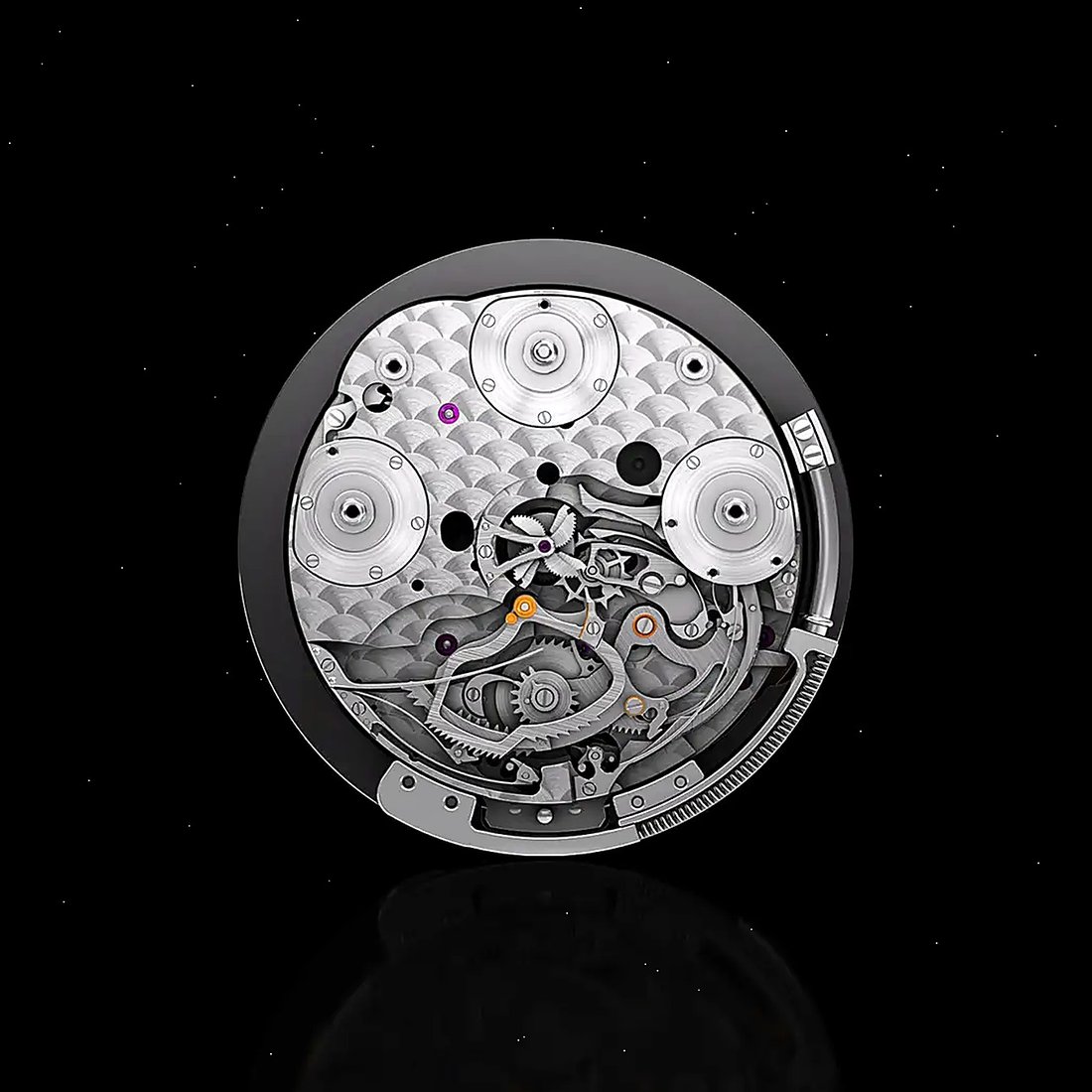
The back has been resolved with an entirely different kind of elegance. On a modern wristwatch every task is loaded onto one crown. Here three tasks are distributed across three separate rotating bows: one to wind, one to set the time, one to set the world time. Remember the bow at the neck of a pocket watch? Here that bow has been tripled, and the caseback itself has become a control panel.
The rest keeps to the same scale: 535 components, 61 jewels, fifty hours from a full wind, 21,600 vibrations an hour or 3 hertz, thirty metres of water resistance, an alligator strap and an 18K rose gold folding buckle. Only eighteen were made, at $858,000.
I will keep looking from here. I will see your night glow, your sky darken, and the stars stay exactly where they are.
And I will know this: if a person looks at the small dome on their wrist and remembers the real one for even a moment, then wonder has not died. Wonder waits patiently underneath the measure. One eye turned upward is enough.
Craft and Technical Detail
The vertical rotating platform: rising from a blued titanium back-dial, it completes a full turn on its own axis every ten minutes and carries every function of the movement.
Triple-axis flying tourbillon: the openworked carriage turns on two axes in sixty and ninety seconds while completing a third, ten-minute axis with the platform.
Earth globe and world time: the largest and most detailed globe in the Astronomia family turns once in twenty-four hours and is read against a surrounding hour scale as a world-time indication.
Astronaut: a 0.2 gram sculpture made and painted by hand; it orbits the watch every ten minutes and spins on its own axis every ninety seconds.
Diamond moon: a one-carat white diamond carved from a large, very high quality rough into a sphere and given the 288-facet Jacob cut; it spins on its own axis every ninety seconds.
Carillon minute repeater: operated by the slide on the left flank, striking hours, quarters and minutes with three hammers on three gongs at six o’clock. Having those three gongs crisscross above the plate in a visible spiral, combined with a triple-axis flying tourbillon, is a first in watchmaking.
Movement: hand-wound manufacture calibre, 535 components, 61 jewels, fifty-hour power reserve, 21,600 vibrations per hour, that is 3 hertz.
Case and dome: fifty millimetres across, twenty-six millimetres tall, 18K rose gold; a single-piece domed sapphire crystal with anti-reflective treatment; water resistant to thirty metres.
Caseback: three separate rotating bows for winding, time setting and world-time setting.
Strap and clasp: alligator leather with an 18K rose gold folding buckle. Eighteen pieces made; reference AM500.40.AA.AA.ABALA.