format_quote"When the fierce outward light is withdrawn, the hidden inner order shines."
Hasan Bekmezci
Black Marble in the Sky: The Moment Time Falls Silent
On the evening of Wednesday 12 August 2026, on the terrace of the observatory set in the Javalambre range above Teruel, the wind stopped without warning. The birds on the slopes fell quiet with the embarrassment that comes before a storm. The clear blue overhead slid within minutes into the depths of violet and indigo, and the air temperature dropped at a rate you could feel on your skin. Two astronomers, Professor Gabriel Vance, who had given his life to celestial mechanics, and the astrophysicist Dr Julian Thorne, were preparing in the shadow of the dome to watch the most finely tuned theatre in the universe.
This eclipse had a peculiarity. Totality would come at half past eight in the evening, with the Sun only five degrees above the horizon, and it would last one minute and thirty-five seconds. The corona would not hang overhead; it would hang just above the ridge.

When the dark disc of the Moon first cut into the burning edge of the Sun, Professor Gabriel lowered his filter and looked up. What was in his eyes was not academic curiosity but a shiver at the depth of existence.
"Look, Julian. Since the earliest ages mankind has fallen into a deep silence before this moment. The sudden darkening, the birds going quiet, stars glittering in the middle of the day. The human mind has always met the withdrawal of light, the source of life, with a great shock. And yet that shock has been the widest door to understanding we were ever given; it made a person grasp his own smallness and look up and think."
"It even brought about a peace that changed the course of history, Gabriel," said Julian. "Remember the twenty-eighth of May, 585 BC. In Anatolia, on the banks of the Halys, the Lydians and the Medes had been locked in a bloody war for six years. Swords were drawn when the sky turned pitch dark in the middle of the day; both armies gave up the battle on the spot, and the proud kings, Cyaxares and Alyattes, married their children to one another and began a peace that held for years. Herodotus tells us that Thales of Miletus had foretold that eclipse. So how, in an age without telescopes or satellites, did Thales know about that one moment of sky?"
"Thales did not prophesy, Julian; he read the timetable in the gears of the sky," said Gabriel. "The Babylonians and the Egyptians had recorded the movements of the Sun and Moon on clay tablets for centuries. Anyone studying that enormous ledger notices the same thing: eclipses do not come at random, they come with a pattern that repeats every eighteen years, eleven days and eight hours. We call it the Saros cycle."
"Why exactly that number?"
"Because an eclipse requires three separate clocks to read zero at the same instant. The first is the cycle of the Moon’s phases, about twenty-nine and a half days. The second is the time the Moon takes to return to the points where its orbit cuts the plane of the Earth’s, about twenty-seven days. The third is the time it takes to return to its closest approach to Earth, again about twenty-seven days, but a different twenty-seven. Those three rhythms come back into line almost exactly after eighteen years and eleven days. Almost. That extra eight hours shifts the next eclipse about a third of the way around the world to the west; to bring it back to the same place you have to wait three Saroses, fifty-four years and thirty-three days."
"So you are reading a timetable."
"Exactly. Think of a railway station: you do not need to know how the engine works to know when the train arrives. Thales read the Babylonians’ cosmic timetable. And the kings put their swords away."
Bending the Invisible: Eddington’s Two Glass Plates
As the half-light covered the terrace, Dr Julian looked up from his logbooks.
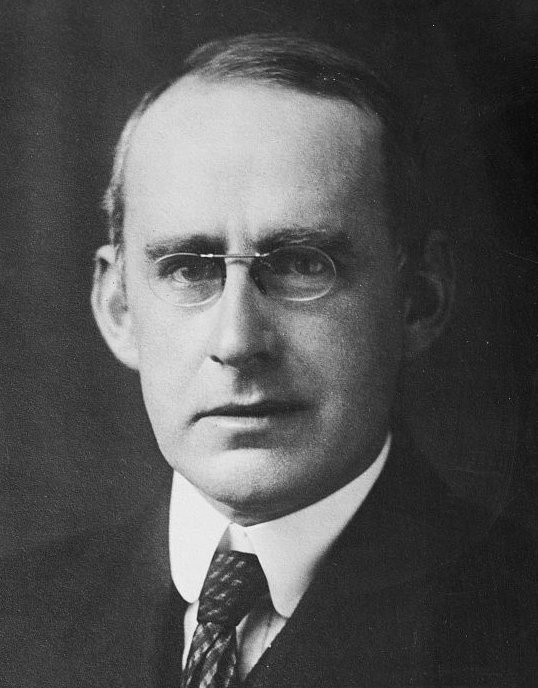
"And what about Sir Arthur Eddington’s legendary observation of 1919, Gabriel? Light bending under gravity sounds so abstract. How did Eddington see stars behind the Sun in daylight, and how exactly did he measure a deflection of one and three quarter arcseconds?"
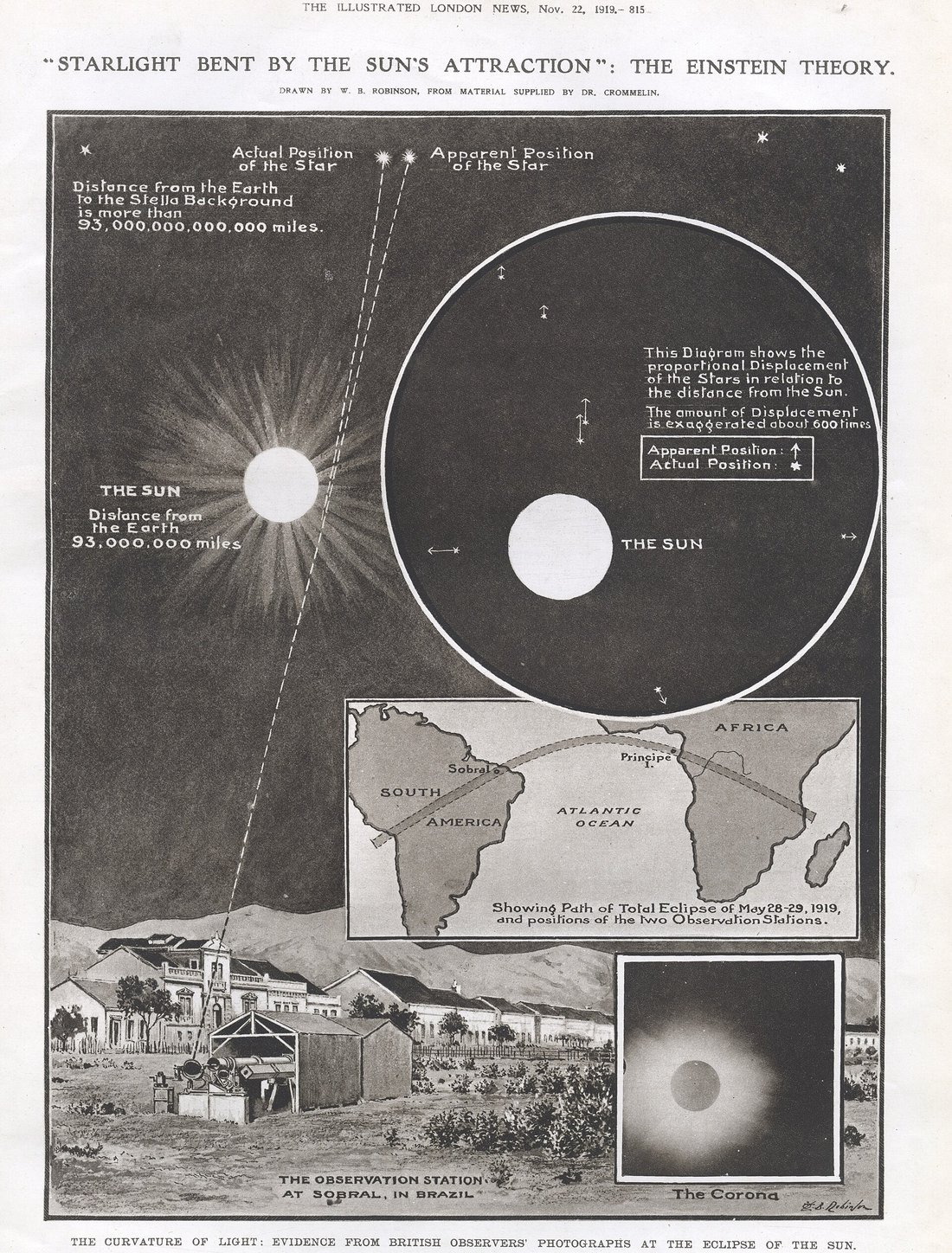
"Let me set the scene first," said Gabriel. "Every year at the end of May the Sun passes in front of the old V-shaped Hyades cluster at the heart of Taurus. Normally the Sun is so bright that you can never see the stars behind it by day. During the eclipse of 29 May 1919 the Moon covered that blinding glare, exactly the way you shade your eyes with your hand, and made the Hyades visible. That eclipse also happened to be one of the longest of the century, six minutes and fifty-two seconds."
"And how does the bending happen on the trampoline of spacetime?"
"Picture a taut trampoline. The trampoline is the fabric we call spacetime. Put an enormous iron ball, the Sun, in the middle of it and its weight hollows out the centre. Now roll a marble in a straight line from one edge to the other. When the marble enters that hollow it cannot keep going straight; its path curves. The marbles of light coming from the Hyades bend in exactly the same way when they enter the hollow the Sun has made."
"And the deflection measured?"
"Einstein predicted one point seven five arcseconds. And here is the crux of it: Newtonian physics also predicted a bending, but exactly half of that, zero point eight seven. So the question was never whether light bends. It was by how much. The whole difference between two theories was hidden in a gap the width of a hair held against the sky."
"How small is that angle?"
"About the angle subtended by the edges of a coin standing two kilometres away. Eddington measured it in three steps."
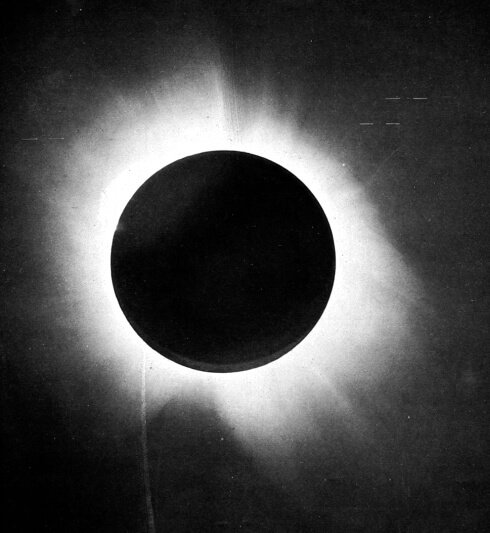
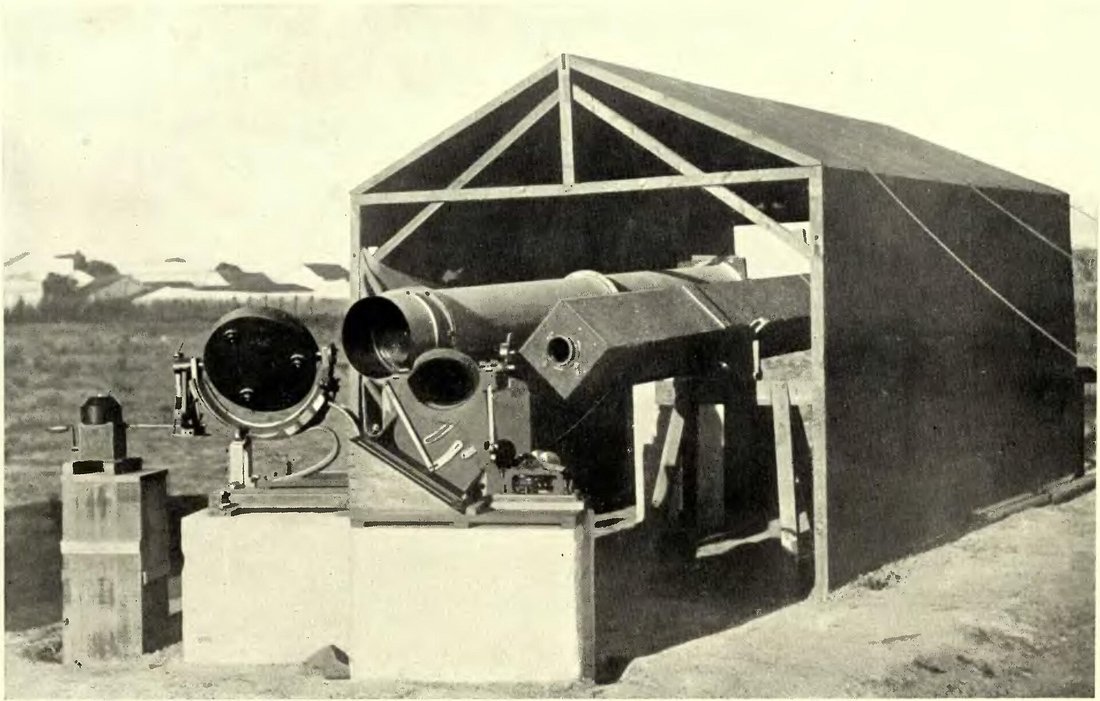
"First, the night exposure. Months before the eclipse, with the Sun nowhere near that part of the sky, he photographed the Hyades; the true, undeflected positions of the stars were printed onto transparent glass plates. Second, the eclipse exposure. On the day, when the sky went dark, the same stars were photographed onto a second plate through a telescope of the same focal length. Third, the two plates were laid one on top of the other."
"And the difference showed up there."
"Put a dot on a sheet of paper and stand a cylindrical glass of water over it; the water refracts the light and the dot appears pushed outwards. When Eddington superimposed his two plates, he saw that the stars nearest the edge of the Sun had been nudged slightly outwards from where the night map had them. The shift, read off with a micrometer measuring engine, landed on the value Einstein had named."
"Was it a single team?"
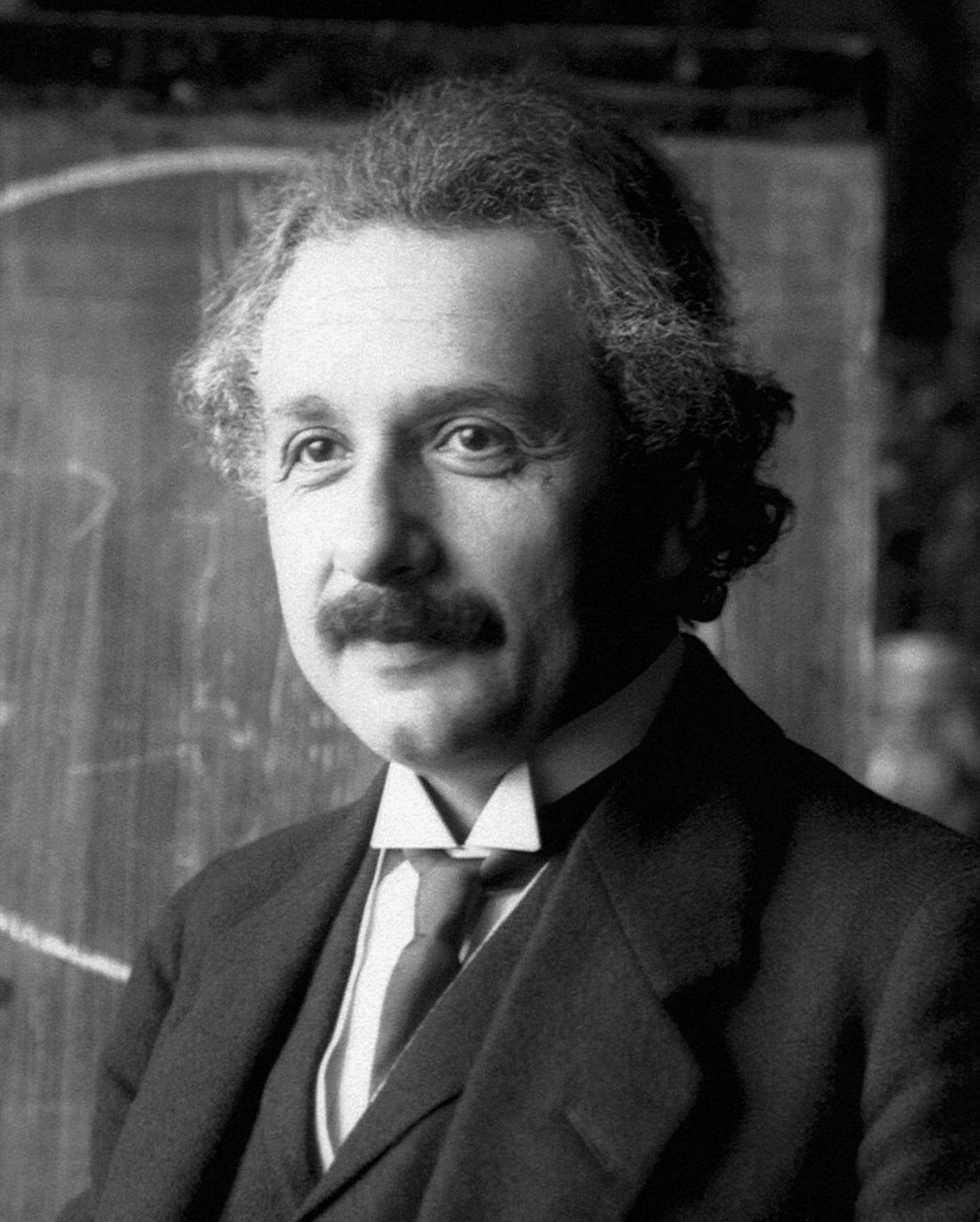
"No, two, and deliberately so. Eddington was on the island of Príncipe off West Africa; Frank Dyson’s team was at Sobral in Brazil. It rained on Príncipe that morning and Eddington salvaged only a handful of usable plates. The results were announced in London at a joint meeting on 6 November 1919, and the next morning the newspapers turned a man whose name nobody had yet learned to pronounce into the most famous person alive."
The Element Found in the Sun’s Crown
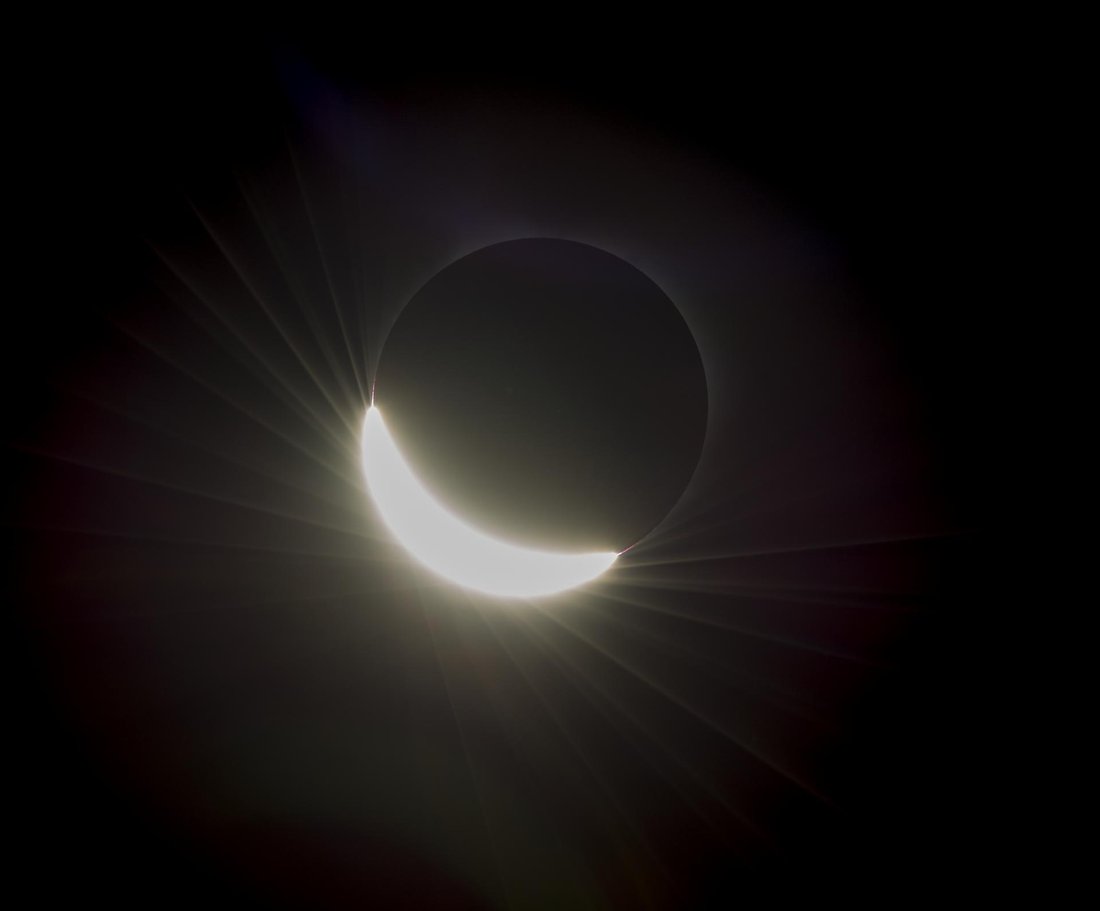
Totality began. The corona appeared around the Sun, waving like silver ivy. The two astronomers fixed their eyes on it.
"Gabriel, you once said that without a solar eclipse helium could not have been discovered. How did mankind find in the crown of the Sun an element it could not find on Earth?"
"You have gone straight to the heart of it," said Gabriel. "Every element has a unique fingerprint in light. Light through a prism spreads into the colours of a rainbow, but inside that rainbow every element has lines of its own. Think of a supermarket barcode: sodium has one barcode, hydrogen another. Because an atom can only jump between particular energy steps, it can only emit particular colours. That is why the barcode is legible at all."
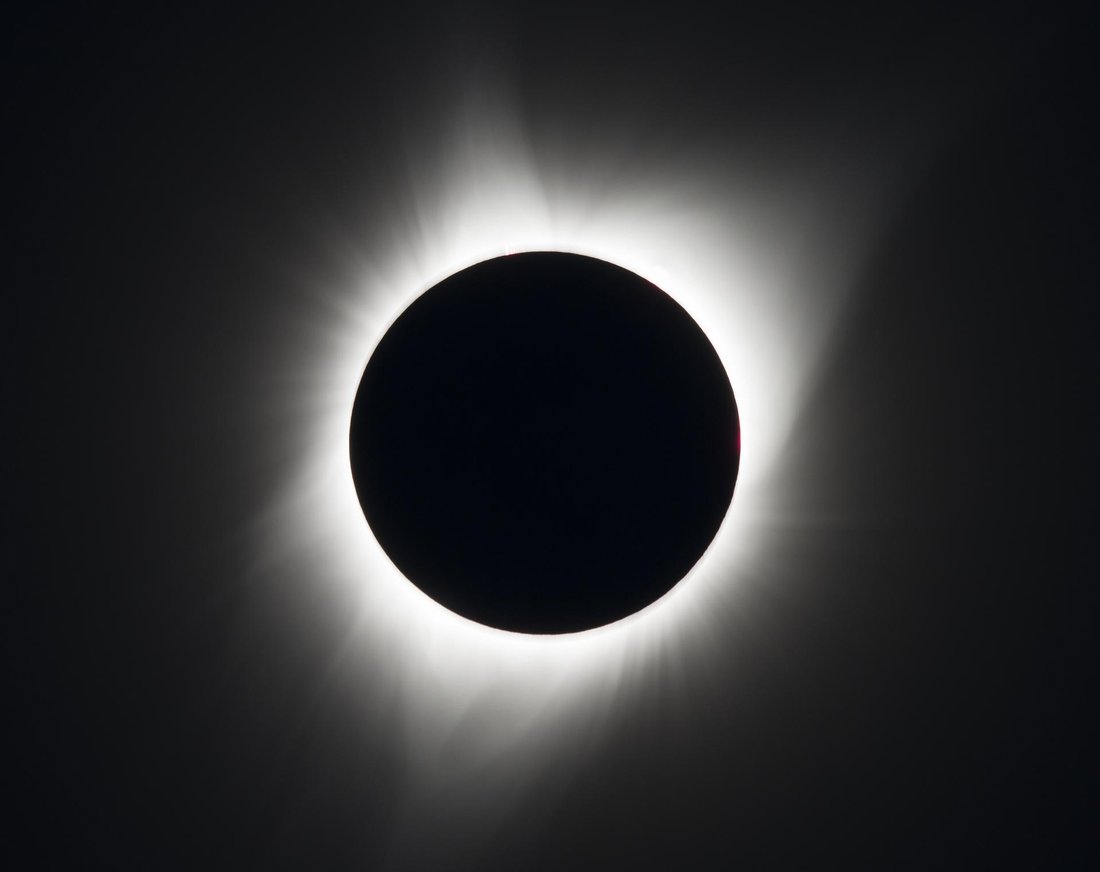
"And helium?"
"During the eclipse of 18 August 1868, the French astronomer Jules Janssen, at Guntur in India, passed the light of the red flames leaping from the Sun’s edge, the prominences, through a spectroscope. He saw a bright, deep yellow line. In October of the same year the Englishman Norman Lockyer caught the same line without waiting for an eclipse. It sat right beside the yellow sodium pair but did not coincide with them; its wavelength was five hundred and eighty-seven and a half nanometres. That barcode matched no element known on Earth."
"And they gave it a name."
"Lockyer and the chemist Edward Frankland named it helium, after Helios, the Greek for the Sun. Enjoy this detail: the element was not found on Earth until twenty-seven years later, in 1895, when William Ramsay dissolved a uranium mineral in acid. Mankind discovered helium not by digging, but from a hundred and fifty million kilometres away, from behind the curtain of an eclipse."
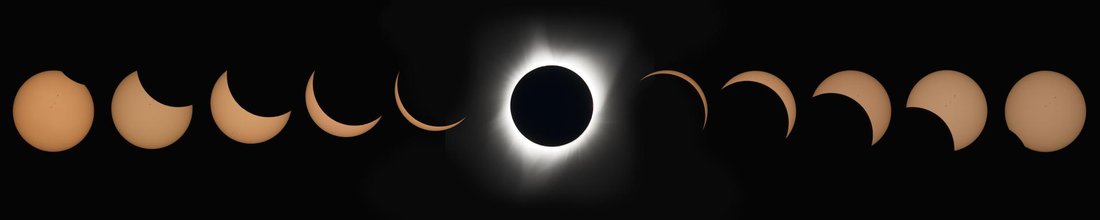
"And why does helium matter so much to the universe?"
"Because it is the ash in the furnace of the cosmos and the heart of the stars. About a quarter of ordinary matter by mass is helium, and almost all of it was made not in stars but in the first three minutes after the Big Bang. Stars fuse hydrogen nuclei into helium under the pressure at their cores; our Sun burns six hundred million tonnes of hydrogen a second in this way, and the four million tonnes of mass lost in the conversion leave as heat and light. The thing warming your face right now is a mass that ceased to exist eight minutes ago."
"And the heavy elements?"
"When a star ages and runs out of hydrogen, it starts burning the helium instead. Three helium nuclei fuse into carbon, carbon takes one more helium and becomes oxygen. Everything down to the iron in your blood is the continuation of that chain. We are the meal that came out of the helium kitchen of dead stars."
"And there is a technological side."
"Helium is the only substance that does not solidify at any temperature under atmospheric pressure. Two degrees above absolute zero it loses its friction entirely and becomes a superfluid that climbs the walls of its container. The superconducting magnets in MRI scanners, particle accelerators and quantum computers work only thanks to that strange liquid. The element discovered in the crown of the Sun is now cooling the magnet that images your brain in hospital."
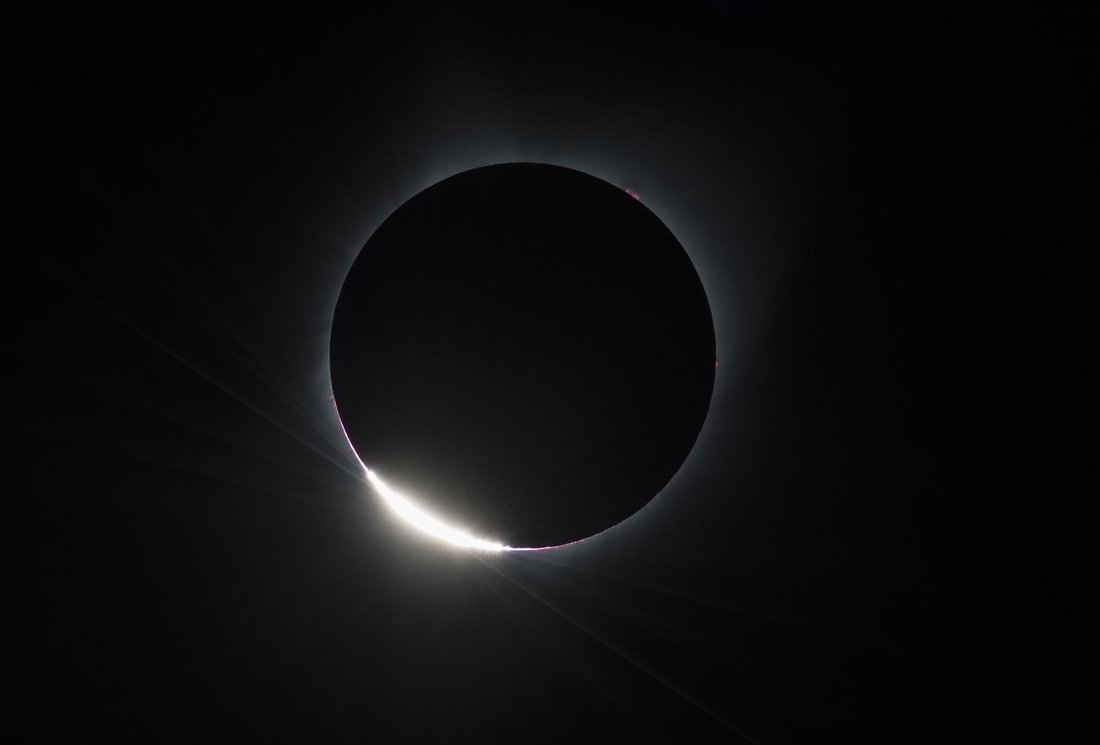
"And beneath all of it there is a fine art," said Gabriel. "The Sun is about four hundred times larger than the Moon and exactly four hundred times further away. Two different sizes and two different distances meet at the same number; that is why the two appear almost the same size in the sky. Had the Moon been a fraction bigger it would have covered the corona as well and hidden the solar wind from us entirely. A fraction smaller or further away, and the blinding disc of the Sun would never have closed completely; its atmosphere could not have been studied and helium could not have been found."
"And the ratio is not even permanent."
"It is not. The Moon recedes by about three point eight centimetres a year. In roughly six hundred million years there will be no such thing as a total eclipse. We live in a narrow window in the history of the universe in which this curtain is drawn to exactly the right width."
Gabriel was quiet for a moment. "The Creator is showing something here: by covering what is visible, He reveals the deep order that is not. When the fierce outward light is withdrawn, the hidden inner order begins to shine."
format_quote"An eclipse is a cosmic laboratory the Creator has handed to us."
An Antikythera on the Wrist: The Hublot MP-08 SunMoon
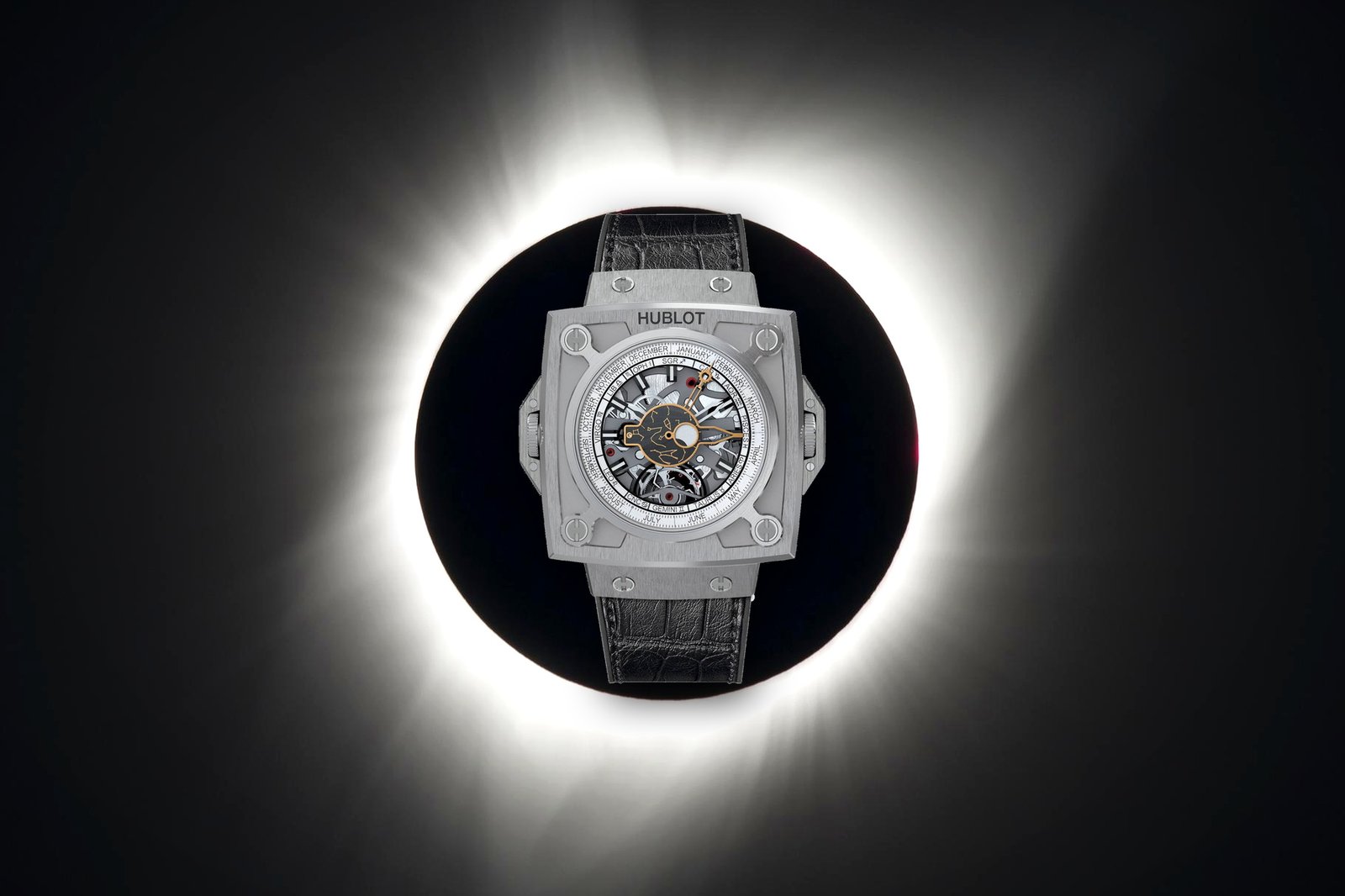
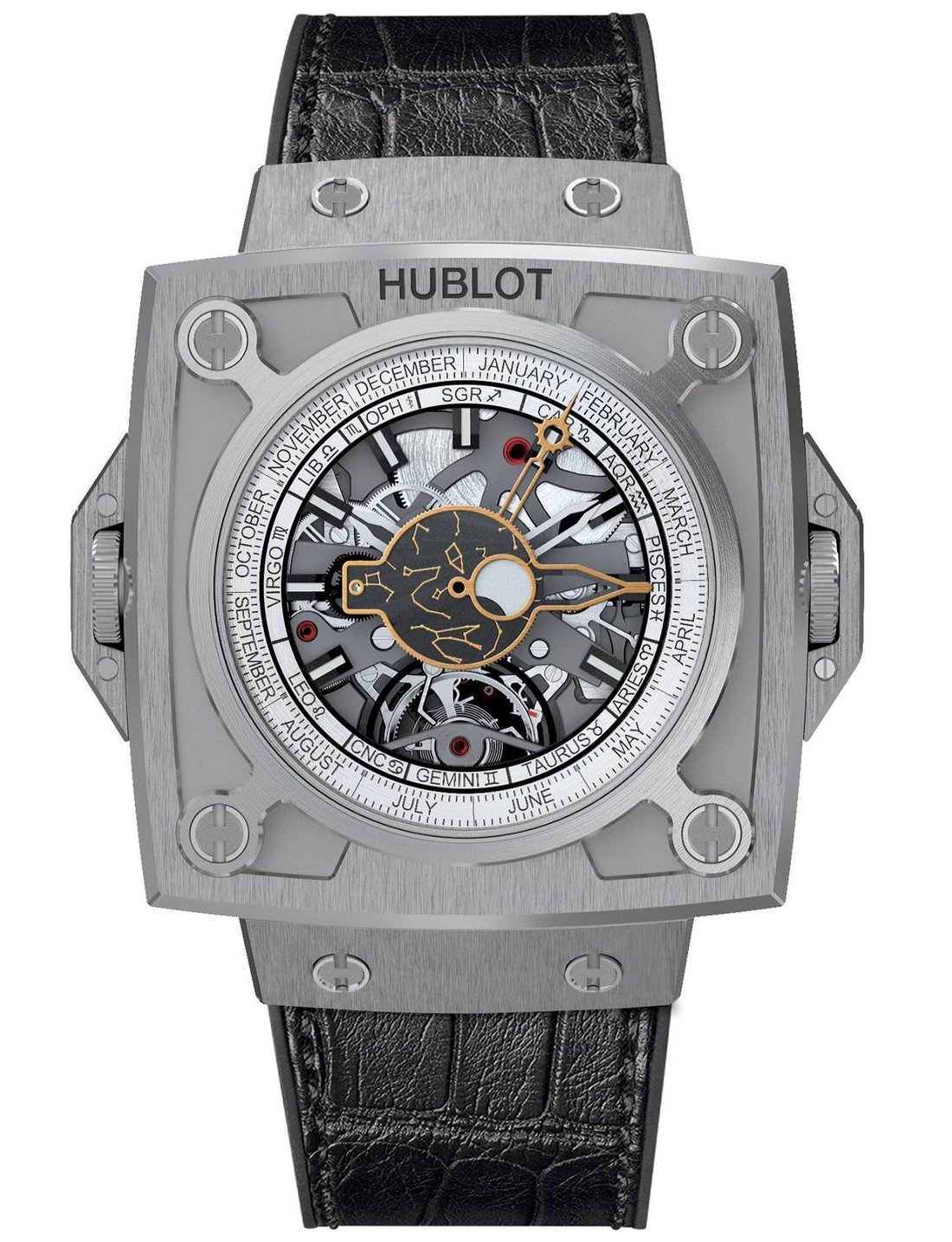
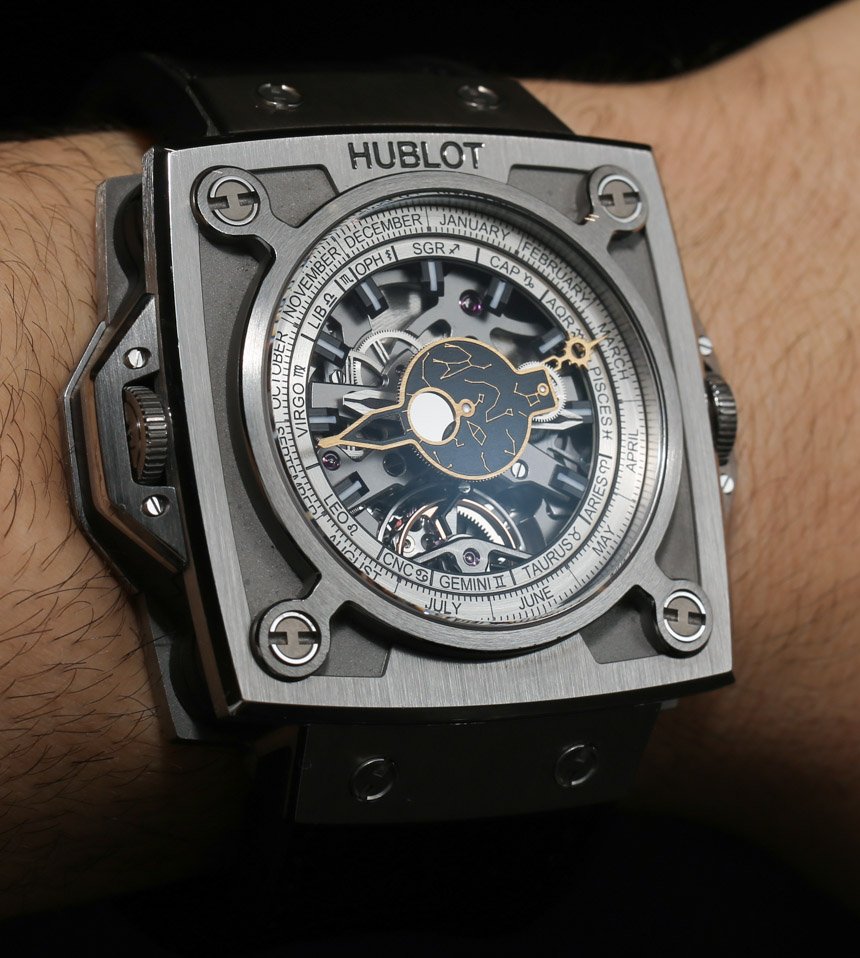
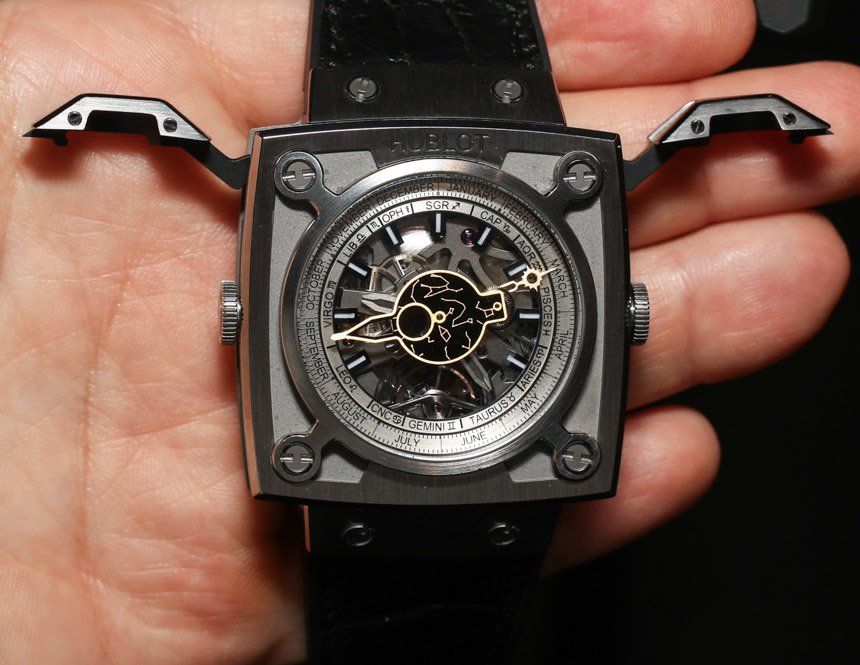
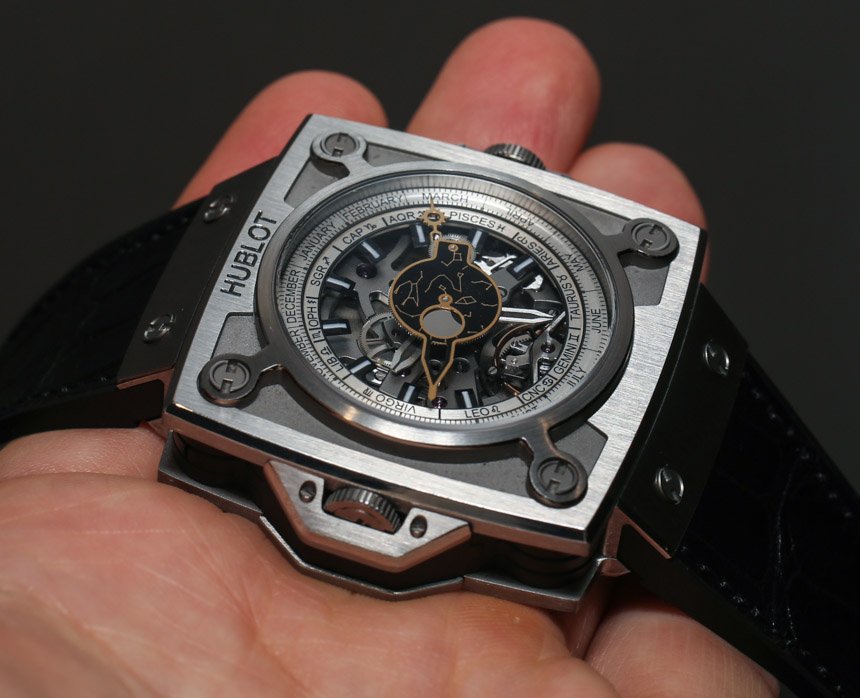
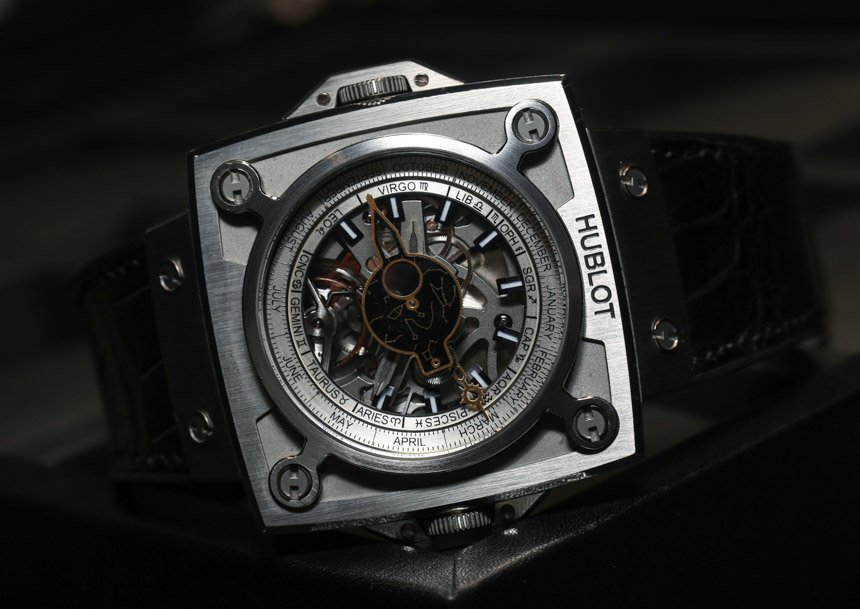
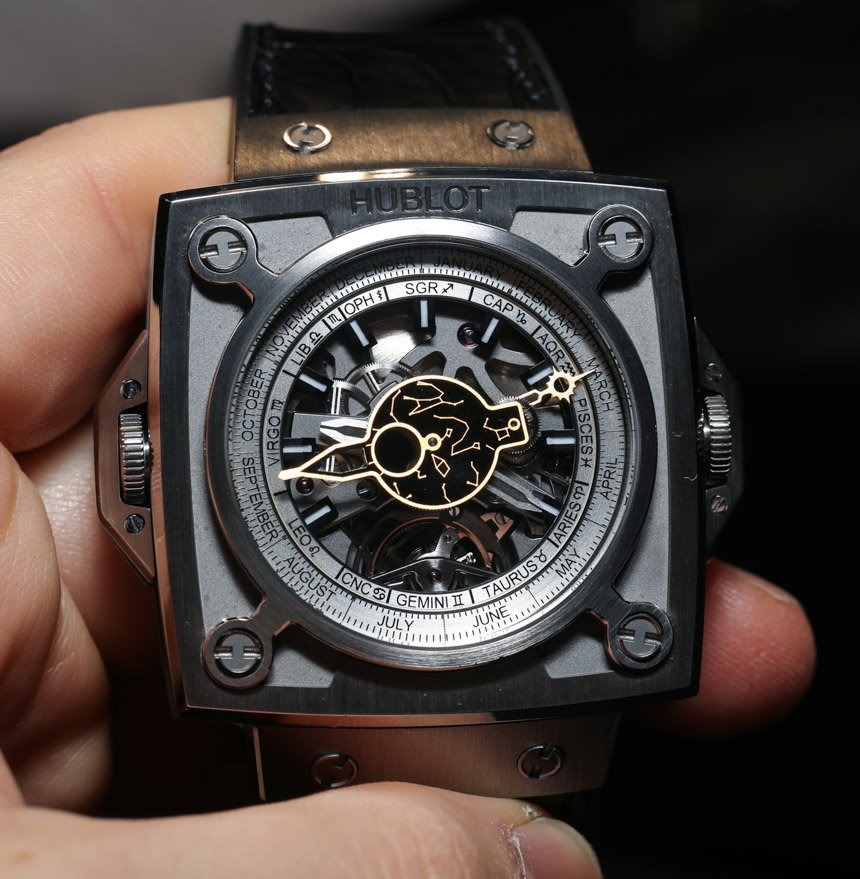
As the first beam bursting from the Sun’s edge formed a diamond ring in the sky, Dr Julian was following the duration of the eclipse on the mechanism on his arm. Professor Gabriel looked with respect at his friend’s titanium, dial-less watch. Only twenty of them exist: the Hublot MP-08 Antikythera SunMoon.
"Julian, while we talk about that four hundred to one balance in the sky, the rhythm of the wheels on your wrist seems to run in step with it. How would you sum up the astronomical intelligence at the heart of this watch?"
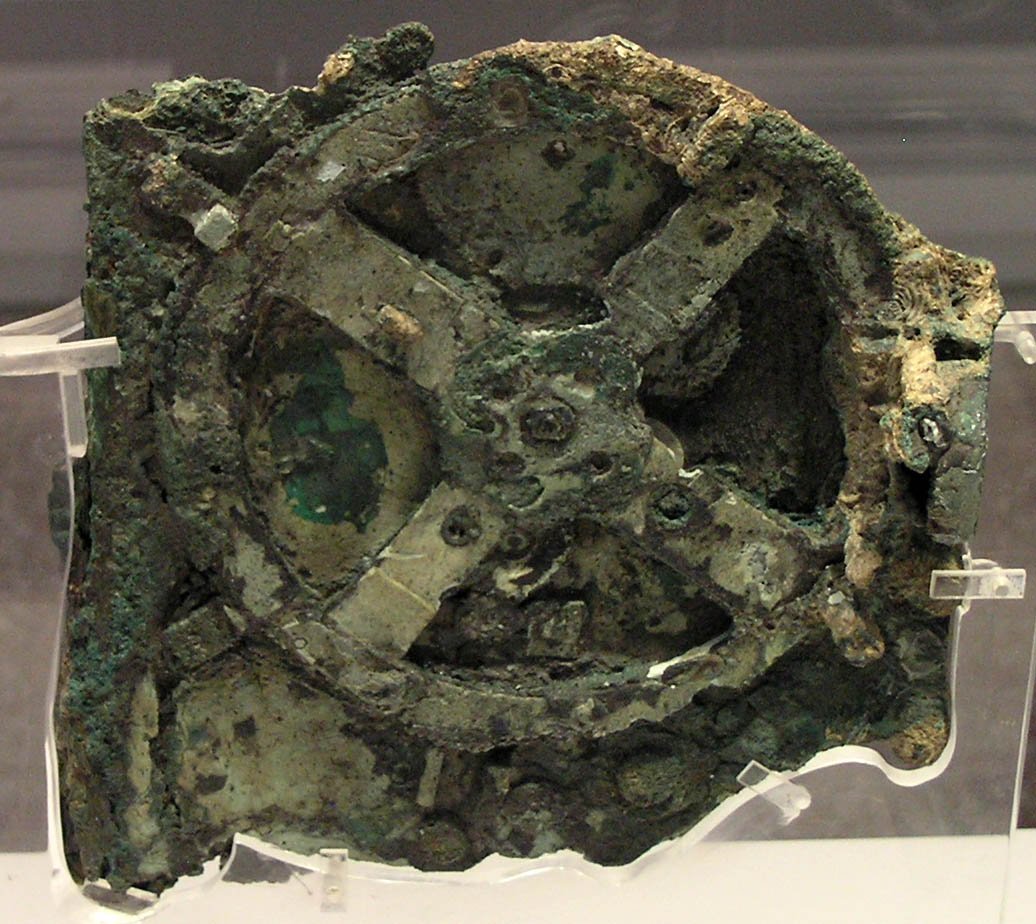
"This watch is the wrist-borne reading of the first analogue astronomical computer mankind ever built, recovered from a ship that sank in the Aegean in the second century BC," said Julian. "And the connection runs deeper than you think, Gabriel. On the back of the Antikythera mechanism there were spiral dials. The upper one counted the lunar calendar; one of the lower ones was a Saros spiral two hundred and twenty-three months long. In other words, the timetable you have just described through Thales had been cut, tooth by tooth, into that bronze machine. Small glyphs engraved in the cells of the spiral said whether the eclipse would be solar or lunar, and even at what hour of the day it would arrive. Beside it, a fourth spiral held the fifty-four year exeligmos, the dial that corrects the extra eight hours you mentioned."
"So the name of this watch is not a reference. It is a family tree."
"Precisely. Hublot’s watchmakers gathered two hundred and ninety-five separate components into a hand-wound calibre called the HUB9008. Thirty-seven jewels, twenty-one thousand six hundred vibrations an hour, three a second. And in the lower half of the dial, a tourbillon turns."
"And how do you read it?"
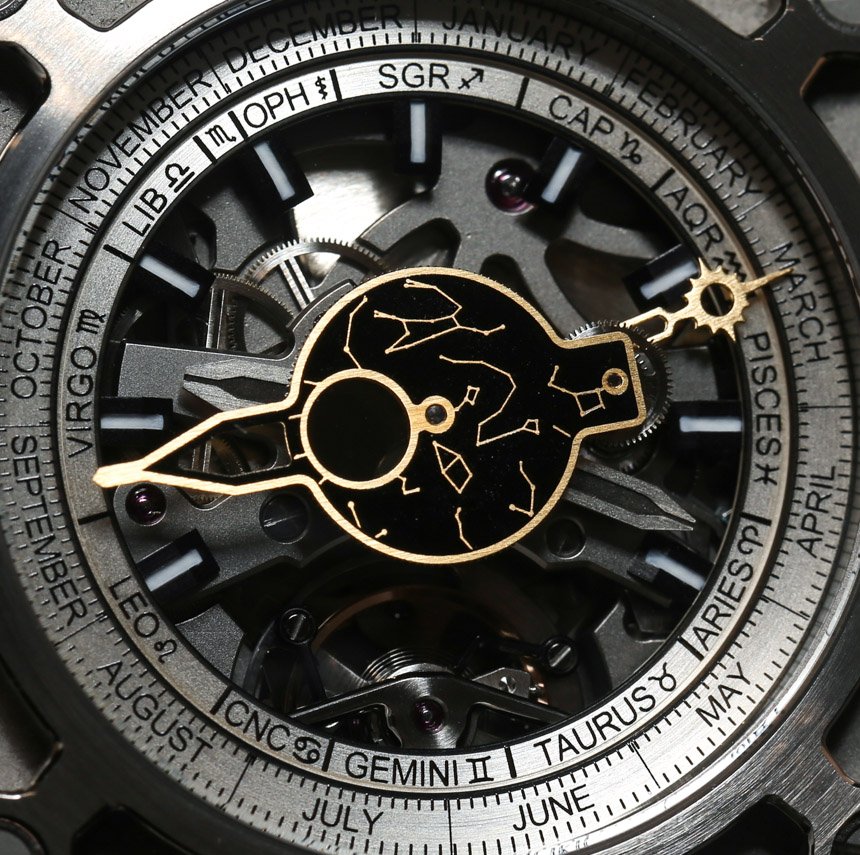
"There are four layers of information stacked on top of one another. Outermost, a fixed ring carrying the names of the twelve months. Just inside it, the names and symbols of the zodiacal constellations. In the middle, the sky itself: constellation lines drawn in gold on a black disc, and an aperture for the Moon. And two hands: one carries a small sun at its tip, the other the Moon. The sun hand shows which constellation the Sun stands in front of today; the moon hand shows where the Moon is."
"And an eclipse?"
"An eclipse is those two hands coming together. What has just happened in the sky happened on the dial as well."
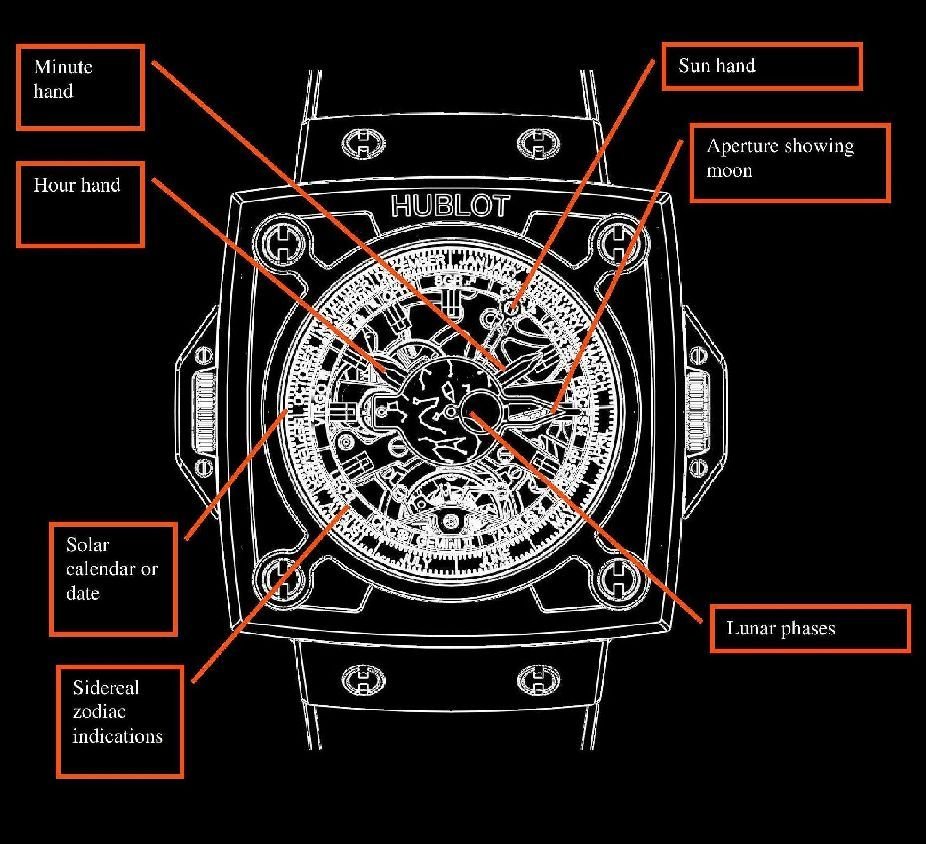
"There is one more detail and to me it is the boldest decision in this watch," Julian went on. "Count the constellations on the ring and you will find thirteen, not twelve. Between Libra and Sagittarius, under the abbreviation OPH, sits Ophiuchus, the Serpent Bearer."
"The constellation astrology ignores."
"That one. On its true path across the sky, the Sun passes through the boundaries of Ophiuchus for about eighteen days every year. Astrology pretends otherwise, because it ruins a scheme of twelve equal slices. Hublot chose to correct the tradition rather than the sky. What you carry on your wrist is an astronomical zodiac, not an astrological one."
"And how do they drive all those indications from one mainspring?"
"They do not; they split it in two. There are two barrels inside, and together they give a hundred and twenty hours, a full five days. The reason is not luxury but arithmetic. A tourbillon carriage already eats more energy than usual, because it turns the balance and itself at the same time. Add a sky chart disc, a moonphase disc and two separate astronomical hands and you have loaded the train with a further constant friction. Drive that from a single barrel and you get a watch that runs fast on the first day and slow on the last."
"And the slow beat?"
"Part of the same calculation. Three oscillations a second is slow by modern standards. But the slower the balance, the less energy it spends per second, and the surplus goes to the carriage and the discs. In this watch, speed has been converted into endurance."
"How is it wound? I see no crown on the dial side."
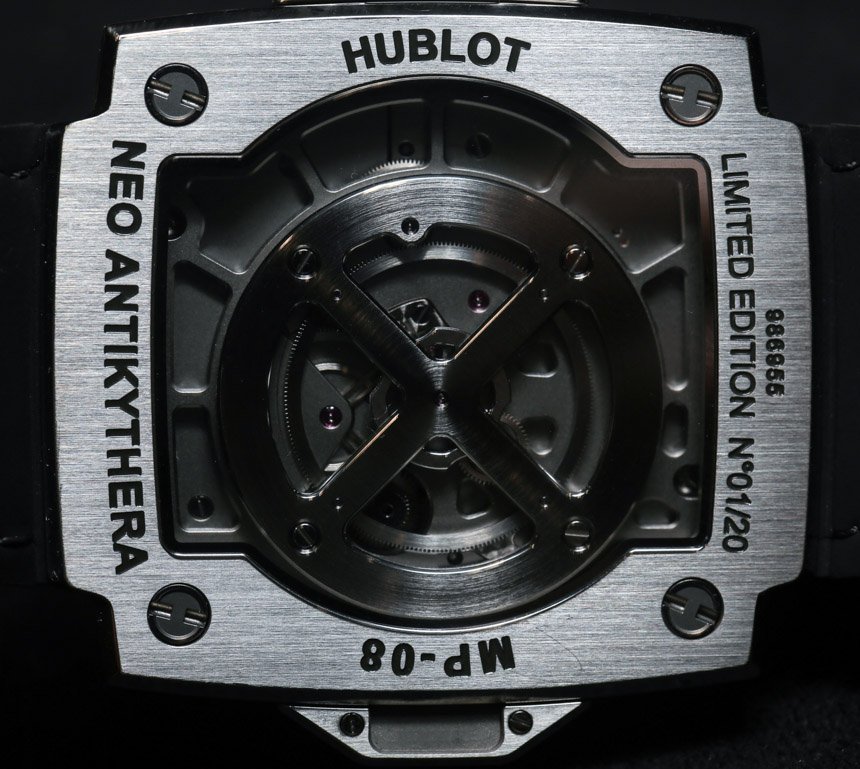
"There are two, one on each flank of the case, and both are hidden under guards that lift like wings," said Julian. "One winds the watch, the other sets the astronomical indications. You cannot touch either without raising a guard. That keeps the rigidity of the case, and it also stops you from disturbing the astronomical setting by accident; resetting a mechanism like this means a trip to the service department."
"The case?"
"A square-bodied titanium structure of thirty-five point two millimetres. Hublot’s registered H-shaped screws sit at the four corners, and they are not decoration but the real fixings holding the sapphire and the back. Water resistant to thirty metres. And engraved on the back, NEO ANTIKYTHERA, and beneath it which of the twenty this one is."
Gabriel spoke without lifting his eye from the loupe.
"Here is what I keep thinking, Julian. The largest wheel inside that bronze box, which lay two thousand years at the bottom of the Aegean, had two hundred and twenty-three teeth, and that number was the count of months in the Saros cycle. Somebody, two thousand years ago, filed the rhythm of the sky into the edge of a piece of metal, one tooth at a time. Today two hundred and ninety-five parts on your wrist do the same job."
"The only difference is scale," said Julian. "And perhaps one more thing: they did it to understand the stars. We do it to remember that we understood."
The light came back. The birds started up again as if nothing had happened. The wind climbed the slope and for a while neither astronomer spoke.
format_quote"They did it to understand the stars. We do it to remember that we understood."
Hasan Bekmezci